Hantek
Hantek 6022BE Review
HobbyistScope Team · Software notes reviewed September 14, 2026
$85.29
◆ At a Glance
Vendor maximum and application limits are different. Capture duration and exact host operation remain unverified; see the software and specification notes below.
◆ Best For
◆ Overview
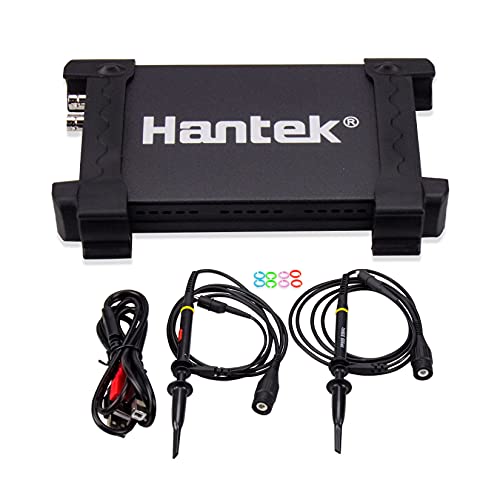
The Hantek 6022BE is the bottom of the oscilloscope market. Around $85, it is a USB dongle with two BNC inputs, no display, no battery, and no standalone capability. You plug it into a PC, open software, and your laptop screen becomes the oscilloscope display. That is the product.
The question is not whether the 6022BE is a good oscilloscope — it is not. The question is whether about $85 buys you enough oscilloscope capability to be useful, and the answer depends entirely on what you are trying to do. For verifying that a signal exists, checking audio frequencies, or learning what an oscilloscope display looks like, the 6022BE works. For anything requiring bandwidth, sample rate, or measurement precision, you have already outgrown it.
This review is written for people near a hard $100 budget ceiling who need to decide whether this is worth buying at all, or whether they should save longer for something meaningfully better. We will be direct about the limitations because they matter more here than with any other scope we review.
◆ Pros & Cons
Pros
- Cheapest USB oscilloscope that actually works
- Tiny and portable — fits in a laptop bag or jacket pocket
- OpenHantek6022 offers a documented software path; check host and driver requirements
- Bus-powered via USB — no wall adapter needed
- Published buffer information is available; capture behavior depends on the application
Cons
- Only 20MHz bandwidth — severely limiting for most real work
- The vendor's maximum sample rate is not a sustained software-acquisition guarantee
- Requires a PC to operate — useless in the field without a laptop
- OpenHantek host testing and support differ by operating system
- No protocol decoding of any kind
You'll Also Need
Common accessories that pair well with this scope.
Hantek PP-200 200MHz Probe Set (2x)
Replacement 200MHz passive probes compatible with most bench scopes
Buy on Amazon · $18 →DEVMO USB Logic Analyzer 8-Channel
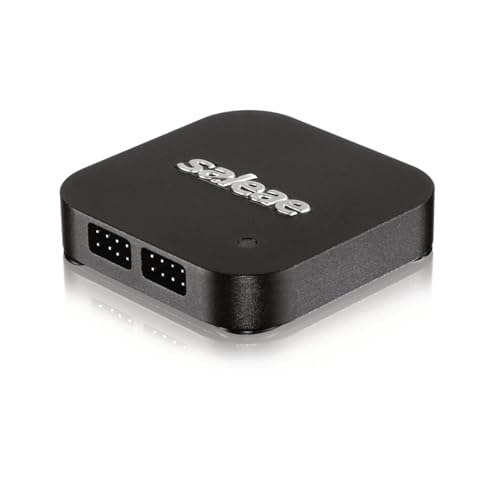
8-channel logic analyzer for debugging digital signals and protocols
Buy on Amazon · $14 →Coaxial BNC Cable 50Ω (3-pack)
BNC to BNC 50Ω coax cables for signal connections
Buy on Amazon · $12 →◆ More Bench Gear We've Reviewed
Beyond the scope: other instruments hobbyists keep on the bench.
See signals in the frequency domain
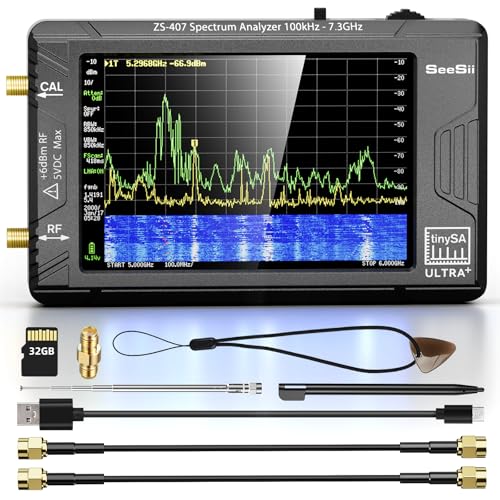
TinySA Ultra
$260.9
See all see signals in the frequency domain picks →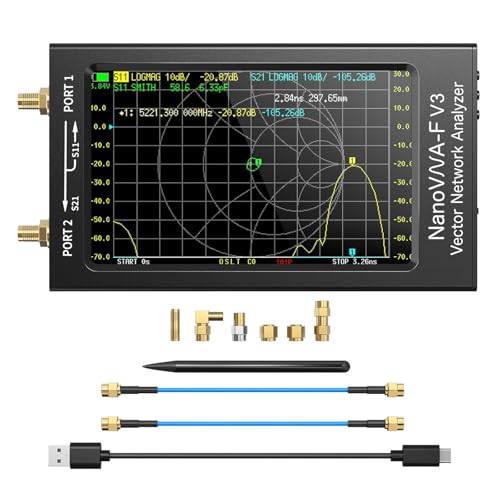
Sweep RF and antenna performance
NanoVNA-F V3
$299.99
See all sweep rf and antenna performance picks →Hantek 6022BE
Prices may change · Free shipping with Prime
◆ Design & Build Quality
The Hantek 6022BE measures 200 x 100 x 35mm and weighs 200 grams. It is a small blue box with two BNC connectors on one end and a USB cable on the other. That is the entire physical product. There is no display, no battery, no buttons, no knobs. It draws all its power from the USB bus.
The enclosure is plastic and feels like what it is: an $85-ish piece of test equipment. It is sturdy enough to sit on a bench without concern, and light enough to toss in a laptop bag. The BNC connectors are adequately mounted and accept standard oscilloscope probes without issue. The USB cable is hardwired to the unit rather than being a detachable connector, which means if the cable is damaged, the entire unit is compromised.
The portability factor is the 6022BE's one genuine physical advantage. At 200 grams with no power adapter needed, you can bring this anywhere you bring a laptop. Paired with a laptop and a set of probes, you have a complete (if limited) measurement setup that fits in a coat pocket. No benchtop scope, and very few handheld scopes, match this level of portability.
Included probes are basic 1x/10x passive probes that are functional but unremarkable. They do the job for the level of measurement precision this scope provides. Upgrading probes on a scope this cheap is not a rational investment.
◆ Performance & Specifications Deep Dive
Hantek's exact 6022BE model column lists two channels, 20 MHz bandwidth and a maximum sample rate of 48 MS/s. The higher rates in the series headline belong to other models. A manufacturer maximum does not establish a sustained acquisition rate in your chosen application.
The inspected OpenHantek6022 3.4.1-rc2 README lists its own sampling modes: 24/30 MS/s require CH1-only acquisition, and 48 MS/s is excluded because of unstable USB streaming. Check the selected application, enabled channels and host before deciding whether a measurement fits. We have not measured waveform accuracy or sustained throughput on a connected device.
Hantek's buffer row says “1M” without an explicit unit in the inspected table. It does not establish a verified onboard memory architecture or the practical capture duration of your software. Dividing an assumed point count by the vendor's maximum rate is not a reliable capture promise. Capture length remains application- and configuration-dependent here.
The exact 6022BE column specifies 8-bit vertical resolution, DC coupling and a gain range of 20 mV–5 V. Do not copy the adjacent model's AC/DC coupling or 10 mV minimum into this model's specifications. Software processing of a captured signal is separate from hardware input coupling.
Hantek 6022BE specifications and downloads◆ Software & User Experience
1. Identify the combination before installing. Record the exact 6022BE model, operating system or Linux distribution and version, CPU architecture, and intended application/build. A USB connector or a downloadable package alone does not establish that the combination will work.
2. Choose the official support path. Hantek's model page has downloads for its own application and driver. OpenHantek6022 is a separate project with its own requirements. Check both sources below before changing an existing setup; there is no unconditional instruction to replace Hantek's driver or buy different hardware.
3. Read the selected release's support conditions. On September 14, 2026, GitHub Latest identifies 3.4.1-rc2. That tagged README describes Linux support and development on Debian trixie amd64; Windows builds are mostly untested and macOS builds completely untested. Non-Linux issue support depends on volunteers. These statements describe project testing and support, not proof that a particular host can or cannot acquire data.
4. Check driver and acquisition requirements. Follow the selected software's USB-access instructions. The inspected OpenHantek release requires its Windows USB-driver path rather than Hantek's original driver; that does not make the original driver defective for Hantek's own application. Its 24/30 MS/s modes require CH1-only operation, and 48 MS/s is excluded for unstable streaming. Package availability does not verify sustained acquisition on your computer.
5. Preview and resolve unknowns before replacing equipment. The project's demo mode lets you explore the interface without hardware. A demo cannot verify drivers, connected-device operation, capture duration or measurement accuracy. Exact compatibility remains unknown until your model, host and build are identified and checked against current documentation or official support. Android operation is unverified here.
Software and specification source notes reviewed September 14, 2026. These notes describe published documentation; we have not tested these hardware/software combinations. Other review sections retain their earlier review context.
- Hantek 6022BE specifications and downloads
- OpenHantek6022 3.4.1-rc2 support and features
- Current OpenHantek releases and packages
- Inspected release's USB-access instructions
Comparing hardware options? Read the USB oscilloscope guide for the wider software and input-connection checklist.
◆ Protocol Decoding & Advanced Features
The 6022BE has no built-in protocol decoding. The hardware does not support it, and neither the official software nor OpenHantek provides serial protocol decoding for SPI, I2C, UART, or any other bus.
This is a hard limitation for embedded development work. If you are debugging communication between a microcontroller and a peripheral, the 6022BE can show you that signals are toggling, but it cannot tell you what data is being transmitted. For protocol analysis at this budget level, a dedicated logic analyzer like the $10-20 Saleae clones or the $379 Digilent Analog Discovery 3 is a better tool.
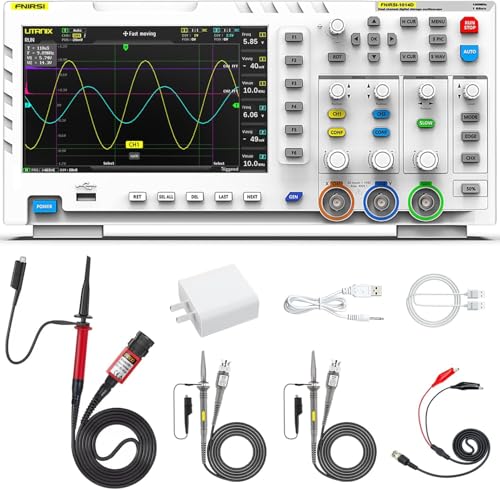
The 6022BE has no function generator. This means you need a separate signal source for testing and experimentation. For a beginner learning oscilloscope concepts, not having a built-in signal source is a meaningful inconvenience. The FNIRSI 1014D at $169.99 and the FNIRSI DPOX180H at $110 both include function generators.
Available analysis and trigger features depend on the application. The inspected OpenHantek6022 3.4.1-rc2 README lists arithmetic, analog and logical math operations, plus Normal, Auto and Single trigger modes. Trigger modes, sources and filters are not the same as trigger types; this list does not establish pulse, pattern or protocol triggering. Use that release's documentation for the features you need rather than assuming that the hardware catalog describes every software function.
The one area where the USB form factor provides a unique advantage is integration with other software tools. Because waveform data is already on your PC, you can script data capture and analysis using Python, MATLAB, or other tools. Several community projects provide Python libraries for interfacing with the 6022BE hardware directly. For automated test setups where you want to capture waveforms programmatically, this is actually an advantage over standalone scopes that require separate USB connectivity.
◆ Real-World Use Cases
For audio circuit work, the 6022BE is genuinely useful. Audio frequencies (20Hz to 20kHz) are below the published 20MHz bandwidth, but the selected software, channel mode and host determine acquisition conditions; the vendor's maximum sample rate is not an achieved-rate guarantee. You can verify amplifier output, check for distortion, measure frequency response, and compare input to output waveforms on the two channels. This is the scope's strongest use case.
For basic Arduino verification, the scope handles simple tasks well. Checking that a digital pin is toggling, verifying PWM frequency and duty cycle at standard Arduino frequencies (490Hz, 980Hz), and confirming that an analog output is at the expected voltage are all straightforward. You will not see detailed edge characteristics on digital signals because the sample rate is too low, but for presence-and-frequency verification the 6022BE is adequate.
For slow serial communication, the scope provides limited visibility. You can see UART waveforms at 9600 baud clearly. I2C at 100kHz is visible. SPI at 1MHz is at the edge of useful visibility. You cannot decode any of these protocols, so you are limited to visual inspection of waveform timing and levels.
For power supply debugging, the 6022BE is marginal. You can see switching frequency of a buck converter if it is below about 500kHz, but the noise floor and vertical resolution make small-signal measurements (like output ripple) unreliable. For serious power supply work, any benchtop scope would be a better choice.
For any work above about 5MHz signal frequency, the 6022BE is not useful. Fast SPI, RF signals, high-speed digital interfaces, and switching regulator analysis at typical frequencies (500kHz-2MHz) are all outside the practical capabilities of this scope. The waveforms you see at these frequencies will be aliased, attenuated, or both.
For portable field work with a laptop, the 6022BE fills a niche. At 200 grams with USB bus power, you can bring oscilloscope capability to locations where carrying a benchtop scope is impractical. Paired with a laptop, you have a basic measurement station that fits in a small bag.
◆ Who Should Buy This (And Who Shouldn't)
Buy the Hantek 6022BE if your budget is genuinely fixed around $85 and you need some oscilloscope capability now. At this price, the alternative is no oscilloscope at all, and having even a basic scope is better than having none when you need to verify that a signal exists.
Buy it if you do audio electronics work. The bandwidth and sample rate are perfectly adequate for audio frequencies, and the USB form factor means your PC monitor becomes a large, comfortable display for waveform viewing.
Buy it if you want the most portable oscilloscope possible. At 200 grams with no external power supply, nothing else matches the 6022BE's portability except the Digilent Analog Discovery 3 (which costs $379).
Do not buy the 6022BE if you can afford the FNIRSI DPOX180H or FNIRSI 1014D. For more money, you get standalone operation (no PC required), higher bandwidth, a built-in function generator, and in the DPOX180H's case, protocol decoding. The capability jump above the 6022BE is steep.
Do not buy it if you are doing embedded development with SPI, I2C, or any digital protocol above 1MHz. The bandwidth and sample rate limitations make protocol-level signal analysis impractical, and the lack of protocol decoding means you cannot interpret the data even if you could see it clearly.
Do not buy it if you expect to use it as your primary bench instrument. The 6022BE is a supplement — a portable secondary scope for quick checks and audio work. It is not a replacement for a real benchtop oscilloscope, and buying it to "save money" on a scope purchase typically means you buy it, realize its limitations, and then buy a proper scope anyway. You end up spending more total.
◆ Alternatives Worth Considering
The FNIRSI 1014D around $170 is the most natural standalone step up. You get a self-contained device with a 7-inch touchscreen, 100MHz bandwidth, 1GSa/s sample rate, a built-in function generator, and battery power. The 1014D is a fundamentally different class of instrument, though it costs roughly twice as much as the 6022BE.
The FNIRSI DPOX180H at $110 is another strong alternative. It is a pocket-sized handheld with 180MHz bandwidth, 500MSa/s sample rate, protocol decoding for UART, SPI, and I2C, a built-in multimeter, and a function generator. For modestly more than the 6022BE, you get a dramatically more capable device. The 2.8-inch screen and 28Kpt memory are limitations, but the DPOX180H is still a better value proposition than the 6022BE for most users.
The Digilent Analog Discovery 3 at $379 is the premium USB alternative. Like the 6022BE, it connects to a PC and uses software for its display. Unlike the 6022BE, it includes 14 instruments: oscilloscope, logic analyzer, protocol analyzer, function generator, power supplies, network analyzer, and more. The WaveForms software is excellent. If you can afford $379, the Analog Discovery 3 makes the 6022BE obsolete in every dimension.
Saleae logic analyzer clones at $10-20 are worth mentioning because if your primary need is protocol decoding (SPI, I2C, UART), a cheap logic analyzer paired with the free PulseView software is actually more useful than the 6022BE. You get protocol decoding, many more channels, and adequate sample rates for serial communication, all for less money. The trade-off is that a logic analyzer cannot measure analog voltage levels — it only sees digital transitions.
The Rigol DS1054Z at $349 represents a different world. Saving beyond the 6022BE's price gets you 4 channels, 50MHz bandwidth, 1GSa/s sample rate, 12Mpt memory, protocol decoding, advanced triggers, and the best community support of any hobbyist oscilloscope. If there is any possibility of stretching your budget, the DS1054Z is worth the wait.
Our Verdict
For the Hantek 6022BE, choose the application and check its requirements before deciding whether the hardware fits your work. Hantek's published maximum rate does not describe every application's acquisition modes. OpenHantek6022 provides a separate software path with documented host, driver and channel conditions; it is not an unconditional recommendation for every computer. If you already own the scope, check those conditions and official support before replacing it. Exact operation on your host remains unverified here.
Hantek 6022BE
$85.29
Prices may change · Free shipping with Prime
◆ Full Specifications
| Full Specifications | |
|---|---|
| Bandwidth | 20MHz |
| Sample Rate | 48 MS/s vendor maximum |
| Channels | 2 |
| Memory Depth | Capture depends on software |
| Display Size | N/A (Software) |
| Display Type | Software (PC) |
| Form Factor | Usb |
| Weight | 0.2kg |
| Dimensions | 200 x 100 x 35 mm |
| Protocol Decoder | No |
| Function Generator | No |
| WiFi | No |
| Battery Option | No |
| Trigger Types | Check the selected application's trigger features |
◆ Frequently Asked Questions
Do I need a computer to use the Hantek 6022BE?
Should I use the official Hantek software or OpenHantek?
Is 20MHz bandwidth enough for Arduino work?
Can the 6022BE decode serial protocols like SPI and I2C?
Is it better to buy the 6022BE or a cheap logic analyzer?
How long can the Hantek 6022BE capture?
Can I use the 6022BE on macOS or Linux?
Is the 6022BE worth buying, or should I save for something better?
◆ Related Buying Guides
Compare With Similar Scopes
◆ Head-to-Head Comparisons
Hantek 6022BE
$85.29
Prices may change · Free shipping with Prime