Saleae
Saleae Logic 8
The Saleae Logic 8 is the tool professionals reach for when they need it to just work. Logic 2 software is years ahead of anything else — waveform search, protocol annotations, a UI that doesn't feel like it was designed in 2005. Worth every penny if you debug embedded systems regularly.
Key Specifications
| Channels | 8 |
| Max Sample Rate | 100 MHz |
| Max Input Frequency | 100 MHz |
| Interface | USB |
| Software | Logic 2 (proprietary) |
| Buffer Depth | 0 samples |
| Voltage Range | 1.2V – 5.5V |
| Price Range | Premium |
Supported Protocols
What We Like
- ✓Logic 2 software is the best in class — years ahead of any alternative
- ✓Simultaneous analog + digital capture (8ch digital / 8ch analog)
- ✓Waveform search and protocol annotations make debugging fast
- ✓20+ protocols supported including CAN, LIN, Manchester, DALI
- ✓Rock-solid build quality — this is a tool that lasts
Limitations
- ✗$399 is a hard sell when the LA1010 handles basics at $60
- ✗8 channels may not be enough for complex bus topologies
- ✗Overkill for occasional use or pure beginners
Overview
The Saleae Logic 8 costs $399, which is nearly seven times the price of a budget logic analyzer and roughly double the cost of a DSLogic U3Pro16. That price demands a justification, and Saleae provides it through a combination of hardware refinement and software excellence that no competitor has fully matched. The Logic 8 captures eight digital channels at 100 MS/s and adds simultaneous analog recording on all eight inputs at 10 MS/s. More importantly, it is paired with Logic 2, a software experience that transforms logic analysis from a chore into something almost enjoyable.
Saleae has cultivated a devoted following among professional embedded engineers, and it is easy to see why. The unboxing experience, the anodized aluminum case, the silicone cables with independent ground wires — every detail signals quality. But the real magic is in the software. Logic 2’s waveform search, protocol annotations, and intuitive navigation save hours on complex debugging tasks compared to open-source alternatives.
The question is whether that polish is worth the premium for a hobbyist. The Logic 8 has only eight channels, no external clock input, and limited triggering options compared to cheaper buffered analyzers. It is a streaming architecture, which means capture depth is limited only by your PC’s RAM but sample rate is fixed. For many hobbyists, those limitations are invisible. For others, they are dealbreakers. This review sorts out which camp you belong in.
Design & Build Quality
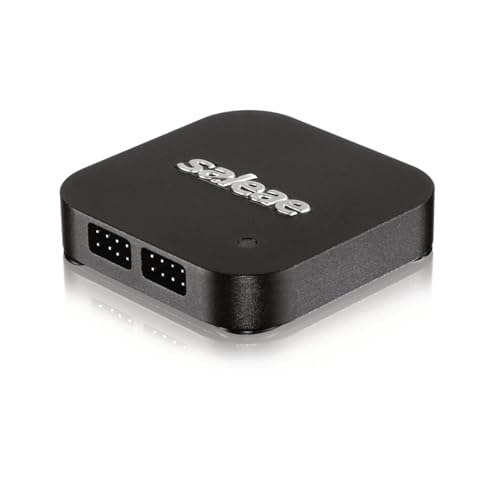
Saleae’s industrial design is in a different league from the budget competition. The Logic 8 is machined from a single block of anodized aluminum, with a satin finish that resists fingerprints and scratches. It is compact — about the size of a deck of cards — and the weight feels reassuring without being heavy. The USB-C connector is modern and robust, and the front edge carries eight probe ports with color-coded silicone rings that match the cable colors.
The included cables are a highlight. Each digital channel gets a flexible silicone wire with a micro-grabber clip on the end and an independent ground lead. That independent grounding is crucial for signal integrity on high-speed or noisy boards; budget analyzers with shared ground buses introduce crosstalk that can corrupt captures. The cables are also replaceable, and Saleae sells spares in multiple lengths and colors.
Internally, the Logic 8 uses a Xilinx Spartan-6 FPGA to handle acquisition and a Cypress USB controller for host communication. The FPGA performs over 5 billion DSP operations per second, according to Saleae, enabling real-time compression and protocol decoding. The analog channels use a dedicated ADC per input, which is why simultaneous analog-plus-digital capture is possible without time-interleaving artifacts.
Performance & Specifications Deep Dive
The Logic 8 samples digital signals at 100 MS/s on all eight channels simultaneously. That is 10 ns time resolution, adequate for SPI at 20-25 MHz, I2C at 400 kHz, and UART at several megabaud. The analog channels sample at 10 MS/s with 1 MHz bandwidth, giving you a one-bit oscilloscope view of each line. That analog capability is genuinely useful for diagnosing level mismatches, slow rise times, or noisy signals that a pure digital analyzer would misinterpret as clean transitions.
The streaming architecture means there is no onboard capture buffer. Data streams continuously to your PC over USB 3.0, and capture length is limited only by available RAM. A 30-second capture at 100 MS/s on eight channels consumes several gigabytes, so a modern PC with 16 GB or more is recommended. The upside is unlimited capture depth for slow signals; the downside is that the sample rate is fixed — you cannot trade depth for speed as you can with buffered analyzers like the DSLogic.
One documented limitation is triggering. The Logic 8 supports edge triggers with optional level conditions on other channels, but it lacks complex triggers like bus-value matching, sequence triggers, or state-machine triggers. Big Mess o’ Wires reviewed the Logic Pro 8 and noted that triggering is performed in software on the PC, which limits complexity. For capturing rare events or specific bus states, buffered analyzers with hardware triggers are more capable. Saleae’s own forums confirm that analog channels can interfere with trigger performance due to USB bandwidth constraints.
Software & User Experience
Logic 2 is the best logic analyzer software available, full stop. The interface is clean and modern, with drag-to-zoom navigation, instantaneous waveform search, and protocol annotations that overlay decoded data directly on the capture. Setting up a new capture takes seconds: select channels, assign protocol analyzers, and click record. Decoders for SPI, I2C, UART, CAN, LIN, I2S, JTAG, and 20+ more protocols are included and actively maintained.
The search functionality is transformative. Need to find every instance where an SPI slave returned 0xFF? Type it into the search box and Logic 2 jumps to each occurrence instantly. Need to measure the time between two events? Drop timing markers and read the delta directly. These workflows are possible in PulseView and DSView, but they are slower and less intuitive. Saleae’s polish shows in a thousand small details: channels can be renamed and reordered by dragging, annotations snap to edges, and the export formats (CSV, binary, VCD) cover every downstream tool.
Logic 2 is not perfect. A lengthy Saleae community thread documents UX regressions versus the older Logic 1.x: the live view lags behind real time during long captures, there is no post-capture glitch filter, scroll zoom sensitivity is low, and the right panel only shows one context at a time. Some users keep both versions installed, using Logic 1 for quick captures and Logic 2 for analyzers that require newer decoders. These are complaints about a product that is already best-in-class; they do not change the overall assessment.
Real-World Use Cases
For professional embedded development, the Logic 8 is a daily driver. Debugging a multi-device I2C bus with address collisions, validating SPI flash programming sequences, or verifying CAN bus arbitration behavior are all faster with Logic 2 than with any alternative. The analog channels add a diagnostic layer that pure digital analyzers cannot match: a signal that looks like a clean digital transition may actually be a slow ramp caused by a weak pull-up or excessive capacitance, and the analog capture reveals it immediately.
In firmware development, the Logic 8 excels at timing analysis. Validating that an interrupt service routine completes within its deadline, measuring UART baud rate drift, or checking PWM duty cycle consistency across temperature are all straightforward. The unlimited capture depth means you can record minutes of slow traffic and then search for anomalies, rather than guessing when to trigger.
Where it frustrates is wide-bus and state-analysis work. Eight channels is enough for most serial protocols but insufficient for a full 16-bit data bus with control signals. There is no state-table view showing bus values per clock cycle, and no external clock input for synchronous state capture. A reviewer on the 68k Macintosh Liberation Army forum called the Saleae "more like an 8-channel, 1-bit oscilloscope" than a traditional logic analyzer, noting the absence of features that legacy HP and Tektronix users expect. For CPU bus debugging or FPGA verification, a 16-channel buffered analyzer is more appropriate.
Who Should Buy (And Who Shouldn't)
Buy the Logic 8 if you are a professional embedded engineer, a serious hobbyist who debugs digital systems regularly, or anyone who values software quality enough to pay for it. The time saved by Logic 2’s search, annotation, and export features pays for the hardware within a few projects. If you rely on logic analysis for your income or sanity, the $399 is an easy investment.
Do not buy it if you need more than eight channels, if you require complex hardware triggering or external clocking, or if you are a casual beginner who will use the tool twice a year. The InnoMaker LA1010 at $60 handles basic protocol decoding competently, and the Kingst LA2016 at $80 adds 16 channels and 200 MHz. Also avoid it if you work primarily with wide parallel buses or vintage CPU systems; the Logic 8’s streaming architecture and limited channel count are mismatched to that workflow. For those users, the DSLogic U3Pro16 or a vintage HP logic analyzer is the better fit.
Alternatives Worth Considering
The DSLogic U3Pro16 at $299 is the capability upgrade. It offers 16 channels, 1 GHz sample rate in buffered mode, a 256 MB hardware buffer, and hardware triggering via DSView software. You lose analog channels and the software polish, but you gain channel count, speed, and trigger complexity. For FPGA and high-speed digital work, the DSLogic is the rational choice.
The Kingst LA2016 at $80 is the budget alternative with more channels. It streams 16 channels at 200 MHz and works with PulseView. The software is nowhere near Logic 2, but the hardware capability per dollar is exceptional. If you need more channels than the Logic 8 provides and can tolerate open-source software, the LA2016 is compelling.
The Saleae Logic Pro 8 at $799 adds 500 MS/s digital sampling and 50 MS/s analog on all channels. It is overkill for most hobbyists but indispensable for professionals working with high-speed serial or analog-digital mixed systems. If you are already considering the Logic 8 and your budget stretches, the Pro model future-proofs your bench for years.
Frequently Asked Questions
What makes the Saleae Logic 8 worth $399 compared to $60 analyzers?
Can the Logic 8 capture analog signals?
Is there a limit to capture length?
Does the Logic 8 support external clocking?
Can I use Logic 2 without the hardware?
What is the difference between Logic 8 and Logic Pro 8?
Saleae Logic 8
$999 — 8 channels, 100 MHz