Best Vector Network Analyzers for Hobbyists
Measure S-parameters, tune antennas, and characterize filters with a pocket-sized VNA. We review every NanoVNA variant that matters.
What Is a Vector Network Analyzer?
A Vector Network Analyzer (VNA) measures how RF signals interact with a device under test. Unlike an oscilloscope, which shows voltage over time, a VNA measures S-parameters — specifically S11 (reflection, or how much signal bounces back) and S21 (transmission, or how much signal passes through). These two measurements tell you everything about impedance matching, filter response, and antenna performance.
The Smith chart is the VNA's signature visualization. It maps complex impedance onto a circular graph, letting you see at a glance whether your antenna is matched to 50 Ω, how reactive it is, and what component values you need to fix it. For antenna tuning — the most common hobbyist use case — a VNA replaces hours of trial and error with a 30-second measurement.
For beginners, the NanoVNA family has made VNAs accessible. At $72–$165, you get genuine 2-port measurement, Smith chart display, and calibration kits that used to cost thousands. If you work with ham radio, DIY filters, or RF circuits, a VNA is the single most useful tool after a basic oscilloscope.
All Vector Network Analyzers Reviewed
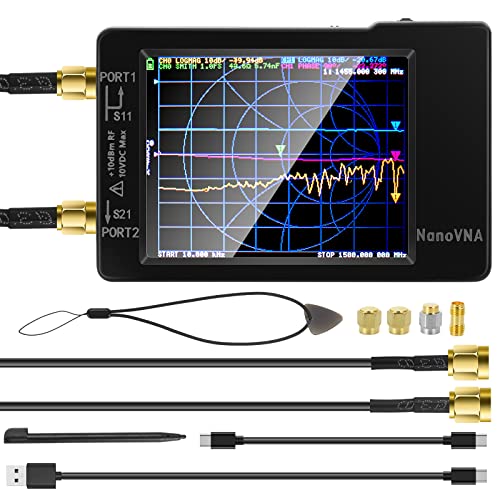
The NanoVNA-H is the entry point into vector network analysis for RF hobbyists. For under $75 you get a 2-port VNA with Smith chart display, battery power, and a calibration kit included. It won't replace a $5,000 Keysight VNA, but for antenna tuning, filter characterization, and transmission line analysis, it delivers genuine value. This is the oscilloscope equivalent of the FNIRSI — cheap, capable, and the right first tool.
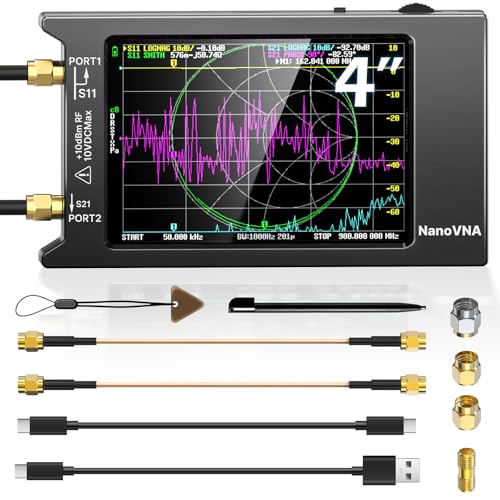
The NanoVNA-H4 is the same great VNA as the H model, but with a screen you can actually read. The 4-inch display transforms the user experience — marker placement, Smith chart navigation, and zooming are all dramatically easier. If you can afford the extra $18, this is the better buy. If budget is tight, the H model delivers identical RF performance.
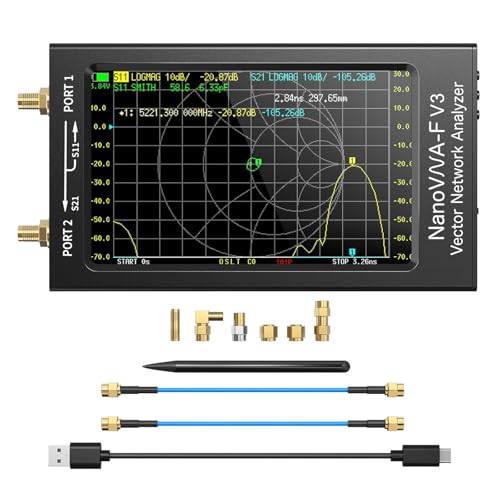
The NanoVNA-F V3 is the premium NanoVNA — 6.3 GHz range, capacitive touchscreen, aluminum enclosure, and higher dynamic range. For serious RF hobbyists working above 1.5 GHz (WiFi antennas, filters, duplexers), this is the only NanoVNA that matters. The $165 price is a leap from the H model, but it's still 1/30th the price of a professional VNA with comparable range. Buy this if your work goes above UHF.
VNA + Oscilloscope: The Complete RF Bench
A VNA and oscilloscope are complementary, not competing tools. Your VNA works in the frequency domain — measuring S-parameters, impedance, and filter response. Your oscilloscope works in the time domain — showing voltage waveforms, digital signals, and transient behavior.
For RF projects, start with the VNA to tune your antenna or filter, then use the oscilloscope to verify the signal integrity of the resulting circuit. Together they cover everything from DC to gigahertz.
See our oscilloscope reviews →Do You Actually Need One?
Yes, if you...
- • Tune ham radio or DIY antennas
- • Characterize RF filters and duplexers
- • Measure impedance and VSWR
- • Design matching networks
- • Work with transmission lines and coax
Probably not, if you only...
- • Debug Arduino and digital circuits
- • Measure DC voltages and currents
- • Check I2C / SPI protocol timing
- • Work entirely below 1 MHz