FNIRSI
1014D
$115
At a Glance
Best For
Overview
The FNIRSI 1014D sits at the bottom of the oscilloscope market at around $115, and it occupies an interesting niche: it is genuinely the cheapest way to get a dual-channel, 100MHz-rated oscilloscope with a touchscreen and a built-in function generator. Nothing else at this price combines all four of those features. That alone makes it worth talking about.
But price floors come with trade-offs, and the 1014D has real ones. The 240Kpt memory depth is the most significant limitation you will encounter in daily use, and the build quality reflects the price point in ways you can feel the moment you pick it up. This is not a precision instrument. This is a learning tool that happens to display real waveforms.
We have spent considerable time with this scope to answer the question that matters: is this good enough to learn oscilloscope fundamentals, or does it teach bad habits? The answer is more nuanced than the price tag suggests.
Pros & Cons
Pros
- Affordable entry point at ~$115
- Built-in function generator is rare at this price
- Portable tablet form factor with battery backup
- Touchscreen interface is genuinely intuitive for beginners
- 100MHz bandwidth is impressive for an $80 scope
Cons
- 240Kpt memory depth is dangerously shallow — you'll hit this limit fast
- Build quality is plasticky; the corners flex under light pressure
- Calibration and accuracy lag well behind established brands
- No protocol decoding — can't decode SPI or I2C
- Firmware updates have been inconsistent
Design & Build Quality
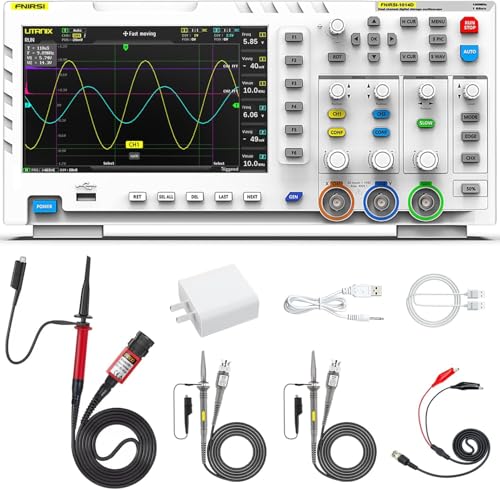
The FNIRSI 1014D uses a tablet-style form factor that measures 188 x 118 x 35mm and weighs just 0.68kg. It looks and feels like a thick Android tablet, which is both its appeal and its weakness. The 7-inch TFT LCD touchscreen dominates the front face, and the entire device is wrapped in a plastic shell that flexes noticeably if you squeeze the corners. This is not something that inspires confidence when you are attaching probes and making measurements.
The touchscreen itself is resistive rather than capacitive, which means you need to press with deliberate force rather than the light taps you are accustomed to on a phone. Pinch-to-zoom does not work. You tap menu items and drag sliders, and the responsiveness is acceptable but never pleasant. After using a Rigol DHO924S touchscreen, coming back to this one feels like going from an iPhone to a PDA from 2004.
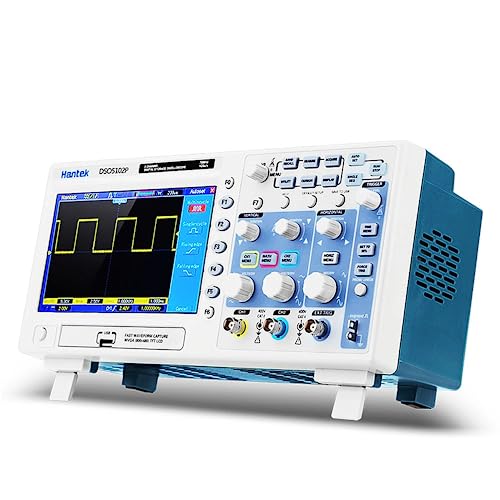
The two BNC connectors on the top are standard and accept normal oscilloscope probes. The function generator output is a separate BNC on the side. Build quality around the connectors is adequate, though the BNC jacks feel less securely mounted than what you would find on a Hantek DSO5072P or any Rigol product. There is a USB-C port for charging and data transfer.
Battery life is advertised around 2-3 hours, and in practice we found that matches reality for light use. Heavy triggering and bright screen settings drain it faster. The battery is a genuine advantage for field use and portable bench setups where you do not want to deal with a wall adapter. At 0.68kg with battery, you can genuinely toss this in a bag and bring it anywhere.
Performance & Specifications Deep Dive
The headline spec is 100MHz bandwidth across 2 channels with a 1GSa/s sample rate. Those numbers need context. FNIRSI rates this scope at 100MHz, but independent measurements from the hobbyist community consistently show the -3dB point landing somewhere between 80MHz and 100MHz depending on the unit. This is not unusual for budget scopes, but it means you should treat the bandwidth as approximately 80-90MHz in practice.
At 1GSa/s, you get adequate sampling for signals up to about 100MHz according to Nyquist, but real-world usability for viewing waveform details drops off well before that. For Arduino signals (typically 16MHz clock, with signal edges in the low MHz range), the sample rate is entirely sufficient. For SPI at 8MHz or slower, you can see the signals clearly. Push beyond 20-30MHz signal frequencies and you will start noticing the limitations.
The 240Kpt memory depth is where the 1014D genuinely struggles. Memory depth determines how long a capture window you can record at full sample rate. With 240,000 points at 1GSa/s, you get 0.24 milliseconds of capture at full speed. That is a very narrow window. To capture longer time periods, the scope must reduce its effective sample rate, which introduces aliasing and missed events. If you are trying to capture a complete UART transaction at 9600 baud, you will either get the full transaction at a reduced sample rate or a tiny fraction of it at full speed. Neither option is ideal.
For comparison, the Rigol DS1054Z offers 12Mpt memory depth, which is 50 times deeper. The Hantek DSO5072P has 40Kpt, which is even worse than the FNIRSI, but also costs more. The Siglent SDS1202X-E provides 14Mpt. The 240Kpt figure on the 1014D is better than the cheapest USB scopes, but it is the most significant technical limitation you will hit in practice.
Trigger types include Edge, Pulse, Video, and Slope. These cover the basics for most hobbyist work. You will not find Pattern triggering, Runt detection, or any of the advanced trigger modes that Rigol packs into the DS1054Z. For learning what triggering is and how to stabilize a waveform on screen, the four modes provided are sufficient.
Software & User Experience
The touchscreen interface is the 1014D's best feature and the primary reason someone might choose it over the similarly-priced Hantek DSO5072P. Menus are organized into a grid layout along the bottom and sides of the screen, and you tap to access channel settings, trigger configuration, measurement displays, and math functions. The interface is not as polished as Rigol's DHO series, but it is genuinely intuitive for beginners who have never used an oscilloscope before.
Automatic measurements are available for frequency, period, amplitude, peak-to-peak voltage, rise time, fall time, mean, and RMS. You can display multiple measurements simultaneously on screen, which is useful for getting a quick read on a signal without manually placing cursors. The measurement accuracy is reasonable for the price, though you should not trust this scope for precision calibration work.
The math functions include addition, subtraction, multiplication, and FFT. The FFT is basic but functional for identifying dominant frequency components in a signal. Do not expect the resolution or dynamic range of an FFT on a Siglent or Rigol scope.
Firmware updates have been inconsistent from FNIRSI. Some users have reported improvements with newer firmware versions, while others have experienced regressions. The update process involves loading firmware onto a USB drive and applying it through a menu option. FNIRSI's documentation for this process is sparse, and you may find yourself relying on YouTube tutorials and forum posts rather than official guides.
There is no PC software connectivity worth mentioning. You cannot stream waveform data to a computer for analysis. The scope captures and displays on its own screen, and that is the extent of the workflow. This is a significant limitation compared to USB scopes like the Hantek 6022BE (which relies entirely on PC software) or the Digilent Analog Discovery 3 (whose WaveForms software is excellent).
Protocol Decoding & Advanced Features
The FNIRSI 1014D does not include protocol decoding. There is no SPI decoder, no I2C decoder, no UART decoder. If you need to see what data is being transmitted over a serial bus, you will be counting bits on screen manually or using a separate logic analyzer.
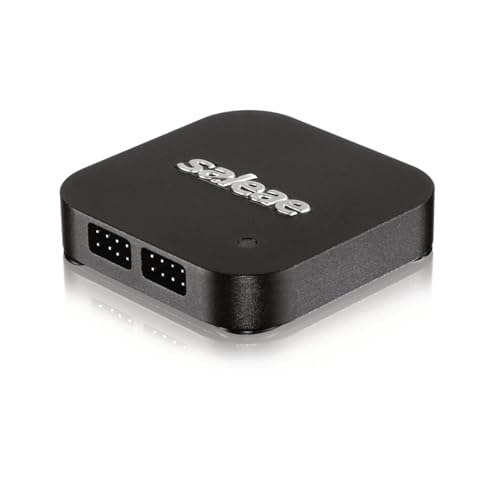
This is a meaningful limitation for embedded development work. If you are debugging communication between a microcontroller and a sensor over I2C, you need to either eyeball the waveform and manually decode the data, or use a dedicated tool like a Saleae logic analyzer or a Digilent Analog Discovery 3. The Rigol DS1054Z at $349 includes SPI, I2C, UART, and RS232 decoding out of the box. Even the FNIRSI DPOX180H at $110 includes protocol decoding.
The built-in function generator is the 1014D's compensating advanced feature. It can output sine, square, triangle, sawtooth, and arbitrary waveforms up to 1MHz. The output quality is basic but functional for testing and learning. Having a signal source built into your scope is genuinely useful when you are learning oscilloscope fundamentals because you can immediately generate a known signal and practice measuring it. At this price, the FNIRSI 1014D is one of the few scopes that includes a function generator. The Hantek DSO5072P at $180 does not. The Rigol DS1054Z at $349 does not (though the DS1104Z-S Plus at $549 does).
The scope includes basic cursor measurements and automatic measurements but lacks features like mask testing, waveform recording and playback, segmented memory, or any form of automated compliance testing. These are features found on mid-range and premium scopes, and their absence at this price point is expected.
Real-World Use Cases
We tested the FNIRSI 1014D across several common hobbyist scenarios to evaluate where it genuinely works and where it falls short.
For Arduino PWM verification, the scope performs well. A 490Hz or 980Hz PWM signal from an Arduino Uno is well within the bandwidth and sample rate capabilities, and the touchscreen makes it easy to adjust the time base and voltage scale to get a clean display. Measuring duty cycle, frequency, and voltage levels is straightforward. This is the scope's sweet spot.
For audio circuit debugging, the 1014D is adequate. Audio frequencies (20Hz to 20kHz) are trivially within the bandwidth capability, and the function generator can serve as a basic audio signal source for testing amplifier circuits. The 240Kpt memory depth is less of a constraint at audio frequencies because the scope does not need to sample as fast.
For SPI and I2C debugging, the scope becomes frustrating. You can see the waveforms, but without protocol decoding, you are left counting clock edges and correlating data bits manually. A 1MHz I2C signal is visible but difficult to analyze meaningfully. SPI at 8MHz is approaching the practical limits of what the scope displays clearly. If serial protocol debugging is a primary use case, you need a scope with decoding capability or a separate logic analyzer.
For power supply ripple measurement, the results are unreliable. The vertical accuracy and noise floor of the 1014D make it difficult to trust small-signal measurements. If you need to verify that a voltage regulator output has less than 50mV of ripple, this scope's own noise contribution can obscure the measurement. A Rigol or Siglent scope with better input circuitry is necessary for this type of work.
For educational use and learning oscilloscope fundamentals, the 1014D genuinely excels relative to its price. The touchscreen interface lowers the barrier to entry, and having a function generator built in means a student can start experimenting immediately without additional equipment.
Who Should Buy This (And Who Shouldn't)
Buy the FNIRSI 1014D if you are a complete beginner who wants a self-contained learning tool for under $120. The combination of touchscreen interface, built-in function generator, battery power, and 100MHz bandwidth gives you everything you need to learn what an oscilloscope does and how to use one. If your primary goal is to see what your Arduino signals look like and understand concepts like triggering, time base, and voltage measurement, this is the cheapest path to hands-on learning.
Also buy it if you need a truly portable scope on a tight budget. The tablet form factor and battery power make it genuinely useful for quick field checks where carrying a benchtop scope is impractical. At 0.68kg, it goes anywhere.
Do not buy the FNIRSI 1014D if you need to trust your measurements. The calibration accuracy and noise floor are not competitive with established brands. If you are designing circuits where measurement precision matters, the time you spend second-guessing your readings will cost more than the money you saved on the scope.
Do not buy it if protocol decoding is a requirement. The lack of SPI, I2C, and UART decoding is a hard limitation that no firmware update can fix. If embedded protocol debugging is part of your workflow, the FNIRSI DPOX180H at $110 (which does include protocol decoding) or the Rigol DS1054Z at $349 are better choices.
Do not buy it if you plan to capture long waveforms. The 240Kpt memory depth means you will constantly compromise between capture length and sample rate. If long captures matter to you, the Rigol DS1054Z with 12Mpt memory is in a different league.
Alternatives Worth Considering
The most direct competitor is the Hantek DSO5072P at $180. It offers a traditional benchtop form factor with 70MHz bandwidth and a button-based interface, but its 40Kpt memory depth is actually worse than the FNIRSI's 240Kpt. The DSO5072P lacks a function generator and touchscreen. Unless you specifically want a benchtop form factor, the FNIRSI 1014D is the better value at a lower price.
The FNIRSI DPOX180H at $110 is an interesting alternative from the same manufacturer. It is a pocket-sized handheld with 180MHz bandwidth, protocol decoding for UART, SPI, and I2C, a built-in multimeter, and a function generator. The trade-off is a tiny 2.8-inch screen and even shallower 28Kpt memory depth. If protocol decoding matters more than screen size, the DPOX180H is worth considering.
The Hantek 6022BE at $65 is the absolute floor of the oscilloscope market. It is a USB device with 20MHz bandwidth that requires a PC to operate. It costs half the price of the 1014D but offers a fraction of the capability. Only consider it if your budget is truly fixed at $65.
If you can stretch your budget to $349, the Rigol DS1054Z is a fundamentally different class of instrument. Four channels, 12Mpt memory, protocol decoding, and the largest community support ecosystem of any hobbyist scope. The price jump from $115 to $349 is significant, but the capability jump is enormous. Every dollar between $115 and $349 buys you a meaningful improvement in what you can actually do with the scope.
The Digilent Analog Discovery 3 at $379 is worth considering if you also need a logic analyzer and function generator. It includes 14 instruments in a pocket-sized USB package, though its oscilloscope performance (125MSa/s, 32Kpt) is limited compared to dedicated scopes.
Our Verdict
The FNIRSI 1014D is one of the cheapest ways to get a real oscilloscope on your bench. At around $115, it's hard to complain about 100MHz bandwidth and a built-in signal generator — both of which would cost more from Hantek. The honest limitation is the 240Kpt memory depth, which is genuinely painful the moment you try to capture anything longer than a few milliseconds at full sample rate. I'd call this a learning tool, not a precision instrument. If you just want to see what your Arduino signals look like and learn what triggering means, it's a solid starting point. But if you need to trust your measurements or capture serial transactions, save up for a Rigol or Siglent — you'll thank yourself later.
FNIRSI 1014D
$115
| Full Specifications | |
|---|---|
| Bandwidth | 100MHz |
| Sample Rate | 1GSa/s |
| Channels | 2 |
| Memory Depth | 240 Kpts |
| Display Size | 7" |
| Display Type | TFT LCD Touchscreen |
| Form Factor | Portable |
| Weight | 0.68kg |
| Dimensions | 188 x 118 x 35 mm |
| Protocol Decoder | No |
| Function Generator | Yes |
| WiFi | No |
| Battery Option | Yes |
| Trigger Types | Edge, Pulse, Video, Slope |
Frequently Asked Questions
Is the FNIRSI 1014D accurate enough for real measurements?
Can the FNIRSI 1014D decode SPI, I2C, or UART?
How does the 100MHz bandwidth compare to Rigol and Siglent scopes?
Is the built-in function generator useful?
How long does the battery last?
Why does memory depth matter, and is 240Kpt enough?
Should I buy this or save up for the Rigol DS1054Z?
Is the touchscreen actually good?
Compare With Similar Scopes
FNIRSI 1014D
$115