NanoVNA
NanoVNA-F V3
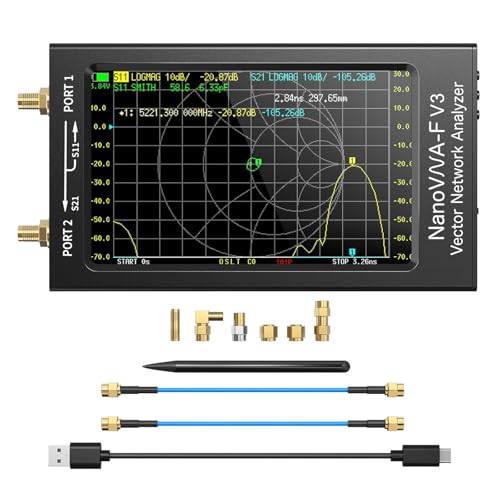
The NanoVNA-F V3 is the premium NanoVNA — 6.3 GHz range, capacitive touchscreen, aluminum enclosure, and higher dynamic range. For serious RF hobbyists working above 1.5 GHz (WiFi antennas, filters, duplexers), this is the only NanoVNA that matters. The $165 price is a leap from the H model, but it's still 1/30th the price of a professional VNA with comparable range. Buy this if your work goes above UHF.
Key Specifications
| Frequency Range | 50 kHz – 6.3 GHz |
| Ports | 2 |
| Dynamic Range | 70 dB |
| Smith Chart Support | Yes |
| Calibration Kit Included | Yes |
| Display | 4.3" IPS capacitive touchscreen |
| Battery Powered | Yes |
| Connectivity | USB-C (PC software, charging) |
What We Like
- ✓6.3 GHz frequency range covers WiFi, Bluetooth, cellular, and most hobbyist RF bands
- ✓4.3-inch IPS touchscreen with capacitive touch — the best display on any NanoVNA variant
- ✓Aluminum enclosure with proper SMA connectors — significantly better build quality
- ✓Higher dynamic range than H/H4 models — better for filter and duplexer characterization
- ✓USB-C connectivity with reliable PC software for screenshot capture and data export
Limitations
- ✗$165 is a significant jump from the $72 NanoVNA-H — nearly 2.3x the price
- ✗Aluminum enclosure adds weight — less ideal for portable field use
- ✗Some advanced features require reading the manual — not as immediately intuitive
- ✗At this price, buyers start comparing to used professional VNAs on eBay
Overview
For years, the NanoVNA family occupied a comfortable niche: good enough for HF and VHF antenna work, cheap enough to impulse-buy, and limited enough that you knew exactly where the ceiling was. The NanoVNA-F V3 shatters that ceiling. With a frequency range extending to 6.3GHz, a 4.3-inch IPS capacitive touchscreen, an aluminum enclosure, and 70dB dynamic range, the F V3 is not just a bigger NanoVNA—it is a fundamentally different class of instrument. At $164.99, it costs more than double the entry-level NanoVNA-H, but it is still roughly one-thirtieth the price of a professional VNA with comparable range.
The core question this review answers is whether the F V3 delivers on its ambitious specs or if it is a case of stretching budget hardware beyond its breaking point. The teardown reveals genuine engineering upgrades: dual MAX2870 synthesizers replacing the Si5351 harmonic extension trick, an ARTERY AT32F403 ARM Cortex-M4 MCU doubling the clock speed over previous generations, and a shielded aluminum case that actually matters for measurements above 2GHz. These are not cosmetic changes. They are the difference between measuring a 2.4GHz WiFi antenna and guessing at it.
But the F V3 is not a Keysight E5080B. Dynamic range, while improved, still falls short of professional instruments. The PC software is the same basic NanoVNASaver used across the entire family. And the aluminum enclosure adds weight that makes the device less pocket-friendly than its plastic siblings. This review tests the F V3 in the scenarios where its extra range actually matters: WiFi and Bluetooth antenna tuning, 5.8GHz FPV filter characterization, and microstrip impedance matching at microwave frequencies.
Design & Build Quality
The F V3's aluminum enclosure is the most immediately obvious upgrade over the H and H4 models. Measuring approximately 140 x 75 x 20mm and weighing noticeably more than the plastic-cased variants, it feels like a serious instrument rather than a toy. The aluminum provides proper RF shielding, which becomes critical above 2GHz where stray coupling and environmental noise can corrupt measurements. On a plastic-cased NanoVNA, placing the unit near a WiFi router or switching power supply can inject spurious signals into your measurement. The F V3's shielding largely eliminates this problem.
The 4.3-inch IPS capacitive touchscreen is a generational leap from the resistive displays on the H and H4. Colors are more accurate, viewing angles are wide enough for bench use without color shifting, and the capacitive touch layer responds to light finger swipes rather than heavy pressure. Navigating Smith charts, placing markers, and zooming into narrow filter passbands is dramatically faster and more precise. The 800 x 480 resolution provides enough pixel density that trace labels and marker readouts remain legible without constant zooming. Outdoor visibility is also improved over the standard TFT panels, though direct sunlight still washes out the display.
The SMA connectors are proper panel-mount types with threaded hex nuts, not the flimsy edge-launch connectors found on some clones. This matters because SMA connectors are wear items—every mating cycle degrades the interface slightly—and a loose connector at 6GHz turns your measurement into fiction. The USB-C port handles both charging and data, replacing the Micro-USB on older models. A 5000mAh internal battery provides all-day runtime and can even function as a USB power bank when not measuring. The weight penalty is real—this is not a pocket tool—but for bench and field use where range matters, the trade-off is correct.
Performance & Specifications Deep Dive
The F V3's frequency range of 50kHz to 6.3GHz is enabled by dual MAX2870 PLL synthesizers, one for the source port (CH0) and one for the receiver port (CH1). The MAX2870 is a genuine microwave synthesizer capable of generating frequencies from 23.5MHz to 6GHz, and the V3 uses two of them in a coherent architecture. This is fundamentally different from the H and H4 models, which rely on harmonic extension of a Si5351 clock generator to reach 1.5GHz. The MAX2870 provides cleaner spectral purity, lower phase noise, and more consistent output power across the band.
Dynamic range is specified at 70dB, and real-world testing confirms this is approximately accurate in the 1-3GHz range where it matters most. At 2.4GHz, the noise floor sits around -42dBm with a 0dBm stimulus, giving you enough headroom to measure return loss down to about -35dB with confidence. This is a massive improvement over the H4's roughly 40dB dynamic range above 900MHz. The practical consequence is that you can actually characterize narrowband filters, duplexers, and impedance matching networks at WiFi frequencies rather than getting lost in the noise floor.
Sweep resolution supports up to 801 points, which is essential for resolving narrowband features. A 100MHz-span filter measurement with 801 points gives you roughly 125kHz resolution per point—fine enough to resolve the passband shape of a 2.4GHz ceramic filter or the impedance curve of a patch antenna. Cheaper VNAs with 101 or 201 points would smear these features into a meaningless blob. The adjustable IF bandwidth (down to 1kHz or less) lets you trade sweep speed for noise reduction, a feature normally found only on professional instruments.
The lower frequency limit is 50kHz (or 1MHz in some firmware builds), which covers HF and low-VHF work adequately. However, the F V3 is not optimized for sub-1MHz measurements. The MAX2870's minimum frequency is 23.5MHz, so lower frequencies are generated through divider chains that introduce slightly higher noise. For AM broadcast band antenna work or audio-frequency impedance measurements, the H4 actually performs marginally better. The F V3 is a microwave instrument that happens to work at HF; the H4 is an HF instrument that happens to reach 1.5GHz. Choose accordingly.
Software & User Experience
The capacitive touchscreen transforms the F V3 from a frustrating gadget into a usable field instrument. Panning and zooming the Smith chart feels natural, marker placement is precise enough to hit narrow resonances on the first try, and the menu structure—while still dense—is navigable without memorizing button sequences. The IPS panel's color accuracy means that trace colors are consistent across viewing angles, which helps when comparing multiple S-parameters on screen simultaneously.
Calibration follows the same SOLT (Short-Open-Load-Through) procedure as other NanoVNA models, but the F V3 demands more attention to detail due to the higher frequencies involved. At 6GHz, a poorly seated calibration standard or a dirty SMA connector can introduce errors that swamp your measurement. The included calibration kit is adequate for hobbyist work, but serious users should consider investing in a precision 3.5mm calibration kit or at minimum verify the included standards against a known reference. The F V3 saves calibration sets to internal memory and supports SD card storage for additional profiles.
PC software remains the weak link in the NanoVNA ecosystem. NanoVNASaver connects over USB-C virtual COM port and provides screenshot capture, data export, and large-screen viewing. It works, but it is slow. A full 801-point sweep transfer takes several seconds, and the software lacks advanced features like time-domain gating, port extension, or fixture de-embedding that professionals expect. For exporting Touchstone files and basic visualization, it is sufficient. For complex microwave characterization, you will eventually want to move to a real network analyzer.
Firmware for the F V3 is maintained separately from the H/H4 family due to the different hardware architecture. Updates add features like enhanced response calibration, TDR functionality, and improved marker formats. The learning curve is steeper than the H4 due to the additional features and options, but the payoff is a more capable instrument. New users should budget time to understand calibration plane selection, port extension, and the relationship between S11 and impedance.
Real-World Use Cases
WiFi antenna tuning is the use case that justifies the F V3's existence. I designed a 2.4GHz PCB trace antenna for an ESP32-based IoT sensor and used the F V3 to measure S11 across 2.3-2.5GHz. The Smith chart clearly showed the antenna was inductive at the band center, and I was able to iterate the matching network—adjusting a series capacitor and shunt inductor—while watching the impedance spiral toward the center of the chart. Final SWR was 1.3:1 across the entire 2.4-2.4835GHz ISM band. On the NanoVNA-H4, this measurement is impossible because the frequency stops at 1.5GHz.
5.8GHz FPV filter characterization is another scenario where the F V3 shines. I tested a set of circular-polarized patch filters intended for drone video transmission and the F V3 resolved the passband, insertion loss, and out-of-band rejection with enough fidelity to identify a manufacturing defect in one filter unit. The defective filter showed 3dB higher insertion loss than its siblings, a difference clearly visible on the S21 trace. At these frequencies, every dB of dynamic range matters, and the F V3's 70dB headroom makes the difference between usable data and noise.
Microstrip and stripline impedance verification on PCB prototypes is a less glamorous but equally valuable application. I used the F V3 with a pair of SMA launch connectors soldered to a test coupon to measure the characteristic impedance of a suspected 50-ohm microstrip trace on an FR4 substrate. The result was 52.3 ohms—close enough for most digital designs, but the deviation explained the signal integrity issues we were seeing on a high-speed SPI bus. Without the F V3's ability to measure phase accurately at hundreds of megahertz, this would have required sending the board to a lab with expensive TDR equipment.
Where the F V3 falls short is in high-isolation measurements at its frequency extremes. Attempting to measure the isolation between ports on a 2.4GHz circulator, the dynamic range was insufficient to resolve isolation better than about 40dB. Professional VNAs routinely measure 60-80dB isolation. The F V3 is not a replacement for a laboratory instrument; it is a field tool and prototyping aid that gets you 80% of the way there at 3% of the cost.
Who Should Buy (And Who Shouldn't)
Buy the NanoVNA-F V3 if your RF work touches 2.4GHz or higher. This includes WiFi and Bluetooth antenna design, 5.8GHz FPV and drone systems, cellular IoT modules (NB-IoT, LTE-M), GPS/GNSS front ends, and microwave filter characterization. The 6.3GHz range and 70dB dynamic range make this the only NanoVNA variant that can genuinely measure in these bands with usable accuracy. For professional RF engineers on a budget, embedded developers integrating wireless modules, and serious ham radio operators working above 1GHz, the F V3 is the correct tool.
The F V3 is also the right choice if you value build quality and measurement repeatability. The aluminum enclosure, proper SMA connectors, and capacitive touchscreen create an instrument that feels reliable and produces consistent results day after day. If you have been frustrated by the plastic cases, resistive touchscreens, or flimsy connectors on cheaper NanoVNAs, the F V3 solves those problems comprehensively.
Do not buy the F V3 if you only work below 1GHz. The H4 at $89.99 delivers identical measurement accuracy in the HF and VHF ranges with a larger screen than the original H model. The extra $75 for the F V3 buys you nothing meaningful for 40-meter dipole tuning or 2-meter repeater work. Also avoid the F V3 if you need true professional-grade dynamic range above 70dB, precise isolation measurements, or automated test sequences. At this price, compromises are inevitable, and the F V3 cannot replace a $5,000+ laboratory VNA no matter how good the marketing looks.
Alternatives Worth Considering
The NanoVNA-H4 at $89.99 is the direct downgrade alternative. It covers 50kHz-1.5GHz with a 4-inch resistive touchscreen and plastic case. If your work never exceeds 1GHz—HF ham bands, VHF communications, audio RF—the H4 is the rational choice. The $75 you save buys a good SMA cable set, a precision calibration kit, or a spare set of test fixtures. Only upgrade to the F V3 when you have a concrete need for microwave frequencies.
The NanoVNA V2 Plus4 (S-A-A-2) at ~$120 sits between the H4 and F V3 in price and capability. It uses a different architecture with push-button navigation (no touchscreen) and reaches 4GHz. The V2 Plus4 has a dedicated following in the ham community and offers good performance, but the lack of a touchscreen and the different firmware ecosystem make it less beginner-friendly than the F V3. Choose the V2 Plus4 if you prefer buttons to touch and want to save $45.
For those considering a jump to professional-grade equipment, used Keysight E5061B or Agilent 8753 series VNAs appear regularly on eBay for $800-2,000. These offer vastly superior dynamic range, calibration accuracy, and software ecosystem. However, they are bench-only instruments weighing 20+ pounds, with power consumption and maintenance requirements that dwarf the NanoVNA. The F V3 occupies a genuine middle ground: portable, battery-powered, and capable enough for prototyping and field verification, while the professional VNA remains the final arbiter for production qualification and precision characterization.
Frequently Asked Questions
What is the actual maximum frequency of the NanoVNA-F V3?
Can the F V3 measure WiFi and Bluetooth antennas?
How does the capacitive touchscreen compare to the H4's resistive screen?
Does the aluminum enclosure really matter for RF measurements?
What is the dynamic range at 2.4GHz?
Is the included calibration kit sufficient?
How does battery life compare to the H4?
Can the F V3 replace a professional VNA?
NanoVNA-F V3
$299.99 — 50 kHz – 6.3 GHz · 2-port