Best Spectrum Analyzers for Hobbyists
See what your circuits are really doing in the frequency domain. Compare TinySA Ultra and alternatives for RF hobbyists on coverage, dynamic range, and signal generator quality.
What Is a Spectrum Analyzer?
A spectrum analyzer shows you how signal power is distributed across frequencies. Where an oscilloscope displays voltage versus time, a spectrum analyzer displays power versus frequency — revealing harmonics, spurs, noise, and interference that are invisible in the time domain.
For RF hobbyists, this means tuning antennas (where is the peak?), checking transmitter harmonics (am I splattering on adjacent channels?), and characterizing filters (what frequencies does it actually pass?). A spectrum analyzer turns guesswork into measurement.
All Spectrum Analyzers Reviewed
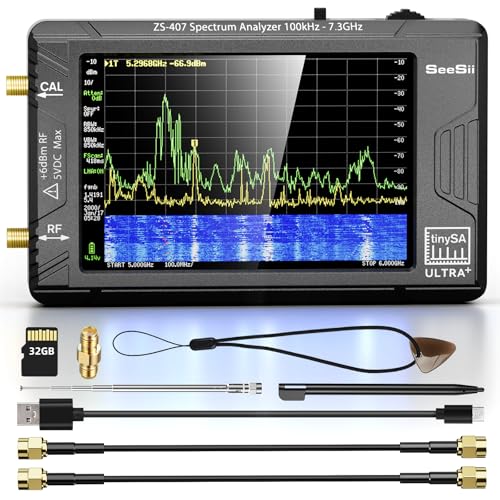
The TinySA Ultra is the spectrum analyzer every RF hobbyist should own first. For $135 you get a 4-inch touchscreen, 6 GHz coverage, and a built-in signal generator. It won't replace a $3,000 Siglent or Rigol SA, but it will tune antennas, check harmonics, and characterize filters better than any $135 tool has a right to. This is the Rigol DS1054Z moment for spectrum analyzers.
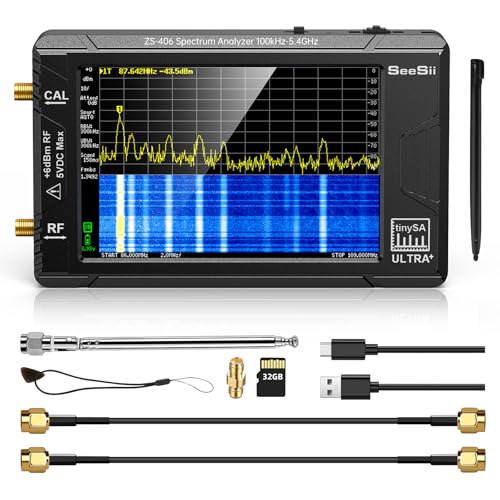
The SeeSii TinySA Ultra+ ZS406 is a credible alternative to the original TinySA Ultra. Same 6 GHz range, same built-in signal generator, same form factor — with slightly better battery life and touch response. If the TinySA Ultra is out of stock or priced higher, this is the buy. If both are available at the same price, the original TinySA has stronger firmware support long-term.
Pair It With Your Oscilloscope
A spectrum analyzer and oscilloscope are complementary tools for RF debugging. The scope shows you what happens in time — the SA shows you what happens in frequency. Together they let you chase harmonics, verify filter roll-off, and debug transmitter spurs from both sides.
Many hobbyists start with a scope for general work, then add a spectrum analyzer when they move into RF, antenna tuning, or EMI investigation. The TinySA Ultra is the natural next step after your first Rigol or Siglent oscilloscope.
See our oscilloscope reviews →Do You Actually Need One?
Yes, if you...
- • Tune antennas or measure SWR (with a return-loss bridge)
- • Check harmonics and spurious emissions from transmitters
- • Characterize RF filters and amplifiers
- • Debug WiFi, Bluetooth, or other 2.4 GHz devices
- • Investigate EMI and interference sources
Probably not, if you only...
- • Debug Arduino and sensor communication
- • Read I2C / SPI / UART protocol data
- • Measure voltages and check continuity
- • Do basic audio or power-supply projects under 1 MHz