◆ At a Glance
◆ Best For
◆ Overview
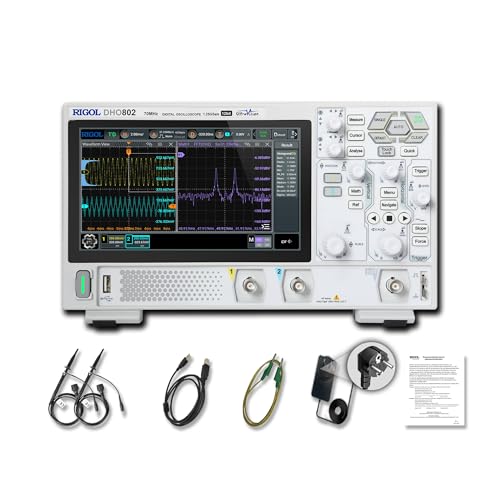
The Rigol DHO802 is the cheapest 12-bit oscilloscope you can buy from a major brand. At $329, it brings the same touchscreen interface, USB-C power, and 12-bit ADC as the rest of the DHO800 series — just with 2 channels instead of 4. That single specification reduction is the entire story of this scope. Everything else about it is essentially the DHO814 in a smaller, lighter, cheaper package.
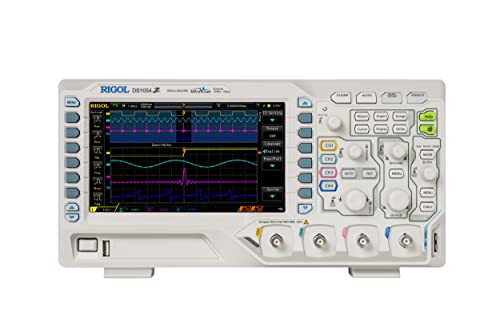
This matters because the 12-bit resolution debate has fundamentally shifted. Five years ago, hobbyists argued about whether 8-bit was enough for benchtop work; today, the consensus on r/AskElectronics and EEVblog has tilted firmly toward 12-bit as the new baseline for any new scope purchase. The DHO802 makes that resolution available at a price point that competes directly with the venerable Rigol DS1054Z, which has held the "recommended first scope" crown for nearly a decade.
The DHO802 is fighting two battles simultaneously. Against the DS1054Z ($349), it offers modern resolution, a touchscreen, and CAN decoding for $20 less — but gives up 2 channels and a decade of community documentation. Against its own sibling the DHO804 ($439), it saves you $110 but loses the second pair of channels that make embedded debugging genuinely pleasant. Whether the DHO802 is the right scope for you comes down entirely to whether 2 channels is enough for the work you actually do — not the work you imagine doing someday.
◆ Pros & Cons
Pros
- 12-bit ADC at $329 — the cheapest way to get modern 12-bit resolution from a major brand
- Same compact form factor and touchscreen as the rest of the DHO800 series
- 25Mpt memory depth is excellent for a scope at this price
- USB-C power means you can run it from a portable battery pack
- Protocol decoding for SPI, I2C, UART, and CAN included
- Modern Rigol UI — the same intuitive touchscreen experience as the DHO924S
Cons
- Only 2 channels — the biggest limitation for embedded debugging
- 70MHz bandwidth is adequate but not exciting
- Fan noise carries over from the DHO800 series
- For ~$120 more, the DHO804 adds 2 more channels which matters enormously
- No function generator
You'll Also Need
Common accessories that pair well with this scope.
Hantek PP-200 200MHz Probe Set (2x)
Replacement 200MHz passive probes compatible with most bench scopes
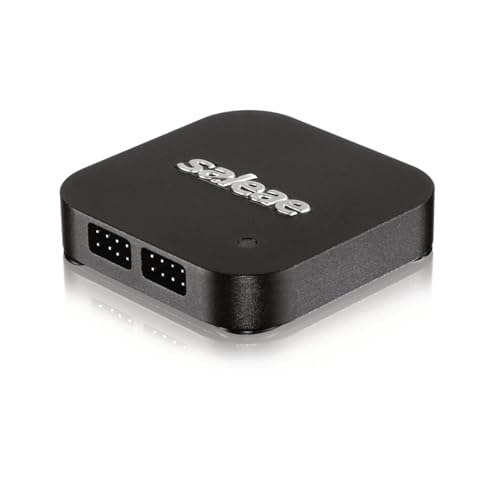
Buy on Amazon · $18 →DEVMO USB Logic Analyzer 8-Channel
8-channel logic analyzer for debugging digital signals and protocols
Buy on Amazon · $14 →Coaxial BNC Cable 50Ω (3-pack)
BNC to BNC 50Ω coax cables for signal connections
Buy on Amazon · $12 →◆ More Bench Gear We've Reviewed
Beyond the scope: other instruments hobbyists keep on the bench.
See signals in the frequency domain
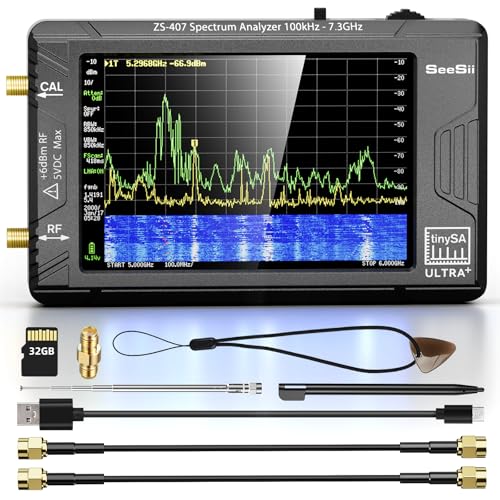
TinySA Ultra
$260.9
See all see signals in the frequency domain picks →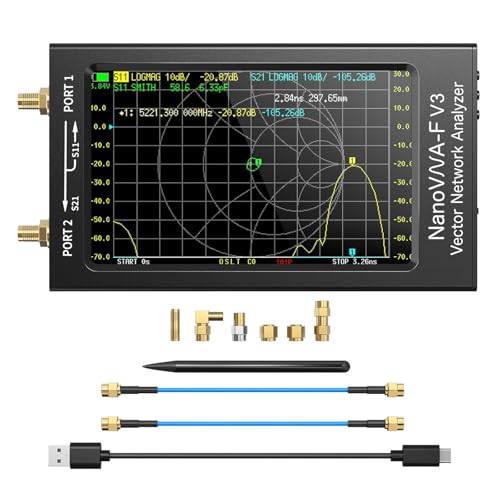
Sweep RF and antenna performance
NanoVNA-F V3
$299.99
See all sweep rf and antenna performance picks →Rigol DHO802
Prices may change · Free shipping with Prime
◆ Design & Build Quality
The DHO802 measures 265 x 162 x 77 mm and weighs 1.78 kg — noticeably smaller and lighter than the DHO900 series and dramatically more compact than the DS1054Z's 313 x 161 x 122 mm chassis. The form factor matters: this scope fits comfortably on a crowded bench, slides into a backpack for field work, and runs from a USB-C power bank if you need true portability.
Build quality is identical to the rest of the DHO800 lineup. Same plastic enclosure with a clean industrial design, same 7-inch IPS touchscreen, same physical knobs and buttons surrounding the display. The touchscreen is the highlight — multi-touch gestures work reliably, pinch-to-zoom is smooth, and tap-to-cursor placement is genuinely faster than the equivalent button presses on the DS1054Z. The physical knobs for vertical scale, horizontal scale, and trigger level provide tactile control where touch isn't ideal.
The USB-C power input is a small detail that has outsized impact. You can power the DHO802 from any USB-C PD source — a phone charger, a laptop power supply, or a portable battery pack. For field work or temporary setups, this eliminates the wall-wart juggling that benchtop scopes usually require. The included power adapter is small enough to throw in a bag alongside the scope.
The IPS display is a step up from the DS1054Z's TFT panel — wider viewing angles, better color accuracy, and crisper text rendering. Side-by-side with the DS1054Z, the difference is immediately obvious. The 1024x600 resolution keeps measurement readouts legible without crowding the waveform area.
Fan noise is the consistent complaint across the DHO800 series, and the DHO802 inherits it. In a quiet home office, you'll hear it. In a workshop or shared lab, you won't notice. It's not loud, but it's present — Rigol prioritized thermal performance over silence.
◆ Performance & Specifications Deep Dive
The 12-bit ADC is the headline specification and the entire reason to buy this scope over the DS1054Z. With 4096 vertical resolution steps versus the DS1054Z's 256 (8-bit), the DHO802 reveals small signals and amplitude variations that would simply not be visible on an 8-bit scope. For audio work, precision analog circuits, and any application where you care about signal detail near the noise floor, 12-bit is transformative.
The 70 MHz bandwidth is adequate for the majority of hobbyist work but not generous. Arduino at 16 MHz, basic embedded development, audio circuits, and analog work below 70 MHz are all comfortable. Faster microcontrollers, high-speed SPI, and any RF work push beyond the DHO802's capability. The 1.25 GSa/s sample rate provides nearly 18x oversampling at 70 MHz bandwidth, which produces clean waveform reconstruction.
The 25 Mpt memory depth is solid for this price point. At full sample rate, 25 million points capture 20 milliseconds of continuous signal — enough for complete protocol transactions, multiple PWM cycles, or extended analog events. The DS1054Z provides only 12 Mpt, so the DHO802 has roughly twice the capture depth at a lower price.
The trigger system is comprehensive and shared with the rest of the DHO platform: Edge, Pulse, Slope, Video, Pattern, Duration, Timeout, Runt, Window, Delay, Setup/Hold, and Nth Edge. Pattern triggering across 2 channels is less powerful than the DS1054Z's 4-channel pattern triggering, but Setup/Hold and Runt triggers remain available and useful. For digital debugging on 2-channel work, the trigger flexibility compensates somewhat for the reduced channel count.
The 2-channel limitation is the critical specification to internalize before buying. SPI debugging needs at least 3 channels (clock, MOSI, MISO) to see the full transaction, or 4 channels including chip select. I2C with an interrupt or enable line uses 3 channels. Any scenario where you need to correlate timing between multiple signals simultaneously requires more than 2 channels. With the DHO802, you'll constantly be reconnecting probes and mentally correlating waveforms from separate captures.
For 2-channel work — single-signal verification, basic analog measurements, audio circuits, dual-trace timing analysis — the DHO802 is excellent. For embedded protocol debugging, you'll quickly hit the channel wall.
◆ Software & User Experience
The DHO802 runs the same UltraVision II firmware as the rest of the DHO platform, which means the user experience is identical to the DHO814, DHO924S, and DHO914S. The touchscreen-first interface is the best in the affordable scope market — Rigol modernized the entire user interaction model when they launched the DHO series, and the result is genuinely pleasant to use.
Menu navigation is shallow and logical. The home screen shows your active waveforms with measurement overlays; tapping any waveform brings up a context menu for that channel; tapping any measurement value brings up the configuration screen for that measurement. The learning curve compared to button-and-knob scopes is minutes, not hours.
Autoset is fast and accurate. Connect a probe to an unknown signal, tap Autoset, and within a second or two the scope has identified the signal, set appropriate timebase and voltage scale, and triggered correctly. This is one of the small features that matters daily — fast autoset means you spend less time configuring the scope and more time looking at signals.
Math functions include addition, subtraction, multiplication, division, FFT with multiple window functions, and digital filtering. The FFT display is competent for basic frequency-domain analysis, though a dedicated spectrum analyzer is the right tool for serious spectral work. Cursor measurements and automatic measurements work the way you expect, with up to 5 simultaneous measurements displayable.
WiFi connectivity is included, which is genuinely useful for remote control and headless operation. The browser-based remote interface mirrors the scope's screen and accepts touch/click input, so you can operate the DHO802 from a tablet or laptop without any installed software. SCPI support enables Python and LabVIEW automation for users who need scripted test sequences.
The touchscreen experience is the biggest day-to-day difference between the DHO802 and the DS1054Z. After a week of using the DHO802, returning to the DS1054Z's button navigation feels antiquated. Tap to place a cursor instead of pressing Cursor, then turning a knob, then pressing another button. Pinch to zoom instead of pressing Zoom, then turning the horizontal knob. The interface is faster for almost every common task.
◆ Protocol Decoding & Real-World Use
The DHO802 includes protocol decoding for SPI, I2C, UART, and CAN. The CAN decoding is notable — Rigol historically charged license fees for CAN/LIN on the DS1000Z series, but the DHO800 series includes CAN at no additional cost. LIN is not included but CAN is, which covers the protocol most automotive hobbyists need.
SPI decoding on 2 channels works for limited cases — you can decode either MOSI or MISO alongside the clock, but not both simultaneously. For most SPI debugging, you really want all four lines visible, which means the DHO802 is the wrong scope for SPI-heavy work. If your work involves a lot of SPI, spend the extra $110 on the DHO814 or DHO804 for the 4-channel capability.
I2C decoding works well on the 2 channels (SDA and SCL). The decoder displays addresses, data bytes, ACK/NACK status, and start/stop conditions clearly. For I2C-focused debugging — sensors, EEPROMs, displays, ADCs — the DHO802 is genuinely useful.
UART decoding handles both standard and non-standard baud rates. You can monitor TX or RX, but not both simultaneously on 2 channels. For debugging serial communication problems, you'll need to swap probes between TX and RX during the debugging session.
For Arduino projects with simple peripherals (one sensor, one LED display, one serial connection), the 2-channel capability is sufficient. You can verify PWM output and check I2C communication, or check serial output and monitor an interrupt line. For Arduino projects with multiple peripherals interacting (SPI display + I2C sensor + interrupt-driven button), you'll feel the channel limit immediately.
For educational use, the DHO802 is a strong choice if budget is tight. The touchscreen makes signal interaction intuitive for students who haven't built scope-operation muscle memory. The 12-bit ADC reveals signal details that 8-bit scopes hide, which is pedagogically valuable. The 2-channel limit forces students to think carefully about what they're measuring and why, which is arguably a good thing for learning.
For audio work, basic analog circuit verification, and single-signal measurement tasks, the DHO802's 12-bit resolution and modern interface make it the best scope under $350 you can buy.
◆ Who Should Buy This (And Who Shouldn't)
Buy the DHO802 if your work is primarily single-signal analysis or simple two-signal correlation. Audio circuit debugging, power supply ripple measurement, single-channel waveform characterization, and basic analog work all fit within 2 channels comfortably. The 12-bit ADC adds genuine value for these applications.
Buy it if you want a modern, touchscreen scope at the lowest price possible. Among scopes with IPS touchscreens, USB-C power, and 12-bit ADCs from major brands, the DHO802 is the cheapest entry point. The DS1054Z costs $20 more but feels a decade older in interface design.
Buy it if portability matters. The compact form factor, low weight, and USB-C power make the DHO802 a viable field-debug tool in ways the DS1054Z is not. Field service technicians, hobbyists who debug at multiple workbenches, or anyone who wants a scope that can travel will appreciate the reduced footprint.
Do not buy the DHO802 if you do embedded protocol debugging with any regularity. SPI, multi-line I2C debugging, and any scenario requiring 3+ channels will frustrate you within the first week. Spend the extra $110 on the DHO804 ($439) or $20 less on the DS1054Z ($349) for 4-channel capability.
Do not buy it if you anticipate growing into more complex projects. The 2-channel limit is real, and "I'll upgrade later" usually means buying a second scope rather than the right scope the first time. If there's any chance you'll need 4 channels in the next 2-3 years, buy 4 channels now.
Do not buy it if community documentation depth is critical. The DHO800 series is newer than the DS1054Z, so the volume of tutorials, forum threads, and YouTube videos is smaller. The DS1054Z's ecosystem is unmatched for community-supported learning.
◆ Alternatives Worth Considering
The Rigol DS1054Z at $349 is the most direct competitor at this price point. For $20 more, you get 4 channels (versus 2), 50 MHz bandwidth (versus 70 MHz — close enough), and a decade of community documentation. The trade-off is the 8-bit ADC, smaller memory (12 Mpt vs 25 Mpt), and the older button-and-knob interface. For embedded debugging, the DS1054Z's 4 channels almost always win. For analog signal detail, the DHO802's 12-bit ADC wins.
The Rigol DHO804 at $439 is the next step up from the DHO802 and the better buy for most users. For $110 more, you get 4 channels, the same touchscreen and 12-bit ADC, and the rest of the DHO platform's capabilities. The DHO804's value proposition is fundamentally better than the DHO802's for anyone doing protocol work.
The Hantek DSO5072P at $180 is the budget alternative if $329 is genuinely out of reach. It provides 70 MHz, 2 channels, 8-bit ADC, and a basic TFT display. It's significantly less capable than the DHO802 — no touchscreen, smaller memory, dated interface — but costs roughly half as much. For occasional hobbyist use without serious protocol debugging requirements, it works.
The FNIRSI DPOX180H at $189 is another budget option with a touchscreen, but with notable build quality and reliability concerns. Some users get years of use; others report failures within months. If you're willing to take the durability gamble, it offers a touchscreen interface below the DHO802's price point.
The Siglent SDS804X HD at $461 is the cross-brand competitor at a higher price point. It offers 70 MHz, 4 channels, 12-bit ADC, 2 GSa/s sample rate, 50 Mpt memory, and CAN/LIN decoding. If you can stretch the budget, the Siglent's cleaner analog front-end (LeCroy heritage) and better specifications make it a strong choice over the DHO802.
Our Verdict
The Rigol DHO802 is the budget entry point to 12-bit oscilloscope territory, and at $329 it's genuinely compelling. You get the same modern touchscreen interface, 12-bit ADC, and compact form factor as the rest of the DHO800 series, just with 2 channels instead of 4. The 25Mpt memory and protocol decoding are both strong at this price. The honest question is whether 2 channels are enough for your work — if you're probing a single signal or doing basic Arduino debugging, absolutely. The moment you need to correlate clock and data lines on SPI, or monitor multiple signals simultaneously, you'll wish you had 4 channels. The DHO804 at ~$439 adds those extra channels, and for most users that $110 premium is worth paying upfront rather than regretting later.
Rigol DHO802
$329
Prices may change · Free shipping with Prime
◆ Full Specifications
| Full Specifications | |
|---|---|
| Bandwidth | 70MHz |
| Sample Rate | 1.25GSa/s |
| Channels | 2 |
| Memory Depth | 25 Mpts |
| Display Size | 7" |
| Display Type | IPS Touchscreen |
| Form Factor | Benchtop |
| Weight | 1.78kg |
| Dimensions | 265 x 162 x 77 mm |
| Protocol Decoder | SPI, I2C, UART, CAN |
| Function Generator | No |
| WiFi | Yes |
| Battery Option | No |
| Trigger Types | Edge, Pulse, Slope, Video, Pattern, Duration, Timeout, Runt, Window, Delay, Setup/Hold, Nth Edge |
◆ Frequently Asked Questions
Is 2 channels really enough for hobbyist work?
DHO802 or DS1054Z at $349?
Does the DHO802 have a bandwidth hack like the DS1054Z?
Why does 12-bit ADC matter?
Can I use the DHO802 for Arduino projects?
Does it work with PC software for remote control?
Is the touchscreen worth the upgrade from the DS1054Z?
How loud is the fan really?
◆ Related Buying Guides
Compare With Similar Scopes
◆ Head-to-Head Comparisons
Rigol DHO802
$329
Prices may change · Free shipping with Prime