◆ At a Glance
◆ Best For
◆ Overview
The Siglent SDS1202X-E is the scope you buy when you have decided that bandwidth matters more than channel count. At roughly $379, it delivers 200MHz bandwidth with 14Mpt memory depth and free protocol decoding that includes CAN and LIN — protocols that Rigol charges extra for. The trade-off is 2 channels instead of 4, and that trade-off defines everything about who this scope is for.
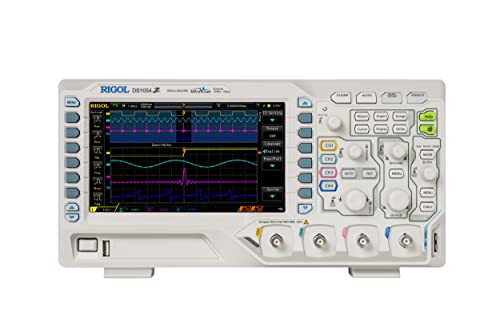
In the eternal DS1054Z-versus-SDS1202X-E debate, neither scope is objectively better. They are optimized for different priorities. The DS1054Z gives you 4 channels and 50MHz. The SDS1202X-E gives you 2 channels and 200MHz. If you are debugging multi-signal embedded systems, the DS1054Z's channels win. If you are working with audio circuits, RF, or high-speed digital signals, the SDS1202X-E's bandwidth wins. Understanding which priority matches your work is the key to making the right choice.
This review will help you determine whether 200MHz bandwidth is a genuine need for your projects or a specification that looks good on paper but does not change what you can actually accomplish.
◆ Pros & Cons
Pros
- 200MHz bandwidth — 4x the stock DS1054Z at nearly the same price
- 14Mpt memory depth is excellent for capturing long waveforms
- Protocol decoding includes CAN and LIN — Rigol charges extra for these
- SPL (Siglent Programming Language) for scripting and automation
- Serial decode is free, not locked behind a paid license
Cons
- Only 2 channels — the fundamental tradeoff versus the DS1054Z
- Interface is less intuitive than Rigol's — steeper learning curve
- Smaller community means fewer tutorials and answered questions online
- No touchscreen — button-heavy navigation
- No function generator
You'll Also Need
Common accessories that pair well with this scope.
Hantek PP-200 200MHz Probe Set (2x)
Replacement 200MHz passive probes compatible with most bench scopes
Buy on Amazon · $18 →DEVMO USB Logic Analyzer 8-Channel
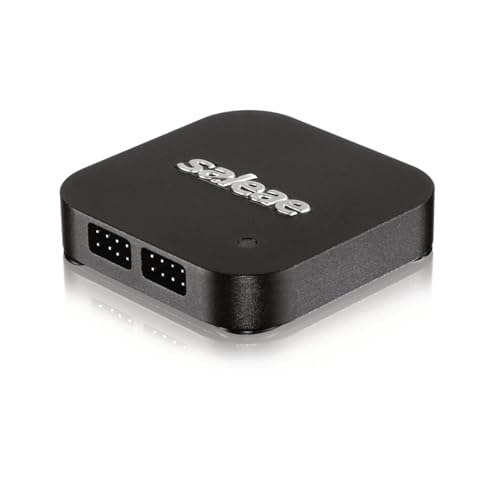
8-channel logic analyzer for debugging digital signals and protocols
Buy on Amazon · $14 →Coaxial BNC Cable 50Ω (3-pack)
BNC to BNC 50Ω coax cables for signal connections
Buy on Amazon · $12 →◆ More Bench Gear We've Reviewed
Beyond the scope: other instruments hobbyists keep on the bench.
See signals in the frequency domain
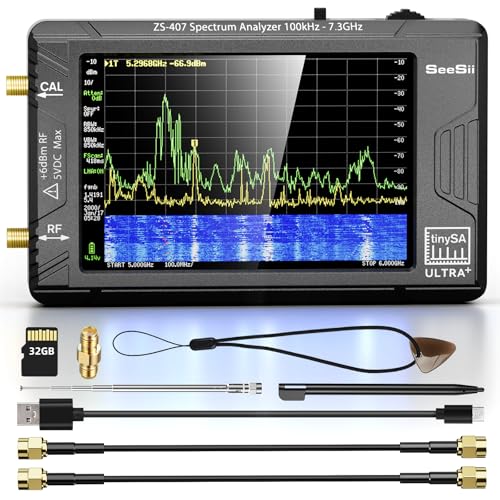
TinySA Ultra
$260.9
See all see signals in the frequency domain picks →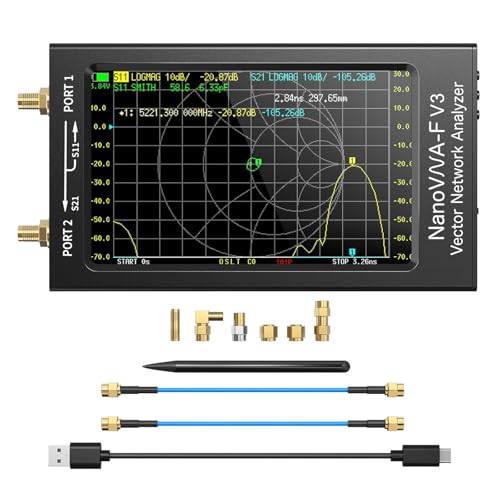
Sweep RF and antenna performance
NanoVNA-F V3
$299.99
See all sweep rf and antenna performance picks →Siglent SDS1202X-E
Prices may change · Free shipping with Prime
◆ Design & Build Quality
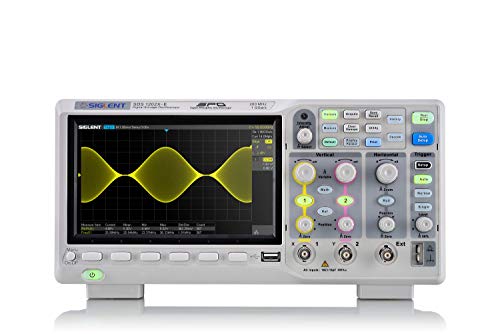
The Siglent SDS1202X-E measures 312 x 151 x 127mm and weighs 3.3kg, placing it in the same size class as the Rigol DS1054Z. The form factor is standard benchtop: display on the left, controls on the right, BNC inputs on the front panel. It sits on a bench with the same presence as a Rigol or Keysight instrument in the same class.
Build quality is solid. The plastic enclosure feels well-assembled with no creaking or flex. Siglent has built a reputation for reliable hardware, and the SDS1202X-E reflects that. The front panel layout is clean and organized, with dedicated sections for vertical, horizontal, and trigger controls. The knobs have a smooth, slightly weighted feel that is pleasant to use for extended sessions.
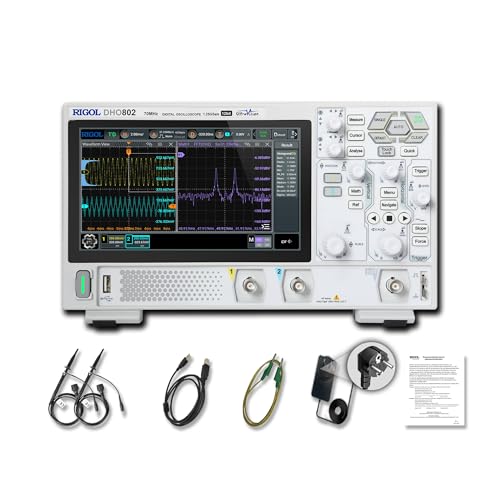
The 7-inch TFT LCD is a standard non-touch panel. Like the DS1054Z's display, it provides adequate brightness and clarity for bench work but lacks the viewing angles and color accuracy of IPS panels found on the Rigol DHO924S or Siglent's own SDS2104X Plus. For normal use where you are seated in front of the scope, the display is perfectly functional.
There is no touchscreen. Navigation is entirely through physical buttons and soft keys along the display. Siglent's menu system is functional but has a steeper learning curve than Rigol's. The menu structure is deeper and the button assignments are less intuitive for first-time users. After a week of regular use, the interface becomes comfortable, but the initial learning period is longer than with a Rigol scope.
The two BNC channel inputs are on the front panel. Having only 2 channels means the front panel is less crowded than a 4-channel scope, and the reduced connector density gives a cleaner appearance. The included probes are good quality for stock probes — Siglent's standard probes are competitive with Rigol's.
The fan noise is present but moderate. In a quiet room, you will hear it. In a typical workshop or lab setting, it blends into the background. This is standard for benchtop scopes at this price.
◆ Performance & Specifications Deep Dive
The SDS1202X-E provides 200MHz bandwidth at 1GSa/s across 2 channels, with 14Mpt memory depth. The 200MHz bandwidth is the defining specification and the primary reason to choose this scope over the DS1054Z.
200MHz means the scope can accurately display signals with frequency content up to 200MHz, with the -3dB attenuation point at that frequency. In practice, signals up to about 150MHz display with good fidelity, and signals approaching 200MHz show increasing attenuation. This bandwidth opens up several use cases that are impractical on a 50MHz scope:
SPI at 20-50MHz clock rates: Many modern microcontrollers run SPI well above the 10MHz range that a 50MHz scope handles comfortably. The SDS1202X-E can display SPI clock signals at 20MHz, 33MHz, and even 50MHz with visible edge detail, though at the upper end you are approaching the bandwidth limit. The DS1054Z at 50MHz (or 100MHz hacked) begins to struggle with SPI above 15-20MHz.
RF oscillator verification: Crystal oscillators, VCOs, and other RF sources in the HF and low VHF range are viewable. You can verify that a 100MHz oscillator is running and examine its output waveform shape. The DS1054Z cannot do this at stock bandwidth.
Signal integrity analysis: Rise time measurements on fast digital signals require bandwidth significantly above the signal frequency. A 10ns rise time requires approximately 35MHz of measurement bandwidth. A 5ns rise time requires 70MHz. A 3ns rise time requires 117MHz. The SDS1202X-E's 200MHz bandwidth provides meaningful rise time measurement capability that the DS1054Z's 50MHz cannot match.
The 1GSa/s sample rate provides 5x oversampling at 200MHz. This is the minimum for reasonable waveform display at the bandwidth limit. For signals below 100MHz, the oversampling improves to 10x and beyond, providing clean, accurate waveform displays.
The 14Mpt memory depth is slightly better than the DS1054Z's 12Mpt. At 1GSa/s, 14 million points give you 14 milliseconds of capture at full sample rate. This is ample for capturing complete serial transactions, analyzing communication sequences, and performing zoom-and-scroll waveform analysis.
The trigger system includes Edge, Pulse, Slope, Video, Window, Interval, Dropout, Runt, and Pattern triggers. This is a comprehensive set, though it lacks some of the more exotic triggers found on the DS1054Z (Duration, Timeout, Delay, Setup/Hold, Nth Edge). For most practical use cases, the SDS1202X-E's trigger set is sufficient. The missing triggers matter primarily for advanced digital timing analysis.
◆ Software & User Experience
Siglent's user interface has a learning curve that is noticeably steeper than Rigol's. The menu structure is logically organized but uses different conventions than what Rigol and Keysight users expect. Vertical, horizontal, and trigger settings are accessed through dedicated buttons, but the deeper configuration menus require navigating through layers that are not always intuitive.
The initial setup period is typically about a week of regular use before you are comfortable with common operations. First-time oscilloscope users may find this frustrating compared to the DS1054Z, whose interface is more immediately understandable. However, once you have learned the interface, it is efficient for daily use.
Automatic measurements are comprehensive, covering standard voltage, time, and derived parameters. The scope supports simultaneous display of multiple measurements, and measurement statistics (mean, min, max, count) are available. The measurement system is functionally equivalent to the DS1054Z's.
The SPL (Siglent Programming Language) is a distinguishing feature. SPL allows you to write scripts that automate scope operations, capture sequences of measurements, and create custom test procedures. For repetitive testing tasks — production verification, automated characterization, or systematic signal analysis — SPL provides genuine productivity gains. The DS1054Z supports SCPI commands for remote control, but SPL offers a higher-level programming environment that is more accessible for creating complex automation scripts.
Siglent's EasyScope PC software provides remote control, waveform capture, and data export over USB or LAN. The software is functional and adequately maintained. It is not as polished as Rigol's UltraScope, but it handles the essential tasks of remote control and data transfer.
The community factor is a real consideration. Siglent's user community is smaller than Rigol's. You will find fewer YouTube tutorials, fewer forum threads, and fewer answered questions specifically about the SDS1202X-E. When you have a question about Rigol's DS1054Z, you can find the answer in minutes. With the SDS1202X-E, you may need to search longer or consult Siglent's documentation directly. This gap is closing as Siglent's market share grows, but it remains noticeable in 2026.
Firmware updates from Siglent are regular and meaningful. The company has a good track record of adding features and fixing issues through firmware updates, and the SDS1202X-E has benefited from several updates since its release. This commitment to ongoing support is a positive indicator for long-term ownership.
◆ Protocol Decoding & Advanced Features
The SDS1202X-E includes protocol decoding for SPI, I2C, UART, CAN, and LIN at no additional cost. The inclusion of CAN and LIN decoding without license fees is a significant differentiator from Rigol, which charges separately for automotive protocol support on most models.
SPI decoding on a 2-channel scope requires choosing which two SPI lines to monitor. You can view clock and MOSI, clock and MISO, or MOSI and MISO. You cannot see all four SPI lines (CLK, MOSI, MISO, CS) simultaneously. This is a practical limitation that 4-channel scopes like the DS1054Z do not have. For simple SPI communication where you know the chip-select timing, 2-channel SPI decoding is workable. For multi-device SPI buses or unfamiliar communication patterns, the inability to see chip-select simultaneously is a real handicap.
I2C decoding works perfectly on 2 channels because I2C uses only SDA and SCL. The decoder displays start/stop conditions, address bytes, data bytes, and acknowledge status. I2C decoding is the protocol that works best on a 2-channel scope, and the SDS1202X-E handles it well.
CAN decoding displays CAN frames with identifier, data field, and CRC information. This is a genuinely valuable inclusion for anyone working with automotive electronics, industrial CAN networks, or CAN-based sensor systems. On Rigol scopes, CAN decoding requires a paid license that typically costs $100-200. Getting it free on the SDS1202X-E represents real savings.
LIN decoding displays LIN frames with identifier, data, and checksum information. Like CAN, this is an automotive protocol that Rigol charges extra for. The SDS1202X-E's free LIN decoding is valuable for automotive electronics work.
The trigger types are comprehensive for the price range. Runt triggering catches pulses that do not reach expected amplitude — useful for signal integrity debugging. Dropout triggering captures signal loss events. Window triggering captures signals entering or exiting a voltage range. These triggers are valuable for diagnosing intermittent signal problems.
The scope does not include a function generator. If you need a built-in signal source, the Rigol DHO924S (around $899) and DS1104Z-S Plus ($549) include them. The SDS1202X-E's lack of a function generator is a minor inconvenience if you do not already own one.
The scope supports pass/fail mask testing, which allows you to define boundaries around a reference waveform and count violations. This is useful for production testing and long-term signal monitoring. The waveform recording function captures sequences of triggered events for later analysis.
◆ Real-World Use Cases
For audio electronics, the SDS1202X-E is excellent. Audio frequencies are trivially within bandwidth, and the 200MHz headroom means you will never encounter bandwidth limitations when working with audio signals. The 2-channel configuration is natural for audio work: input on Channel 1, output on Channel 2. Measuring gain, checking distortion, analyzing filter responses, and verifying amplifier stability are all straightforward. The FFT function provides basic spectrum analysis of audio signals.
For RF and signal integrity work, the 200MHz bandwidth is the SDS1202X-E's primary advantage over the DS1054Z. Verifying crystal oscillators at common frequencies (10-50MHz), measuring rise times on fast digital signals, and characterizing filter responses in the HF range are all practical tasks. The SDS1202X-E can provide meaningful measurements on signals that the DS1054Z's 50MHz bandwidth simply cannot resolve.
For embedded development with I2C, the SDS1202X-E is highly capable. I2C uses only 2 lines, which is a perfect match for the 2-channel scope. The included protocol decoder works well, and the 14Mpt memory captures complete I2C transactions with room to spare. For I2C-heavy development work, the SDS1202X-E is arguably better than the DS1054Z because the extra bandwidth provides cleaner waveform display of the I2C signals.
For embedded development with SPI, the 2-channel limitation becomes apparent. SPI requires at least 3 lines to decode meaningfully (clock, data, chip-select), and ideally 4 (adding the second data line for bidirectional monitoring). With only 2 channels, you are limited to viewing 2 SPI lines at a time. For simple, single-device SPI communication, this is workable. For complex SPI debugging with multiple devices or unknown communication patterns, you will wish you had 4 channels.
For automotive electronics, the free CAN and LIN decoding provides a significant advantage. Connecting to a CAN bus and viewing decoded frames is straightforward. For basic CAN bus monitoring and troubleshooting, the SDS1202X-E is a cost-effective tool. The limitation is that automotive systems often have multiple signals you want to correlate — CAN bus activity with sensor outputs, for example — and 2 channels constrain how many signals you can view simultaneously.
For power supply work, the 200MHz bandwidth provides better visibility of switching edges and high-frequency ripple than the DS1054Z's 50MHz. Switching power supplies operating at 500kHz-2MHz produce harmonics well into the tens of MHz range, and the SDS1202X-E can display these with reasonable fidelity. The 2-channel limitation means you choose between monitoring input and output, output and switching node, or other combinations — but you cannot see all relevant signals at once.
◆ Who Should Buy This (And Who Shouldn't)
Buy the Siglent SDS1202X-E if your work primarily involves signals above 50MHz. Audio circuits with high-bandwidth op-amps, RF oscillators in the HF range, signal integrity analysis on fast digital signals, and characterization work that requires accurate rise time measurements all benefit from 200MHz bandwidth. If a 50MHz scope would leave you wondering what the signal really looks like, the SDS1202X-E resolves that uncertainty.
Buy it if CAN or LIN protocol decoding is important to your work and you want to avoid paying license fees. The SDS1202X-E includes CAN and LIN decoding at no extra cost, while Rigol charges separately for these protocols on the DS1054Z. If you are working with automotive electronics or industrial CAN networks, this represents genuine savings.
Buy it if you primarily work with I2C or single-signal measurements where 2 channels are sufficient. I2C is a perfect match for a 2-channel scope, and the extra bandwidth provides cleaner waveform display than the DS1054Z can offer.
Do not buy the SDS1202X-E if you regularly need to view 3 or more signals simultaneously. SPI debugging, multi-signal timing analysis, and any scenario requiring simultaneous monitoring of more than 2 signals will be significantly more frustrating on a 2-channel scope. The DS1054Z's 4 channels are worth the bandwidth trade-off for embedded development work.
Do not buy it if you are a beginner choosing your first oscilloscope. The smaller community and steeper learning curve mean you will spend more time figuring things out on your own. The DS1054Z's massive tutorial ecosystem makes the initial learning process much smoother.
Do not buy it if your budget reaches the Rigol DHO924S tier and you need 4 channels. Around $899, the DHO924S provides 250MHz bandwidth (more than the SDS1202X-E), 4 channels, 50Mpt memory, a touchscreen, WiFi, and CAN/LIN decoding. It combines the bandwidth advantage of the SDS1202X-E with the channel count of the DS1054Z, but at a much higher price.
◆ Alternatives Worth Considering
The Rigol DS1054Z at $349 is the most direct alternative and the core of the bandwidth-versus-channels debate. It costs $30 less and provides 4 channels, 12Mpt memory, and comprehensive protocol decoding, but only 50MHz bandwidth (hackable to 100MHz). For embedded development where multiple signals need simultaneous monitoring, the DS1054Z's channels are more valuable than the SDS1202X-E's bandwidth. For single-channel or dual-channel work at higher frequencies, the SDS1202X-E wins.
The Rigol DHO924S around $899 is the scope that renders the DS1054Z-vs-SDS1202X-E debate largely moot. It provides 250MHz bandwidth and 4 channels, eliminating the need to choose between the two. Add a touchscreen, WiFi, 50Mpt memory, a function generator, and CAN/LIN decoding, and the DHO924S becomes the stronger all-around instrument if the higher price fits your budget.
The Siglent SDS1104X-U at $419 is Siglent's own 4-channel answer. It provides 100MHz bandwidth with 4 channels, 14Mpt memory, and free CAN/LIN decoding. If you want Siglent's build quality and free automotive protocol support with 4 channels, the SDS1104X-U bridges the gap between the SDS1202X-E and the Rigol alternatives.
The Siglent SDS1204X-E at $775 is the 4-channel version of the SDS1202X-E. Same 200MHz bandwidth, same 14Mpt memory, same free CAN/LIN — but with 4 channels. The $396 premium over the SDS1202X-E is steep, and the Rigol DHO924S around $899 offers 250MHz with 4 channels for only about $125 more. The SDS1204X-E is difficult to recommend at its current price point.
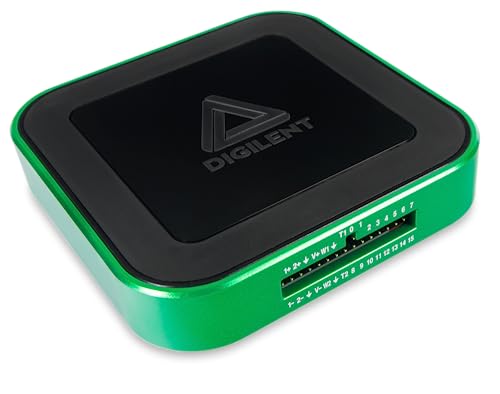
The Digilent Analog Discovery 3 at $379 is a USB multi-instrument that complements rather than replaces the SDS1202X-E. Its 16-channel logic analyzer provides the multi-signal visibility that the 2-channel SDS1202X-E lacks for digital debugging. Many users own both a Siglent benchtop scope for analog work and an Analog Discovery for digital protocol analysis.
Our Verdict
The Siglent SDS1202X-E is the DS1054Z's biggest competitor, and it wins on raw specs: 200MHz bandwidth, 14Mpt memory, and protocol decoding that includes CAN and LIN without paying for licenses. The catch is you only get 2 channels, and that trade-off matters more than it sounds. When you're debugging SPI with clock, data, and chip-select lines all running, or trying to correlate an analog signal with a digital trigger, you'll wish you had 4 channels. If you work primarily with audio circuits, RF signals, or single-channel measurements, the 200MHz bandwidth is genuinely useful and this scope makes complete sense. For general embedded debugging with multiple signals, I'd take the DS1054Z's 4 channels over the extra bandwidth.
Siglent SDS1202X-E
$379
Prices may change · Free shipping with Prime
◆ Full Specifications
| Full Specifications | |
|---|---|
| Bandwidth | 200MHz |
| Sample Rate | 1GSa/s |
| Channels | 2 |
| Memory Depth | 14 Mpts |
| Display Size | 7" |
| Display Type | TFT LCD |
| Form Factor | Benchtop |
| Weight | 3.3kg |
| Dimensions | 312 x 151 x 127 mm |
| Protocol Decoder | SPI, I2C, UART, CAN, LIN |
| Function Generator | No |
| WiFi | No |
| Battery Option | No |
| Trigger Types | Edge, Pulse, Slope, Video, Window, Interval, Dropout, Runt, Pattern |
◆ Frequently Asked Questions
Should I buy the SDS1202X-E or the Rigol DS1054Z?
Is 200MHz bandwidth necessary for hobbyist work?
Are only 2 channels a real limitation?
Is CAN/LIN decoding really free on the SDS1202X-E?
How does the learning curve compare to Rigol?
Does the SDS1202X-E have a function generator?
Can I use SPL scripting for automated testing?
How does the SDS1202X-E compare to the DHO924S?
◆ Related Buying Guides
Compare With Similar Scopes
◆ Head-to-Head Comparisons
Siglent SDS1202X-E
$379
Prices may change · Free shipping with Prime