Rigol
Rigol DHO804 Review
Documentation-based review, without independent bench testing. Scores are editorial; prices are reference values. Confirm the seller’s current offer.
HobbyistScope editorial team
$459
◆ At a Glance
◆ Best For
◆ Overview
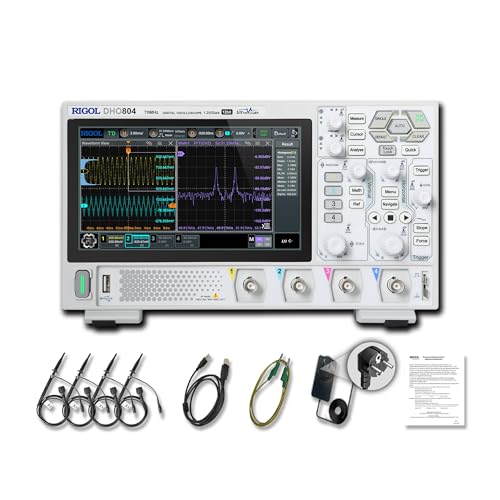
The Rigol DHO804 is a four-channel, 70 MHz oscilloscope aimed at a compact low-voltage electronics bench. Its attraction is the combination of a nominal 12-bit converter, touchscreen controls and four simultaneous analog inputs. That makes it worth comparing with the Siglent SDS804X HD and older DS1054Z when choosing a first general-purpose scope.
The important buying question is whether its supported acquisition modes and options fit your signals. A headline maximum does not apply to every channel configuration, and a modern display does not establish superior measurement accuracy or faster learning. Budget for probes and required options as well as the instrument.
This is a documentary review of manufacturer specifications and selection tradeoffs, not a hands-on test. HobbyistScope has no physical test log, measured noise comparison, acoustic measurement or long-term reliability study for this review. Current product cards and seller terms establish the offered package and price; specifications below do not promise current availability.
◆ Pros & Cons
Pros
- 4 analog channels for simultaneous signal comparison
- 70 MHz nominal bandwidth; 25 Mpts acquisition memory
- Protocol decoding: SPI, I2C, UART
Cons
- 1.25 GSa/s single-channel, 625 MSa/s dual-channel, 312.5 MSa/s full-channel; 25 Mpts single-channel, 10 Mpts dual-channel, 5 Mpts full-channel. Maximum rate and depth depend on active channel configuration.
- Specification-based assessment; no hands-on measurement record is documented
Core bench / four jobs
Build the signal path, not a pile of gear
Optional candidates for observing, probing, checking, and generating. Check your supplied equipment before choosing any additions.
Check the probes supplied with your exact package first. An extra probe pack is an option for a documented need, not a requirement for every buyer. Confirm the exact model and measurement limits before choosing an accessory.
3 optional add-on candidates; one distinct job each
- 01See the signal
See the signal
Rigol DHO804
70 MHz · 4 channels · 25 Mpts
Selected scope - 02Reach the circuit
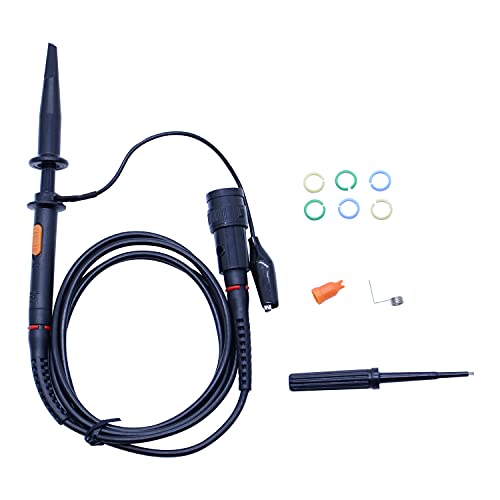
Reach the circuit
Hantek PP-250 (2-Pack)
250 MHz · 1X/10X switchable · 1.2 m lead
- 03Check voltage
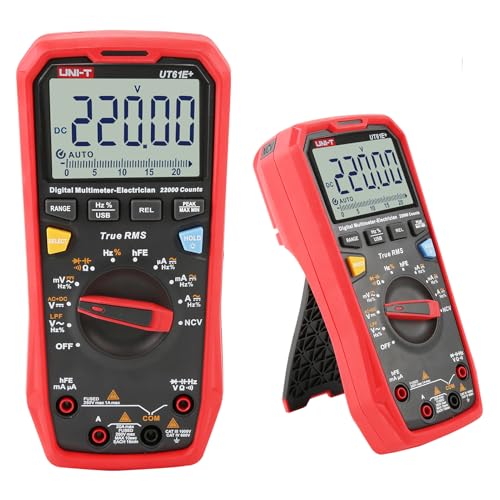
Check voltage
UNI-T UT61E+
true RMS · 22,000 count · capacitance · frequency
Purchase link withheld pending exact product verification.Read review - 04Create a test signal
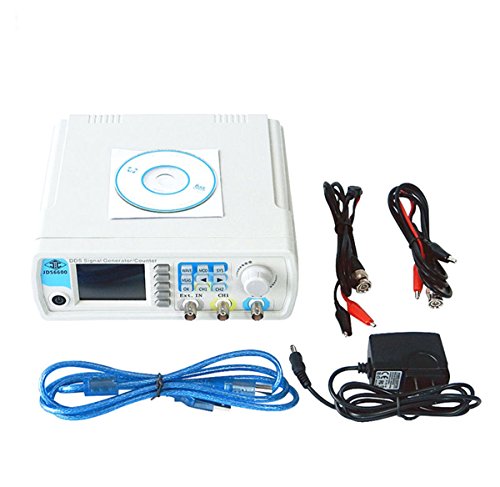
Create a test signal
JDS6600 60 MHz DDS Signal Generator
60 MHz · 2 channels · arbitrary waveform
Prices and availability can change. These are separate buying links, and each instrument uses its category-specific Amazon Associates tag.
Rigol DHO804
Prices may change · Confirm price, shipping, and returns with the seller
◆ Design, dimensions and controls
The official DHO800 data sheet specifies a chassis approximately 265.35 × 161.75 × 77.38 mm and 1.78 kg. The seven-inch capacitive touchscreen has a 1024 × 600 display. Those documented dimensions help estimate bench space; allow additional room for cables, cooling and probe access.
This review has not handled the instrument and does not rate case stiffness, knob feel, fan acoustics or touch responsiveness. Inspect the front-panel layout in a demonstration if those characteristics matter to the purchase. A published interface feature is evidence that a control exists, not that it is pleasant to use.
◆ Acquisition: check the active-channel configuration
Four inputs can display a supply rail, clock and two data/control signals in one acquisition. That shared time reference is useful for investigating whether a supply event precedes a communication failure. It does not remove the need to check sample-rate sharing.
The manufacturer’s DHO804 table gives maxima of 1.25 GSa/s with one channel, 625 MSa/s with two and 312.5 MSa/s with all four. Its corresponding memory maxima are 25 Mpts, 10 Mpts and 5 Mpts under the stated channel conditions. Consult the channel-group footnotes and selected operating mode in the manual. Do not assume four full-rate 25 Mpt records merely because the scope has four connectors.
For ordinary stored records, duration is points divided by actual sample rate. Reducing the rate can extend the time window while reducing detail. A suitable trigger may be more useful for a rare glitch than simply selecting the longest record.
◆ Bandwidth and vertical resolution in context
Rated bandwidth is an analog response specification, not a guarantee of flat amplitude response up to that number. At a scope’s −3 dB bandwidth, a sine wave is attenuated substantially. Leave margin for amplitude work, and use the probe-and-scope rise time when evaluating fast digital edges. The clock frequency of a development board does not fully describe the edge speed at its pins.
Nominal 12-bit conversion provides more quantization levels than an 8-bit converter. Effective resolution, noise, gain accuracy and probe loading still depend on settings and conditions. This review supplies no comparative measurements proving the DHO804 quieter or more accurate than a competitor. Choose from specified accuracy at the settings you need, rather than interpreting ADC bits as a complete performance score.
◆ Interface, computer control and options
Touch controls and physical controls provide two ways to navigate settings. Compare channel setup, cursors, triggering and decoder configuration in the manual or a demonstration. No timed usability study is attached here; the review does not claim that the interface learns faster or runs smoother than Siglent’s.
The DHO800 sheet documents wired interfaces including USB, LAN and HDMI. This review does not claim built-in Wi-Fi. Check the exact host application, supported operating system and control commands before relying on computer integration.
The DHO800 documentation lists CAN decoding as standard alongside common embedded decoders. Verify the exact trigger behavior, firmware and option configuration for each required protocol; do not assume CAN requires an extra license on the DHO804. Decoder availability, protocol triggering and accessory inclusion are separate questions. The DHO804 is not presented as including the DHO900 S-model generator. Do not assume a series comparison table includes every option in a base order.
◆ Suitable projects and important limits
For low-voltage embedded work, four inputs let you compare SPI clock, chip select, MOSI and MISO. For audio or an amplifier, they can compare input, output and internal nodes. A logic analyzer can complement the scope when a wider bus or long digital history is the main requirement. These are proposed workflows, not measurements performed for this review.
A 70 MHz instrument can be useful for many slower circuits, but suitability depends on the actual waveform and required accuracy. It is not a general RF instrument or a substitute for a multimeter in every task. Conventional scope channels share a reference and are not independently isolated inputs. Never defeat protective earth or connect a standard probe ground to a live mains node. Input limits, measurement category and probe ratings must all fit the circuit. USB-C power or a battery pack does not establish isolation. Keep initial learning on known low-voltage signals.
◆ Who should consider it
Consider the DHO804 when four analog channels, a compact chassis and touchscreen operation match the work, and the complete current package fits the budget. Compare its reduced all-channel sampling rate with the signals you actually need to see together.
Choose another configuration when two channels are enough and budget dominates, when a supported higher bandwidth is required, or when your job needs isolated inputs. Buy the stock supported capability. An unofficial firmware change is not a guaranteed upgrade, a calibration certificate or a substitute for the correct safety-rated instrument.
◆ Alternatives and source basis
Compare the SDS804X HD for its documented acquisition modes and decoder package. Compare the DS1054Z when an older conventional interface and its current total price make sense. Consider the DHO924S only when its additional supported bandwidth or generator capability solves a known requirement. Do not rank these choices using stale price gaps or presumed analog superiority.
Primary reference: [Rigol DHO800 manufacturer data sheet](https://www.rigol.com/dam/global/downloads/brochures/en/data-sheet/oscilloscopes/DHO800_DataSheet_EN.pdf). This establishes the rated configuration and physical specifications cited above. It does not establish independent performance, user comfort or long-term reliability. Confirm the exact included probes, firmware and options before ordering.
◆ Verified manufacturer configuration
[Official DHO800 data sheet](https://www.rigol.com/dam/global/downloads/brochures/en/data-sheet/oscilloscopes/DHO800_DataSheet_EN.pdf), checked November 1, 2026. Dimensions: 265.35 x 161.75 x 77.38 mm; package-excluded/net weight: 1.78 kg. 1.25 GSa/s single-channel, 625 MSa/s dual-channel, 312.5 MSa/s full-channel; 25 Mpts single-channel, 10 Mpts dual-channel, 5 Mpts full-channel. Maximum rate and depth depend on active channel configuration. This is documentary evidence, not a measured verification.
Our Verdict
The Rigol DHO804 pairs 70 MHz nominal bandwidth with 4 analog channels and 25 Mpts acquisition memory. Four analog channels let you compare multiple rails or related signals in one capture. Protocol decoding can help interpret supported serial buses; check the exact included decoder options. Choose capture duration and sample rate together; maximum memory and sample rate may depend on the enabled channel count. This recommendation is based on listed specifications, without documented hands-on performance testing. The DHO804 is a useful comparison point for a first four-channel bench scope when 70 MHz bandwidth is enough and 12-bit acquisition is a priority; confirm sample-rate sharing before planning multi-channel captures. Published acquisition limits: 1.25 GSa/s single-channel, 625 MSa/s dual-channel, 312.5 MSa/s full-channel; 25 Mpts single-channel, 10 Mpts dual-channel, 5 Mpts full-channel. Maximum rate and depth depend on active channel configuration.
Rigol DHO804
$459
Prices may change · Confirm price, shipping, and returns with the seller
◆ Full Specifications
| Full Specifications | |
|---|---|
| Bandwidth | 70MHz |
| Sample Rate | 1.25GSa/s |
| Channels | 4 |
| Memory Depth | 25 Mpts |
| Display Size | 7" |
| Display Type | Capacitive Touchscreen |
| Form Factor | Benchtop |
| Weight | 1.78kg |
| Dimensions | 265.35 x 161.75 x 77.38 mm |
| Protocol Decoder | SPI, I2C, UART, CAN |
| Function Generator | No |
| WiFi | No |
| Battery Option | No |
| Trigger Types | Edge, Pulse, Slope, Video, Pattern, Duration, Timeout, Runt, Window, Delay, Setup/Hold, Nth Edge |
◆ Frequently Asked Questions
Is the DHO804 a four-channel scope?
Is it the same size as a large conventional bench scope?
Does it have built-in Wi-Fi?
Is 70 MHz enough for Arduino work?
Does 12-bit conversion prove lower noise than Siglent?
Can I assume every decoder and a generator are included?
Should I buy it for an unofficial unlock?
◆ Related Buying Guides
Compare With Similar Scopes
◆ Head-to-Head Comparisons
Rigol DHO804
$459
Prices may change · Confirm price, shipping, and returns with the seller