◆ At a Glance
◆ Best For
◆ Overview
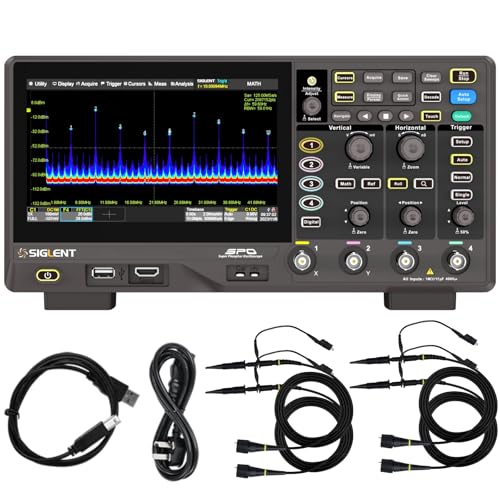
The Siglent SDS804X HD is the scope the Reddit electronics community refuses to stop arguing about. At $461 it offers 70 MHz bandwidth, 4 channels, a 12-bit ADC, 2 GSa/s sample rate, 50 Mpt memory, and free CAN/LIN decoding. The headline bandwidth looks modest, but the rest of the package is strong for a sub-$500 scope.
The Siglent's case rests on three arguments that the spec sheet doesn't fully capture. First, the analog front-end. Siglent's LeCroy heritage in high-end oscilloscope design is most visible in the noise floor and signal fidelity of their lower-end products. Multiple EEVblog teardowns and head-to-head bench tests consistently show the SDS804X HD with a cleaner ADC implementation than equivalent-priced Rigol scopes. For precision analog work, the difference is measurable, not just marketing copy.
Second, the bandwidth unlock. Siglent sells the SDS804X HD with software-locked bandwidth — the underlying hardware supports 200 MHz, and a software license unlocks it. Aftermarket licenses are available, and the community has documented unofficial unlocks. This means the SDS804X HD can grow into a 200 MHz scope without replacing the instrument.
Third, Siglent's protocol-decoder generosity. Where Rigol meters out decoders by SKU tier, Siglent has historically included CAN and LIN for free on their HD-series scopes. For automotive hobbyists or anyone working with industrial protocols, the cost-of-ownership math favors Siglent significantly.
The DHO924S still wins on stock bandwidth and includes a function generator, but it now sits in a much higher price tier. For users who value measurement quality, future bandwidth headroom via the unlock, and free protocol decoders, the SDS804X HD is a legitimately strong under-$500 choice.
◆ Pros & Cons
Pros
- 12-bit ADC with what Reddit considers a cleaner analog front-end than Rigol — LeCroy heritage shows
- 2GSa/s sample rate is genuinely faster than the DHO804's 1.25GSa/s
- 50Mpt memory depth matches the DHO924S and doubles the DHO804
- CAN and LIN decoding included free — Siglent's standard generosity on protocols
- 70MHz bandwidth is unlockable to 200MHz via software license — massive upgrade path
- 7-inch capacitive touchscreen with responsive multi-touch gestures
Cons
- 70MHz stock bandwidth is limiting — you're paying for the upgrade path, not the base spec
- No built-in function generator (optional add-on)
- Siglent's community is smaller than Rigol's — fewer tutorials and forum answers
- The DHO804 is the closest Rigol rival near this price
Core bench / four jobs
Build the signal path, not a pile of gear
A four-instrument path for observing, probing, checking, and generating without buying overlapping tools.
3 separate add-ons; one distinct job each
- 01See the signal
See the signal
Siglent SDS804X HD
70 MHz · 4 channels · 50 Mpts
Selected scope - 02Reach the circuit
Reach the circuit
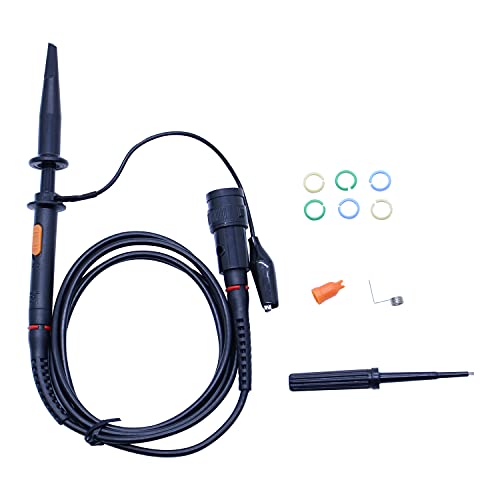
Hantek PP-250 (2-Pack)
250 MHz · 1X/10X switchable · 1.2 m lead
- 03Check voltage
Check voltage
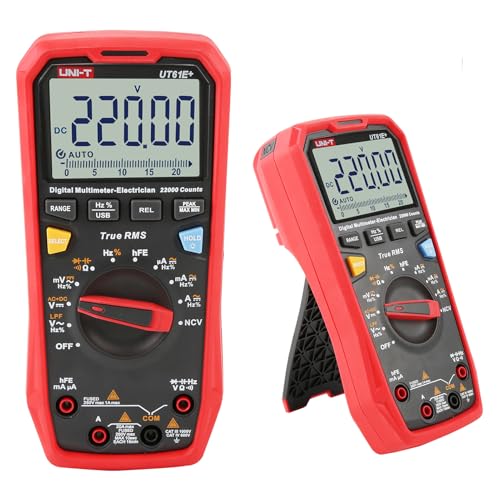
UNI-T UT61E+
true RMS · 22,000 count · capacitance · frequency
- 04Create a test signal
Create a test signal
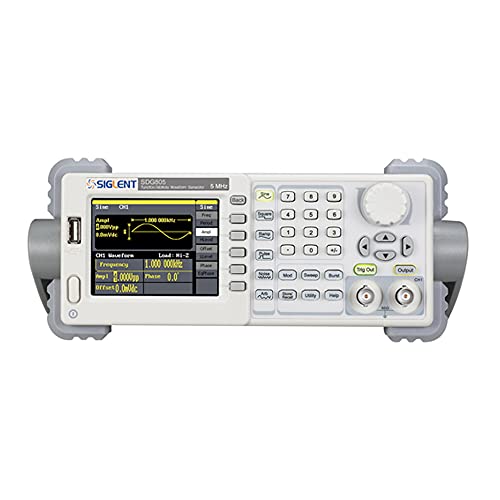
Siglent SDG1032X
30 MHz · 2 channels · IQ baseband · arbitrary waveform
Prices and availability can change. These are separate buying links, and each instrument uses its category-specific Amazon Associates tag.
Siglent SDS804X HD
Prices may change · Free shipping with Prime
◆ Design & Build Quality
The SDS804X HD measures 312 x 151 x 133 mm and weighs 2.6 kg. The form factor is conventional Siglent — clean industrial design with the 7-inch IPS touchscreen on the left, physical controls on the right, four BNC inputs across the front panel, USB and LAN ports on the rear. The chassis feels solid; Siglent's build quality has consistently been one of their strengths.
The 7-inch IPS touchscreen is excellent. Wide viewing angles, accurate colors, responsive multi-touch input. The 1024x600 resolution provides crisp text and waveform rendering. Compared to the DHO platform's IPS panels, the Siglent display is essentially equivalent in quality, with similar response time and visual clarity.
The physical knobs surrounding the display follow standard oscilloscope conventions — vertical scale and position per channel, horizontal scale and position, trigger level. Knob feel is good, with smooth rotation and clear detents. The button layout is logical, with dedicated buttons for the most common operations (Run/Stop, Autoset, Single, Default, Save/Recall).
Where the SDS804X HD diverges from the DHO platform is in physical heft. The 2.6 kg weight versus the DHO900's 3.8 kg makes the Siglent noticeably lighter and easier to reposition. The form factor is more conventional benchtop than the DHO800's compact chassis, but it's still smaller than the larger DHO900 series.
The included probes are decent — standard Siglent passive probes rated for 200 MHz, which gives you headroom for the bandwidth unlock if you choose to enable it. Probe compensation adjustment works smoothly with the scope's built-in test signal.
Fan noise is present but subtle. Several SDS800X HD owners on EEVblog have described the fan as quieter than the equivalent Rigol DHO units, though both are audible in silent environments. The fan ramps based on temperature, so during light use the noise is minimal.
The analog front-end is where Siglent's build quality genuinely shows through. The internal layout, shielding, and power distribution all reflect Siglent's higher-end engineering. The 12-bit ADC implementation has lower input noise than the equivalent Rigol implementation in independent measurements — this is the scope's strongest argument.
◆ Performance & Specifications Deep Dive
The 70 MHz stock bandwidth is the SDS804X HD's most controversial specification. At face value, it looks limiting next to the DHO924S's 250 MHz. The full story requires understanding Siglent's bandwidth licensing model. The hardware supports up to 200 MHz, and Siglent sells software licenses to unlock the additional bandwidth. The base SDS804X HD provides 70 MHz; with an unlock license, the same hardware delivers 200 MHz performance.
This matters because it changes the buying decision from "buy enough bandwidth now" to "buy enough bandwidth when I need it." For users who currently work within 70 MHz signal frequencies, the unlocked bandwidth is a future option, not an immediate requirement. When your needs grow, you upgrade the firmware, not the scope.
The 2 GSa/s sample rate is genuinely faster than the Rigol DHO platform's 1.25 GSa/s and matches scopes costing significantly more. At the unlocked 200 MHz bandwidth, 2 GSa/s provides 10x oversampling, which produces excellent waveform reconstruction. At 70 MHz stock, the oversampling is nearly 29x — more than sufficient for clean reconstruction.
The 50 Mpt memory depth matches the Rigol DHO924S and exceeds the DHO814's 25 Mpt. At full sample rate, 50 million points capture 25 milliseconds of continuous signal. For extended protocol captures, longer sensor monitoring sessions, and any application requiring deep timeline analysis, the 50 Mpt memory provides genuine value.
The 12-bit ADC is the SDS804X HD's strongest technical argument. Siglent's implementation has been consistently praised for low noise floor and clean signal capture. In bench-test comparisons on EEVblog, the SDS804X HD has shown measurably lower input-referred noise than the Rigol DHO platform — typically by 1-2 dB at equivalent vertical scales. This translates to genuinely visible detail improvement when measuring small signals or characterizing low-amplitude noise.
The trigger system covers Edge, Pulse, Slope, Video, Window, Interval, Dropout, Runt, and Pattern triggers. The Siglent trigger names some triggers differently than Rigol (Interval instead of Setup/Hold, Dropout instead of Timeout), but the underlying capabilities are similar. For complex digital debugging, the trigger flexibility is comprehensive.
The 4-channel capability is essential for protocol work. SPI debugging, multi-line I2C analysis, and any scenario requiring time-correlation between 3+ signals all benefit from 4 channels. The SDS804X HD matches the DHO924S, DHO914S, and DS1054Z in channel count.
◆ Software & User Experience
The SDS804X HD runs Siglent's modern UI, which is competitive with but stylistically different from Rigol's UltraVision II. Both are touchscreen-first interfaces with shallow menu structures, but Siglent's design has a slightly different visual language. After a brief learning curve, users coming from any modern touchscreen scope adapt within hours.
Menu navigation uses a combination of touch and physical controls. The home screen displays active waveforms with measurement overlays; tapping any waveform brings up channel options; tapping a measurement value brings up its configuration. The basic interaction model matches modern conventions across the industry.
Autoset works reliably. Connect a probe to an unknown signal, tap Autoset, and the scope configures itself within a second. Like all modern scopes, Autoset is occasionally suboptimal — it might choose a timebase that hides important detail or set vertical scale conservatively. But for the vast majority of signals, Autoset provides a usable starting point quickly.
Math functions include the standard set: addition, subtraction, multiplication, division, FFT with multiple window functions (Rectangle, Hanning, Hamming, Blackman), integration, differentiation, and digital filtering. The FFT implementation is competent for basic spectrum analysis, though dedicated spectrum analyzers remain better for serious spectral work.
Automatic measurements support multiple simultaneous measurements with statistics (min, max, mean, standard deviation). The measurement set is comprehensive, covering voltage parameters, time parameters, derived measurements, and signal quality metrics.
WiFi connectivity is included, with browser-based remote access. The remote interface mirrors the scope's display and accepts touch input, making remote operation genuinely usable. SCPI commands work over USB or network for Python and LabVIEW automation.
Where the Siglent UX shines is in protocol decoding configuration. The decoder setup is more streamlined than the Rigol equivalent, with sensible defaults for common protocols and clear visual feedback during configuration. For users who decode protocols regularly, the workflow advantage is real.
The Siglent community is smaller than Rigol's, which is the SDS804X HD's biggest non-technical drawback. There are fewer YouTube tutorials, fewer forum threads, fewer answered questions. Siglent's documentation is good and the user manual is comprehensive, but the institutional knowledge volume doesn't yet match what Rigol has accumulated over the DS1054Z's decade-long popularity.
◆ Protocol Decoding & Bandwidth Unlock
The SDS804X HD includes free protocol decoding for SPI, I2C, UART, CAN, and LIN. The free CAN and LIN inclusion is Siglent's consistent generosity advantage — Rigol charges separately for CAN/LIN on lower-tier models (DS1054Z) and includes only CAN on the DHO802/DHO814. For automotive hobbyists, CAN bus enthusiasts, and OBD-II tinkerers, the free LIN inclusion saves additional license fees.
SPI decoding leverages all 4 channels to capture clock, MOSI, MISO, and chip-select simultaneously. The decoded bytes display as hexadecimal overlays on the waveform traces. Decoded byte sequences can be exported for further analysis. SPI decoding works reliably at clock rates up to about 30 MHz at 70 MHz bandwidth; with the unlock, this extends to roughly 80 MHz SPI clocks.
I2C decoding shows start/stop conditions, 7-bit and 10-bit addresses, data bytes with read/write interpretation, and ACK/NACK status. Search functionality lets you filter for specific addresses, which is valuable in busy multi-device I2C scenarios.
UART and RS232 decoding handle standard and arbitrary baud rates. Both TX and RX can be decoded simultaneously on separate channels, useful for debugging command-response protocols.
CAN decoding handles standard and extended frame formats up to 1 Mbps. The decoder displays frame ID, data bytes, and control fields. Filter functionality lets you isolate specific message IDs in busy automotive networks.
LIN decoding handles standard LIN frames at typical automotive speeds. For users debugging body electronics in modern vehicles, this is the protocol that LIN is used for, and the free decoder is genuinely valuable.
The bandwidth unlock is the SDS804X HD's most distinctive feature. The hardware is identical between the 70 MHz and 200 MHz versions; only the firmware enforces the bandwidth limit. Siglent sells official upgrade licenses, and unofficial unlock procedures exist in the community (discussed widely on EEVblog). The official upgrade is the legitimate path; the unofficial path is documented but unsupported.
At 200 MHz unlocked, the SDS804X HD becomes a genuinely high-bandwidth scope at a price that's competitive with $700+ scopes. For users who need bandwidth above 100 MHz but do not want to jump to the premium DHO924S tier, the unlocked Siglent provides a useful growth path.
Math analysis features include Bode plot analysis (with external signal source), eye diagrams, and standard FFT spectrum analysis. The Bode plot capability is useful for filter design and feedback loop characterization. Eye diagrams support digital signal quality analysis for high-speed serial protocols.
◆ Real-World Use Cases
For precision analog work — audio circuit design, op-amp characterization, low-noise signal analysis, power supply ripple measurement — the SDS804X HD's clean 12-bit ADC is genuinely transformative. The lower noise floor reveals signal details that even the equivalent Rigol DHO scopes can't quite match. For users who care about measurement quality over raw bandwidth, this scope is the right choice.
For embedded protocol debugging, the SDS804X HD is competent and well-equipped. SPI debugging benefits from the full 4-channel capability and reliable decoder. I2C debugging works well with the free decoder and 50 Mpt memory for capturing extended transactions. UART analysis on separate channels for TX and RX simultaneously is straightforward. The bandwidth is adequate for most embedded clock rates.
For automotive and CAN bus work, the free LIN inclusion is the SDS804X HD's standout feature. The 50 Mpt memory captures extended automotive network sessions for diagnosing intermittent issues. The CAN/LIN filter capability isolates specific messages in busy networks. For automotive hobbyists, the Siglent provides genuine cost savings over scopes that charge separately for these decoders.
For educational use, the modern touchscreen interface lowers the learning curve. The 12-bit ADC reveals signal details that 8-bit scopes hide, which is pedagogically valuable. The 4-channel capability supports multi-signal experiments common in electronics courses. The smaller Siglent community is a minor drawback for student researchers seeking tutorials, but Siglent's official documentation is comprehensive.
For power supply design, the SDS804X HD's clean noise floor matters significantly. Switching power supply ripple analysis, output noise characterization, and load transient response measurement all benefit from the lower input-referred noise. For users serious about power supply work, the Siglent's measurement quality is the right choice.
For RF work at 70 MHz stock, the SDS804X HD is limited but adequate for HF work below 30 MHz. With the 200 MHz bandwidth unlock, the scope becomes capable for VHF and lower-frequency RF measurement. The bandwidth unlock pathway turns the SDS804X HD into a viable RF debugging tool, which the lower-tier Rigol DHO802/DHO814 scopes can never become.
For users who plan to grow into more demanding work, the bandwidth unlock is the SDS804X HD's most strategic feature. You buy 70 MHz today, unlock 200 MHz when you need it, and never have to buy a second scope.
◆ Who Should Buy This (And Who Shouldn't)
Buy the SDS804X HD if you value measurement quality over raw bandwidth specs. The clean Siglent 12-bit ADC, lower input-referred noise, and LeCroy heritage in analog front-end design produce genuinely better measurements than equivalent-priced Rigol scopes for analog and precision work. If your work involves small signals, audio, power supply analysis, or any signal where noise floor matters, the Siglent is the right choice.
Buy it if the bandwidth unlock pathway matters to you. The ability to upgrade to 200 MHz via software license without buying a new scope is a unique advantage. If you anticipate needing more bandwidth in the future but don't want to pay for it today, the SDS804X HD provides flexibility no Rigol product matches.
Buy it if you need free CAN and LIN decoding. For automotive hobbyists, OBD-II tinkerers, and anyone working with industrial protocols using CAN/LIN, the free inclusion saves significant license fees over Rigol's tiered approach.
Buy it if you trust Siglent's engineering for the analog front-end. The community consensus on EEVblog and Reddit is that Siglent's signal path is cleaner than equivalent Rigol implementations, particularly for low-amplitude signal work.
Do not buy the SDS804X HD if you need maximum stock bandwidth today. The DHO924S provides 250 MHz stock bandwidth and a built-in function generator, but it costs substantially more at current pricing.
Do not buy it if community documentation depth is critical. Siglent's community is smaller than Rigol's, with fewer tutorials and forum threads. For users who rely heavily on community support for learning, the Rigol ecosystem is more mature.
Do not buy it if you anticipate needing a built-in function generator. The SDS804X HD does not include one; you'll need a separate signal source.
◆ Alternatives Worth Considering
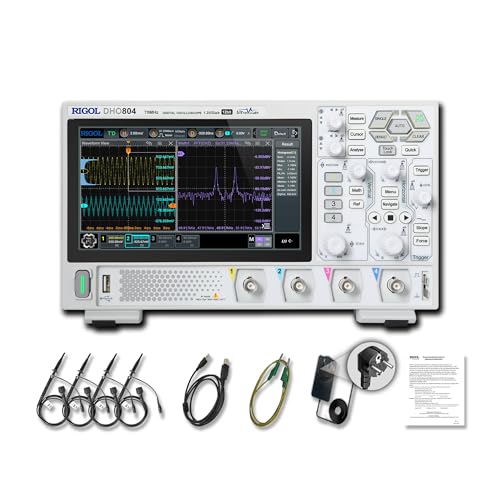
The Rigol DHO804 at $439 is the primary under-$500 alternative. It has a smoother Rigol touchscreen workflow, but the Siglent counters with a cleaner 12-bit front end, 50 Mpt memory, CAN/LIN included, and the bandwidth-unlock path.
The Rigol DHO924S around $899 is the premium stock-bandwidth alternative. It gives you 250 MHz and a built-in 25 MHz function generator, but it no longer competes as a same-price choice.
The Siglent SDS814X HD at $587 is the price-up sibling. 100 MHz stock bandwidth (versus 70 MHz on the 804X HD) with the same 12-bit ADC, 2 GSa/s sample rate, 50 Mpt memory, and CAN/LIN decoding. If 100 MHz stock fits your work better than 70 MHz, the SDS814X HD is worth the premium.
The Rigol DS1054Z at $349 is the legacy budget alternative. 50 MHz stock (100 MHz hacked), 4 channels, 8-bit ADC, 12 Mpt memory, and the largest oscilloscope community on the internet. The trade-offs are real — 8-bit ADC, smaller memory, dated interface — but $349 with decade-deep community support is the safest first-scope purchase available.
For users with bigger budgets considering the SDS804X HD, the Siglent SDS2104X Plus around $1,400 is the upgrade path within the Siglent line. 100 MHz bandwidth, 4 channels, 200 Mpt memory, and Siglent's full premium feature set. For serious analog work, the SDS2104X Plus is a meaningful step up.
Our Verdict
The Siglent SDS804X HD is THE competitor to the Rigol DHO804 that Reddit can't stop debating. On paper, 70MHz around $461 looks underwhelming — but the real story is Siglent's 12-bit ADC implementation, which the community consistently praises as having a cleaner noise floor than Rigol's, thanks to Siglent's LeCroy heritage in analog front-end design. The 2GSa/s sample rate and 50Mpt memory depth are both better than the DHO804. The bandwidth unlock to 200MHz via software license is the ace up its sleeve — it turns a mid-$400s scope into a legitimate 200MHz instrument for an additional fee. If you value measurement quality over Rigol's UI, this is the 12-bit scope to buy. If you want the simplest modern first scope, compare it directly against the DHO804.
Siglent SDS804X HD
$461
Prices may change · Free shipping with Prime
◆ Full Specifications
| Full Specifications | |
|---|---|
| Bandwidth | 70MHz |
| Sample Rate | 2GSa/s |
| Channels | 4 |
| Memory Depth | 50 Mpts |
| Display Size | 7" |
| Display Type | IPS Touchscreen |
| Form Factor | Benchtop |
| Weight | 2.6kg |
| Dimensions | 312 x 151 x 133 mm |
| Protocol Decoder | SPI, I2C, UART, CAN, LIN |
| Function Generator | No |
| WiFi | Yes |
| Battery Option | No |
| Trigger Types | Edge, Pulse, Slope, Video, Window, Interval, Dropout, Runt, Pattern |
◆ Frequently Asked Questions
Is the 70 MHz bandwidth really enough?
How does the bandwidth unlock actually work?
Is the Siglent ADC really cleaner than Rigol's?
Does it really include free CAN and LIN decoding?
Should I buy the SDS804X HD or the DHO924S?
Is the Siglent community big enough for support?
Does the SDS804X HD have a function generator?
What's the difference between SDS804X HD and SDS814X HD?
◆ Related Buying Guides
Compare With Similar Scopes
◆ Head-to-Head Comparisons
Siglent SDS804X HD
$461
Prices may change · Free shipping with Prime