Rigol DHO804 vs Siglent SDS1202X-E
Head-to-head spec comparison to help you pick the right scope for your bench.
Verdict
It's a Tie
The Rigol DHO804 and Siglent SDS1202X-E are evenly matched — your choice depends on which features matter most to you.
Spec-by-Spec Comparison
| Spec | Rigol DHO804 | Siglent SDS1202X-E |
|---|---|---|
| Bandwidth | 70 MHz | 200 MHz |
| Sample Rate | 1.25 GSa/s | 1 GSa/s |
| Channels | 4 | 2 |
| Memory Depth | 25 Mpts | 14 Mpts |
| Display Size | 7" | 7" |
| Weight | 3.8 kg | 3.3 kg |
| Price | $439 | $379 |
| Rating | 7.0/10 | 7.5/10 |
| Protocol Decoder | Yes | Yes |
| Function Gen | No | No |
| WiFi | Yes | No |
| Battery | No | No |
| Buy on Amazon | Buy on Amazon |
Pros & Cons
Rigol DHO804
Pros
- 7-inch IPS touchscreen — same display as the DHO924S
- 25Mpt memory depth is solid for extended capture sessions
- Modern, intuitive interface makes learning easy
- 4 channels with protocol decoding (SPI, I2C, UART)
- WiFi connectivity for remote viewing and data export
Cons
- 70MHz bandwidth is the real compromise — limits this scope's ceiling
- No built-in function generator unlike the DHO924S
- 25Mpts memory is half the DHO924S's 50Mpts
- Stepping up to the DHO924S now costs substantially more
Siglent SDS1202X-E
Pros
- 200MHz bandwidth — 4x the stock DS1054Z at nearly the same price
- 14Mpt memory depth is excellent for capturing long waveforms
- Protocol decoding includes CAN and LIN — Rigol charges extra for these
- SPL (Siglent Programming Language) for scripting and automation
- Serial decode is free, not locked behind a paid license
Cons
- Only 2 channels — the fundamental tradeoff versus the DS1054Z
- Interface is less intuitive than Rigol's — steeper learning curve
- Smaller community means fewer tutorials and answered questions online
- No touchscreen — button-heavy navigation
- No function generator
Our Verdicts
Rigol DHO804
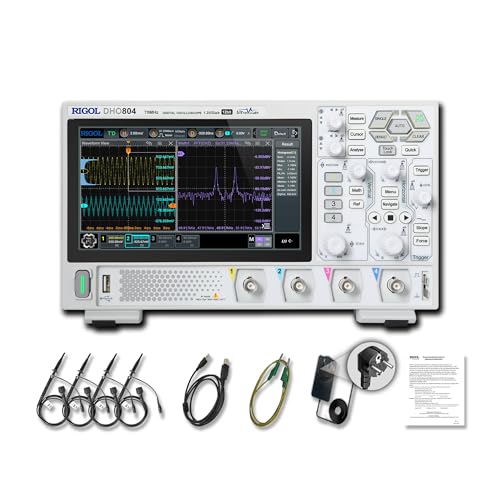
The Rigol DHO804 is the entry point to Rigol's DHO platform, offering the same 7-inch IPS touchscreen experience as the DHO924S with 70MHz bandwidth and 25Mpt memory at $439. For Arduino, basic analog work, and learning, 70MHz is genuinely sufficient — most signals you'll encounter stay well under this limit. The old objection was that the DHO924S cost almost the same; that is no longer true. With the DHO924S now priced like a premium scope, the DHO804 is the modern Rigol touchscreen pick for buyers who want a current interface without jumping near $900.
Siglent SDS1202X-E
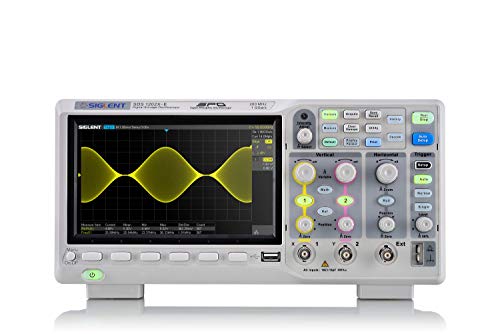
The Siglent SDS1202X-E is the DS1054Z's biggest competitor, and it wins on raw specs: 200MHz bandwidth, 14Mpt memory, and protocol decoding that includes CAN and LIN without paying for licenses. The catch is you only get 2 channels, and that trade-off matters more than it sounds. When you're debugging SPI with clock, data, and chip-select lines all running, or trying to correlate an analog signal with a digital trigger, you'll wish you had 4 channels. If you work primarily with audio circuits, RF signals, or single-channel measurements, the 200MHz bandwidth is genuinely useful and this scope makes complete sense. For general embedded debugging with multiple signals, I'd take the DS1054Z's 4 channels over the extra bandwidth.