Hantek
Hantek PP-250 (2-Pack)
The Hantek PP-250 2-pack is the default upgrade probe for anyone tired of the cheap probes that ship with budget scopes. 250MHz bandwidth, 1X/10X switching, and a BNC connector that actually fits. Buy a set and throw away the ones that came with your scope.
Specifications
| Bandwidth | 250 MHz |
| Attenuation | 1X/10X switchable |
| Probe Type | Passive |
| Lead Length | 1.2 m |
| Input Capacitance | 18 pF |
| Rise Time | 1.4 ns |
| Includes Accessories | Yes |
Compatible Scopes
What We Like
- ✓250MHz bandwidth handles everything a hobbyist-grade scope can display
- ✓1X/10X switchable — use 1X for low-frequency, 10X for everything else
- ✓Universal BNC connector fits virtually any oscilloscope
- ✓Two probes included — great value for the price
- ✓Compensation adjustment screw works correctly out of the box
Limitations
- ✗Plastic body feels less substantial than Rigol or Siglent OEM probes
- ✗No ground spring clip included — basic alligator ground only
- ✗Cable is slightly stiffer than premium probes
Overview
The Hantek PP-250 is the probe upgrade you buy when you realize the cheap probes that shipped with your budget scope are lying to you. At $20 for a two-pack, it is one of the best values in test equipment accessories. With 250MHz bandwidth, 1X/10X switching, and a compensation range that plays nicely with virtually any scope, the PP-250 replaces the weakest link in most hobbyist measurement chains.
But let us be clear about what $10 per probe actually buys. The plastic body feels less substantial than Rigol or Siglent OEM probes. The included ground lead is a basic alligator clip, not a ground spring. And while the 250MHz bandwidth spec is genuine, real-world performance depends heavily on how well you compensate the probe and how short your ground path is.
I have used PP-250s on Rigol, Siglent, and FNIRSI scopes. They consistently outperform the stock probes that come with budget equipment, particularly on fast-switching signals where probe bandwidth actually matters. This review covers where the PP-250 shines, where it falls short of premium alternatives, and whether you should buy a set or save for something better.
Design & Build Quality
The PP-250 is a standard passive probe in the classic BNC-to-tip form factor. The body is gray plastic with a 1X/10X slide switch near the BNC connector. The switch detents are positive enough that you will not accidentally change attenuation mid-measurement, though the plastic feels thinner than OEM probes from Rigol or Siglent.
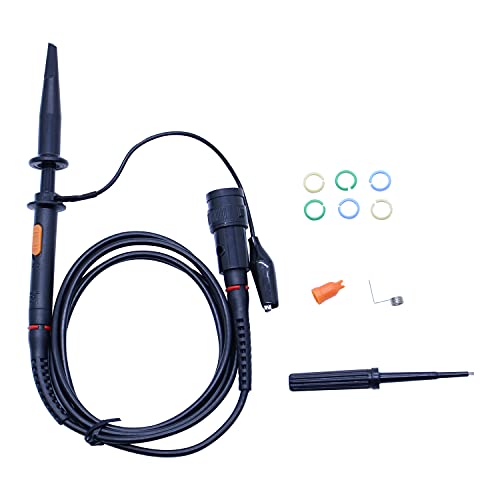
The included accessories are minimal: a compensation adjustment tool, a sprung hook tip, a basic ground lead with alligator clip, and color-coded probe rings. Notably absent is a ground spring, which is frustrating because the ground spring is the single most important accessory for high-frequency measurements. You will want to buy one separately or make your own from guitar string or welding wire, as EEVblog forum users suggest.
The 1.2-meter cable is slightly stiffer than premium probes. This is noticeable when routing around a crowded bench but does not affect measurement quality. The BNC connector fits securely on every scope I have tested it with. The input capacitance of 18pF is higher than some premium probes but falls within the compensation range of most hobbyist-grade scopes.
Performance & Specifications Deep Dive
The 250MHz bandwidth spec is genuine and meaningful for hobbyist work. On a 100MHz scope, the probe is not the limiting factor. On a 200MHz scope, it is just adequate. The 1.4ns rise time matches what you would expect from a 250MHz probe and is consistent with independent tests from EEVblog forum members who have compared multiple budget probes side-by-side.
In practice, bandwidth is only half the story. The real limitation at high frequencies is grounding. With the included alligator ground lead, you will see ringing and overshoot on fast edges regardless of the probe's rated bandwidth. This is not a probe flaw -- it is physics. The ground lead inductance forms an LC resonant circuit with the probe capacitance. Using a ground spring or direct barrel ground reduces this dramatically.
The 1X mode is useful for low-impedance, low-frequency signals where you need full sensitivity. At 1X, bandwidth drops to about 6MHz, which is fine for audio, power supply ripple, and slow logic. For almost everything else, 10X is the correct setting. The 10M ohm input impedance in 10X mode loads most circuits gently enough for accurate measurement.
Compensation adjustment works correctly. The trimmer range covers 10-30pF, which accommodates virtually every budget scope on the market. I have compensated PP-250s on Rigol DS1054Z, Siglent SDS1104X-E, and FNIRSI 1014D scopes without issues.
Software & User Experience
There is no software. Probes are purely analog devices, and the PP-250 is no exception. The user experience is entirely about physical handling: attaching the BNC, selecting 1X or 10X, adjusting compensation, and choosing the right ground connection for your signal.
Compensation is the critical setup step. Every time you move the probe to a different scope or even a different channel, you should verify compensation using the scope's square wave calibrator. An undercompensated probe rounds off rising edges; an overcompensated probe adds overshoot. Both make your measurements unreliable. The PP-250's compensation adjustment is responsive and holds its setting well.
The hook tip is genuinely useful for hands-free probing of through-hole components and test points. It is not precise enough for fine-pitch SMD work -- for that, you need micro-grabbers like the Pomona 5518. The locating sleeve helps keep the probe steady on component leads.
One practical note: the 1X/10X switch is not labeled as clearly as some OEM probes. In a hurry, it is easy to forget which position is which. I have learned to always verify the switch position by checking the scope's auto-sense readout or by touching a known voltage and confirming the scaling.
Real-World Use Cases
Replacing stock probes on budget scopes is the PP-250's primary use case. The probes that ship with entry-level Rigol, Siglent, FNIRSI, and OWON scopes are typically 60-100MHz units with inconsistent compensation. Upgrading to the PP-250 immediately improves rise-time measurements and reduces ringing on fast digital edges. On a Rigol DS1054Z, switching from stock probes to PP-250s visibly sharpens square wave edges and reduces overshoot.
Digital circuit debugging benefits from the 250MHz bandwidth when examining SPI, I2C, or UART signals at higher speeds. The 10X attenuation reduces circuit loading, which matters when probing high-impedance nodes. For microcontroller work, the PP-250 provides a clearer picture of what is actually happening at the pin versus what the stock probe shows.
Power supply analysis is adequate but not exceptional. The 10X mode handles typical DC rail voltages up to 300V RMS, and the probe correctly shows switching ripple. However, for serious power supply work, a differential probe or current probe provides more insight than any passive probe.
The PP-250 is not suitable for high-voltage work. At 300V RMS in 10X mode, it handles typical electronics but falls far short of the 1000V+ ratings of dedicated high-voltage probes. Do not use it for mains-side power supply probing or motor drive work.
Who Should Buy (And Who Shouldn't)
Buy the Hantek PP-250 if you own a budget oscilloscope with stock probes under 150MHz and want a genuine performance upgrade for minimal cost. At $20 for two probes, it is a no-brainer for anyone doing digital electronics, microcontroller work, or general circuit debugging. The bandwidth improvement alone justifies the price.
Also buy it if you need spare probes for a second channel or want a dedicated probe for a specific project that you would rather not subject your expensive OEM probes to. The price is low enough that damaging one is not a financial catastrophe.
Do not buy the PP-250 if you need professional-grade build quality, precision SMD probing, or high-voltage measurement. For SMD work, add Pomona 5518 micro-grabbers. For high voltage, buy a proper HV probe. And if you own a premium scope like a Keysight or Tektronix, invest in matching premium probes rather than putting budget probes on expensive hardware.
Alternatives Worth Considering
The Rigol RP2200A at ~$35 is the natural choice for Rigol scope owners. It is designed for optimal compensation with Rigol hardware and includes a complete accessory kit with ground spring. The 200MHz bandwidth is slightly lower than the Hantek, but the OEM-matched compensation and better build quality justify the extra $15 if you own a Rigol.
The Siglent PP215 at ~$30 is the equivalent for Siglent scope owners. It offers 150MHz bandwidth, a spring-loaded hook tip, and optimized compensation for Siglent scopes. The lower bandwidth is limiting if you own a 200MHz+ Siglent, but for SDS1000X-E and SDS800X HD series, it is well-matched.
For significantly better performance, the Pintek CP-3351R at ~$40 offers 350MHz bandwidth and autosense capability. EEVblog forum users report these are the best bang-for-buck upgrade from budget probes. If your scope has 200MHz+ bandwidth, the extra $20 over the Hantek PP-250 is worthwhile.
Frequently Asked Questions
Does the Hantek PP-250 include a ground spring?
Will the PP-250 work with my oscilloscope?
What is the real bandwidth in 1X mode?
How do I compensate the PP-250?
Is the 250MHz bandwidth genuine?
Can I use the PP-250 for mains voltage measurements?
Hantek PP-250 (2-Pack)
$23.99 — 250 MHz passive probe