UNI-T
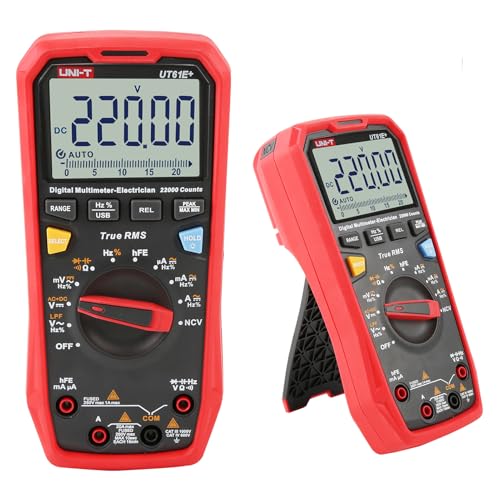
UNI-T UT61E+
The UNI-T UT61E+ is the best meter under $50. The 22000-count display gives you resolution that rivals meters 3x the price, the true RMS engine is accurate, and the USB data logging is a genuine differentiator. The first meter I'd recommend to any electronics hobbyist.
Specifications
| Display Count | 22,000 |
| CAT Rating | CAT II 1000V |
| DC Voltage | 0.1mV – 1000V |
| AC Voltage | 0.1V – 750V |
| Current | 0.1µA – 10A |
Features
What We Like
- ✓22000-count display gives resolution that rivals meters 3x the price
- ✓True RMS with 0.1% basic accuracy — genuinely impressive for $50
- ✓USB data logging for capturing measurements over time
- ✓Auto-ranging with manual override for bench work
- ✓Capacitance and frequency measurement included
Limitations
- ✗CAT II only — not rated for panel work or high-energy circuits
- ✗USB interface requires driver installation on Windows
- ✗Build quality is noticeably cheaper than Fluke (lighter, less rugged)
Overview
The UNI-T UT61E+ is the meter that makes you question why anyone spends more. At roughly $50, it delivers a 22000-count true RMS display, 0.1% basic DC accuracy, USB data logging, and auto-ranging with manual override — a feature set that rivals meters costing three times as much. For electronics hobbyists and bench tinkerers, it has become something of a legend.
But the UT61E+ also carries baggage. UNI-T's reputation for optimistic safety ratings precedes it. EEVblog forum teardowns have raised valid questions about input protection, fuse ratings, and whether the CAT claims on the box match what's inside. The build quality is undeniably lighter and less rugged than Fluke or Brymen.
So the real question isn't whether the UT61E+ is a good value — it clearly is. The question is whether its limitations matter for your specific work. If you spend your time on a bench measuring voltage references, logging battery discharge curves, and debugging microcontroller circuits, this meter is a genuine standout. If you're poking around live breaker panels, the safety story gets more complicated. This review digs into what the UT61E+ does brilliantly, where it cuts corners, and who should actually buy one.
Design & Build Quality
The UT61E+ feels like what it is: a $50 meter built to a price. The plastic case is lighter and less dense than Fluke or Klein equivalents. The rotary dial has decent detents but lacks the precision of premium meters. Drop it from bench height onto concrete and you'll hold your breath; drop a Fluke 117 and you don't.
That said, the layout is functional. The LCD is large and readable, with a blue backlight that illuminates evenly. The 22000-count display shows five full digits plus a half digit, which is genuinely useful when you're measuring a 3.3V rail and want to see millivolt drift. The bar graph is present but updates slowly compared to higher-end meters — more of a nice-to-have than a tool you rely on.
The included test leads are average at best. The probe tips are exposed metal without the shrouding you'd want for high-energy work. The USB interface cable (included) uses an optical-isolation scheme that connects to the meter's proprietary port. EEVblog forum users note that the cable can be finicky with driver installation on Windows, and Linux support requires third-party tools like sigrok. Some users have modded the RS-232 adapter to use standard USB-serial chips for better compatibility.
Performance & Specifications Deep Dive
The headline spec is the 22000-count resolution. In practice, this means you can resolve 0.01mV on the 220.00mV DC range and 0.1mV on the 2.2000V range. For electronics work — checking reference voltages, measuring op-amp offsets, characterizing power supplies — this resolution is transformative at the price. The Brymen BM869s offers 60000 counts but costs nearly three times as much.
True RMS performance is solid for the price class. Independent tests and EEVblog discussions suggest the AC accuracy is genuine and useful for audio, power supply ripple, and non-sinusoidal signals. The 0.1% basic DCV accuracy is competitive with meters costing $100-150. Frequency measurement covers a useful range, and capacitance measurement is included — something the Fluke 117 offers too, but many budget meters omit.
The safety ratings are where things get murky. The UT61E+ is labeled CAT II 1000V, but forum teardowns have revealed 250VAC-rated fuses and input protection that wouldn't pass independent CAT III certification. For bench work on low-voltage circuits, this is irrelevant. For mains-connected equipment or panel work, it's a genuine concern. The meter is absolutely not suitable for high-energy electrical work regardless of what the label claims.
Current measurement includes µA, mA, and 10A ranges. Burden voltage in the µA and mA ranges has been criticized on forums as higher than ideal, which can affect measurements in sensitive circuits. The 10A range uses a 10A fuse with a 30-second maximum duty cycle, which is standard for this class.
Software & User Experience
USB data logging is the UT61E+'s killer feature at this price. The meter outputs a 14-byte serial packet containing the measurement value, range, and mode information. The included Windows software is functional but dated — it captures and graphs data over time, which is exactly what you need for logging battery discharge, thermal drift, or power supply stability.
The hobbyist community has done significant work here. Arduino projects that read the UT61E+ serial output directly are well-documented on the EEVblog forums. Users have built automated test setups where the meter feeds data to a microcontroller or PC for real-time plotting. The Bluetooth dongle (UT-D07B, sold separately) enables wireless logging to phones, though compatibility is spotty with older Android versions.
On-meter operation is straightforward. Auto-ranging is fast enough for bench use, and manual range override is available when you want to lock the display for stable readings. The continuity buzzer is adequate but not lightning-fast. Min/Max and data hold functions are present. The interface is menu-light — there are no deep nested settings to navigate, which is refreshing after using meters that bury features under layers of button combinations.
Real-World Use Cases
Bench electronics is where the UT61E+ earns its reputation. Measuring a 3.3V regulator output at 3.298V with 0.001V resolution lets you spot drift that a 4000-count meter would round away. Logging a LiPo battery discharge curve over two hours via USB provides data you'd otherwise need a dedicated data logger to capture. For Arduino, Raspberry Pi, and general microcontroller work, the accuracy and resolution are genuinely impressive.
Audio and small-signal work is another strength. The true RMS measurement handles music signals, PWM audio, and switching power supply noise better than average-responding meters. Forum users report using the UT61E+ for amplifier bias adjustment and audio circuit debugging with good results.
For automotive diagnostics, the meter handles battery voltage, alternator output, and continuity testing competently. The DC current ranges work for parasitic draw testing, though the burden voltage means you need to be mindful of circuit sensitivity. Temperature measurement is not included, so you'll need a separate probe for HVAC or engine diagnostics.
Where it falls apart is electrical panel work. The CAT II rating and questionable input protection mean this meter has no business near mains distribution panels, service entrances, or high-energy industrial equipment. Several EEVblog users have been explicit: if you're an electrician, buy a Fluke or a properly certified meter. The UT61E+ is an electronics bench tool, not a field electrical tool.
Who Should Buy (And Who Shouldn't)
Buy the UNI-T UT61E+ if you're an electronics hobbyist, student, or bench technician who needs high resolution, true RMS, and data logging on a tight budget. It's the first meter I recommend to anyone building their first electronics workbench. The 22000-count display and USB connectivity are genuine differentiators that meters costing twice as much often lack.
Don't buy the UT61E+ if you do residential or commercial electrical work, need to work on live panels, or value ruggedness above all else. The safety ratings are suspect, the build quality is light, and the test leads aren't appropriate for high-energy circuits. If your meter needs to survive a job site, get a Fluke 117 or Klein MM400 instead. Also skip it if you need temperature measurement — the UT61E+ doesn't have it, and the Brymen BM869s or Klein MM400 do.
Alternatives Worth Considering
The Brymen BM869s at ~$140 is the logical upgrade path. It offers 60000 counts, CAT IV 600V (genuinely certified), dual simultaneous display, and 0.025% DC accuracy. It lacks USB logging in the base package — the optical USB cable is a separate purchase — but for electronics work with occasional high-voltage exposure, it's a significant step up in safety and precision.
The Fluke 117 at ~$160 trades resolution and connectivity for ruggedness and true safety certification. It has only 6000 counts and no data logging, but it's built to survive and its CAT III 600V rating is independently verified. For anyone who splits time between bench work and field electrical work, the 117 is the safer single-meter choice.
For pure budget shoppers, the AstroAI AM33D at ~$23 covers basic voltage, resistance, and continuity. It lacks true RMS, auto-ranging, and any connectivity, but it gets the job done for battery testing and simple continuity checks. The UT61E+ is worth the extra ~$25 for anyone doing anything more serious than occasional household electrical checks.
Frequently Asked Questions
Is the UNI-T UT61E+ safe for mains voltage work?
How does the USB data logging work?
What is the actual DC voltage accuracy?
Can the UT61E+ measure temperature?
Is the true RMS function genuine?
What is burden voltage and should I worry about it?
Does the UT61E+ work with Linux or Mac?
UNI-T UT61E+
$95.99 — CAT II 1000V · 22,000 count