Best Function Generators for Hobbyists
Generate test signals and characterize your circuits properly — a function generator is the natural companion to your oscilloscope.
What Is a Function Generator?
A function generator produces electrical waveforms — sine waves, square waves, triangle waves, pulses — at frequencies you specify. You connect it to a circuit under test and observe the output on your oscilloscope. This lets you characterize filters (what frequencies does it pass?), test amplifiers (how does gain change with frequency?), and verify digital circuits (does this respond correctly to a clock signal?).
Without a function generator, you depend on your circuit to generate its own test signals. With one, you control exactly what goes in — making debugging and characterization dramatically faster.
All Function Generators Reviewed
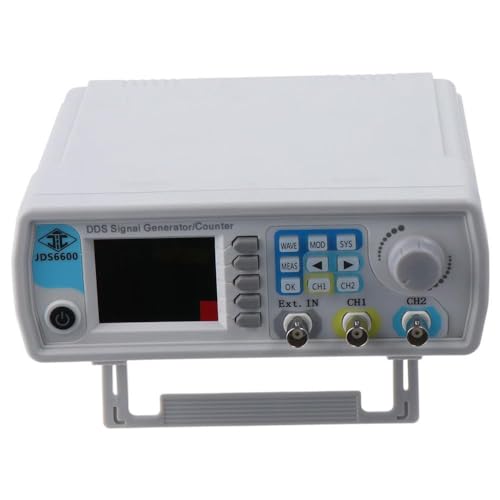
The JDS6600 is the starting point for hobbyists who need a function generator but can't justify $300. Two channels, 60MHz, and a stack of waveforms for $76. The software is basic but functional. This is the scope equivalent of the Rigol DS1054Z — a solid first tool at an honest price.
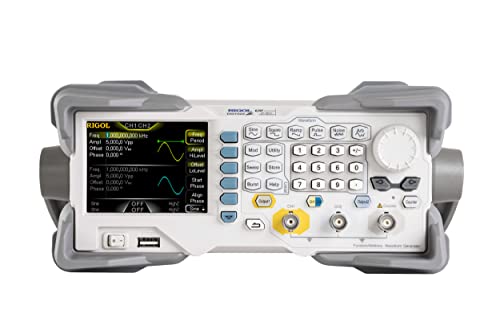
If you already own a Rigol oscilloscope, the DG1022Z is the obvious companion. The 160 built-in waveforms cover every standard test signal, the 14-bit DAC is cleaner than cheaper generators, and the software integration with Rigol scopes is a genuine time-saver. Worth every cent for serious bench work.
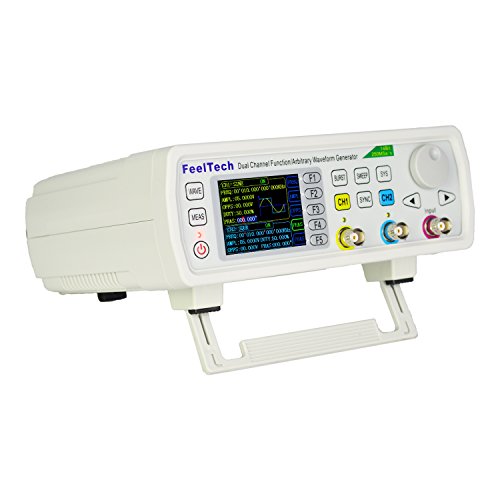
The FeelTech FY6600 is the value play between the JDS6600 and the Rigol DG1022Z. The PC software makes programming arbitrary waveforms easier than fighting the front panel, and the counter mode is actually useful. Not as clean as the Rigol but a big step up from the JDS6600.
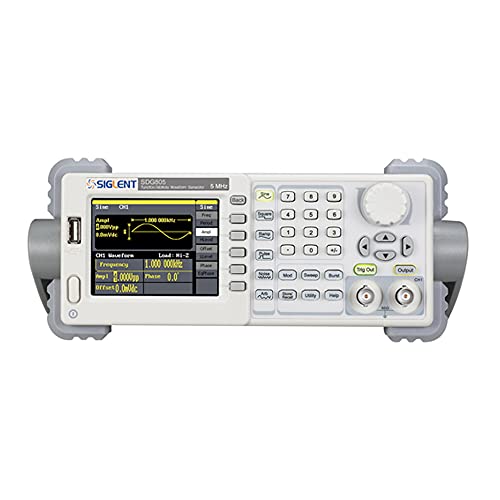
The Siglent SDG1032X is what engineers reach for when signal quality matters. The spectral purity on the sine output is measurably better than cheaper generators — you'll see it on your spectrum analyzer. IQ baseband output is unusual at this price and invaluable for RF work. The best under-$300 generator you can buy.
Pair It With Your Oscilloscope
A function generator and oscilloscope together are how you measure frequency response — inject a signal at a known frequency, observe what comes out. They're the fundamental toolkit for analog circuit characterization.
If you own a Rigol oscilloscope, the Rigol DG1022Z integrates natively. For any other scope, the Siglent SDG1032X or JDS6600 work perfectly as universal tools.
See our oscilloscope reviews →Do You Actually Need One?
Yes, if you...
- • Test amplifier gain and frequency response
- • Characterize analog filters
- • Debug audio circuits
- • Work with RF or transmission lines
- • Need to inject clean clock signals for testing
Probably not, if you only...
- • Debug Arduino and sensor communication
- • Read I2C / SPI / UART protocol data
- • Measure voltages and check continuity
- • Do basic microcontroller projects