Siglent
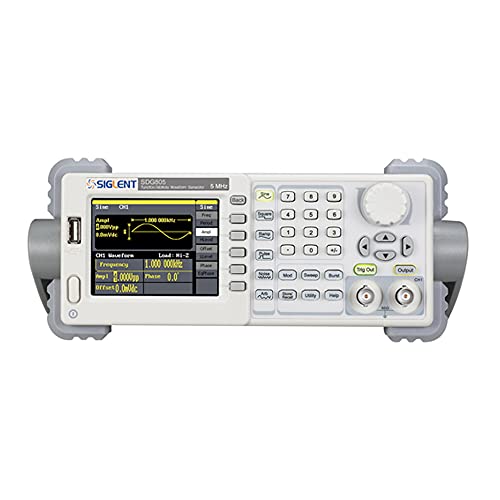
Siglent SDG1032X
The Siglent SDG1032X is what engineers reach for when signal quality matters. The spectral purity on the sine output is measurably better than cheaper generators — you'll see it on your spectrum analyzer. IQ baseband output is unusual at this price and invaluable for RF work. The best under-$300 generator you can buy.
Key Specifications
| Max Frequency | 30 MHz |
| Channels | 2 |
| Frequency Resolution | 1 µHz |
| Output Impedance | 50Ω |
| Amplitude Range | 4mVpp – 20Vpp (high-Z load) |
| Display | 4.3" TFT color LCD |
| Connectivity | USB Device, USB Host, LAN, GPIB (optional) |
| Arbitrary Waveform | Yes |
| Burst Mode | Yes |
Waveform Library
Modulation Types
What We Like
- ✓Spectral purity on sine output is measurably better than cheaper generators
- ✓IQ baseband output for RF hobbyists working with SDR and modulation
- ✓16K arbitrary waveform points — 4x more than most competitors
- ✓EasyWave PC software is the best in class for waveform creation
- ✓LAN control enables remote operation and automation
Limitations
- ✗$299 is the highest price in our comparison — hard to justify for casual use
- ✗30MHz max frequency means it needs pairing with an RF generator for VHF+ work
- ✗Large footprint — occupies significant bench space
Overview
The Siglent SDG1032X is the most expensive function generator in our comparison at $299, and it earns that price tag with a combination of signal purity, feature depth, and software polish that the budget tier cannot touch. It is a 30 MHz, dual-channel arbitrary waveform generator with a 14-bit DAC, 150 MSa/s sample rate, 16K points of arbitrary waveform memory, and a feature that is genuinely unusual at this price: IQ baseband output for RF and software-defined radio work. If the JDS6600 is a bicycle and the Rigol DG1022Z is a commuter car, the SDG1032X is a sports sedan — overkill for some, but deeply satisfying for those who appreciate precision engineering.
Siglent has built a loyal following in the hobbyist and small-lab community by delivering professional specifications at mid-tier prices. The SDG1032X is a prime example. The EasyPulse technology addresses a genuine DDS weakness — jitter on non-integer clock divisions — and the proprietary TrueArb mode reconstructs arbitrary waveforms point-by-point rather than skipping samples. These are not bullet-point fillers; they produce measurably better signals on a fast scope or spectrum analyzer.
The question is whether those improvements matter for your work. If you are testing audio circuits or debugging SPI buses, the SDG1032X is arguably too much generator. But if you are designing filters, characterizing amplifiers, or experimenting with SDR modulation schemes, the extra fidelity and IQ output are transformative. This review tests the SDG1032X in both contexts to find where the value lies.
Design & Build Quality
Siglent’s design language is clean and professional. The SDG1032X sits in a metal case with rubber corner bumpers and a sturdy tilt bail, measuring 260 x 296 x 107 mm and weighing 3.43 kg. It feels like a piece of lab equipment, not a toy. The power switch is robust, the rotary encoder has satisfying detents, and the soft keys below the screen respond with positive tactile feedback.
The 4.3-inch TFT color LCD (480 x 272) is the largest and clearest display in our comparison. It shows both channels simultaneously with waveform previews, numeric readouts, and modulation status icons. The screen is readable from a wide angle and does not wash out under typical bench lighting — a real advantage over the JDS6600’s narrow-view TFT and the FY6600’s waveform-blind LED display.
Front-panel connectivity includes two BNC outputs. Around back you get USB device and host ports, a LAN port, a BNC for the 200 MHz frequency counter, a 10 MHz reference in/out, and an Aux BNC for external modulation or trigger. Optional GPIB is available for legacy test racks. The frequency counter has its own dedicated input, which means you can measure an external signal without occupying an output channel — a small but meaningful workflow improvement.
Performance & Specifications Deep Dive
The SDG1032X’s 30 MHz sine output is backed by a 14-bit DAC and 150 MSa/s sample rate. Siglent quotes THD below 0.075% and spurious emissions below -40 dBc across the full bandwidth. Independent bench tests by Elektor Magazine measured even lower distortion at 1 kHz, confirming the specifications are conservative. The EasyPulse technology deserves special mention: it eliminates the one-clock jitter that plagues traditional DDS generators when the sample rate is not an integer multiple of the output frequency. The result is square and pulse waveforms with consistent edge timing across the entire frequency range.
Amplitude output is 4 mVpp to 20 Vpp into high impedance (2-10 Vpp into 50 Ω, depending on frequency). The 20 Vpp maximum holds up to 10 MHz for both sine and square, then drops to 10 Vpp above that. Core Electronics testing in Australia confirmed these limits and noted square-wave rise times around 4.2 ns with proper cable termination — competitive with generators costing twice as much.
The arbitrary waveform memory holds 16K points, four times the typical budget generator. More importantly, TrueArb mode plays back every point without skipping, preserving the fine structure of complex waveforms. For simulating cardiac signals, power supply startup sequences, or communication preambles, the difference is visible on a scope. Standard DDS mode is also available for longer waveforms at reduced fidelity.
The IQ output is the unique selling point. It provides in-phase and quadrature baseband signals for driving external modulators or SDR front ends. At $299, no other generator in our comparison offers this. If you are experimenting with AM, FM, or digital modulation without a dedicated RF generator, the SDG1032X is a gateway drug to serious RF work.
Software & User Experience
Front-panel operation on the SDG1032X is intuitive. The soft keys align with on-screen labels, the rotary encoder adjusts values quickly, and a numeric keypad allows direct entry when precision matters. It takes minutes, not hours, to feel comfortable navigating modulation menus, setting up sweeps, or configuring burst sequences.
The LAN port enables full remote control via VXI-11, raw sockets, or Telnet. Siglent provides documented SCPI commands, and the built-in web server lets you control the generator from a browser without installing any software. That is a genuine convenience for lab environments where installing vendor applications on every PC is a hassle.
EasyWave, Siglent’s PC software, is widely regarded as the best waveform editor in this price class. It runs on Windows and requires NI-VISA drivers, which is a one-time installation step. Once running, it supports drawing waveforms with the mouse, importing CSV files, applying math functions, and sequencing multiple waveforms for playback. Core Electronics’ review praised the software’s capability while noting the NI-VISA prerequisite as a minor trap for first-time installers. There is no macOS version, but the web interface and LAN scripting cover most cross-platform needs.
Real-World Use Cases
In precision analog design, the SDG1032X shines. The low THD and excellent amplitude flatness (±0.1 dB below 10 MHz) mean your generator is not the weakest link when measuring op-amp distortion or filter roll-off. The sweep function, paired with a Siglent SDS1204X-E oscilloscope, can produce Bode plots directly on the scope screen — a workflow that saves hours compared to manual point-by-point measurement. Elektor Magazine called this a significant advantage for analog designers.
For embedded and digital work, the EasyPulse technology produces clean square waves up to 30 MHz with less than 300 ps plus 0.05 ppm of period jitter. That matters when debugging high-speed SPI or validating clock distribution networks. The pulse mode supports independently adjustable rise and fall times down to 16.8 ns, with 100 ps resolution — precise enough for simulating slow edges to test input glitch immunity.
In RF and SDR experimentation, the IQ baseband output is a genuine superpower. You can generate complex modulation envelopes, feed them into an external mixer, and upconvert to your target frequency. For hobbyists building their first SDR transmitters or studying modulation theory, the SDG1032X replaces a far more expensive vector signal generator for baseband tasks. The 30 MHz limit means you are working at baseband or IF, not RF directly, but that is exactly where most learning and prototyping happens.
Who Should Buy (And Who Shouldn't)
Buy the SDG1032X if you are a serious hobbyist, student, or small-lab engineer who needs the cleanest signals under $300, values IQ output for RF work, or wants software integration with Siglent oscilloscopes. It is the best generator in our comparison for analog precision, arbitrary waveform fidelity, and pulse quality. If you spend significant time on the bench and appreciate tools that get out of your way, the SDG1032X is worth every dollar.
Do not buy it if you are a casual beginner who just needs a sine wave for audio testing, if $300 strains your budget, or if you never touch RF or modulation work. The JDS6600 handles basic tasks at one-fourth the price, and the Rigol DG1022Z covers most intermediate needs for $50 less. The SDG1032X’s large footprint also makes it less appealing for portable or cluttered benches. It is a specialized tool for specialized needs — albeit one with enough general capability that you will rarely feel limited.
Alternatives Worth Considering
The Rigol DG1022Z at $249 is the closest competitor. It matches the 14-bit DAC and dual-channel architecture but tops out at 25 MHz and lacks IQ output. The Rigol has superior ecosystem integration with Rigol scopes and a more mature LAN remote-control implementation. Choose the Rigol if you are already in that ecosystem or if the $50 savings matter. Choose the Siglent if you need IQ, the extra 5 MHz, or the larger waveform memory.
The Siglent SDG1062X at $459 extends bandwidth to 60 MHz and adds more waveform memory. It is the upgrade path if you outgrow the 1032X, but for most hobbyists the 30 MHz limit is not the binding constraint — the IQ output and signal purity are.
For pure budget consciousness, the JDS6600 at $76 delivers 60 MHz sine output and basic arb capability. It is not in the same league for signal quality or software, but it generates sine waves and square waves competently. If your scope is the instrument you care about and the generator is just a signal source, the JDS6600 is the rational economic choice.
Frequently Asked Questions
What is EasyPulse technology and why does it matter?
Can the SDG1032X be controlled from a web browser?
What is IQ baseband output used for?
How does the SDG1032X compare to the newer SDG1032X Plus?
Is EasyWave software available for macOS?
Can I use the SDG1032X with a non-Siglent oscilloscope?
Siglent SDG1032X
$299 — 30 MHz · 2ch