Rigol
Rigol DG1022Z
If you already own a Rigol oscilloscope, the DG1022Z is the obvious companion. The 160 built-in waveforms cover every standard test signal, the 14-bit DAC is cleaner than cheaper generators, and the software integration with Rigol scopes is a genuine time-saver. Worth every cent for serious bench work.
Key Specifications
| Max Frequency | 25 MHz |
| Channels | 2 |
| Frequency Resolution | 1 µHz |
| Output Impedance | 50Ω |
| Amplitude Range | 1mVpp – 10Vpp (50Ω load) |
| Display | 3.5" TFT color LCD |
| Connectivity | USB Device, USB Host, LAN |
| Arbitrary Waveform | Yes |
| Burst Mode | Yes |
Waveform Library
Modulation Types
What We Like
- ✓160 built-in waveforms cover every standard test signal you'll ever need
- ✓14-bit DAC produces cleaner output than cheaper 12-bit generators
- ✓USB/LAN connectivity for remote control and waveform downloads
- ✓Excellent software integration with Rigol oscilloscopes
- ✓Genuine 50Ω output impedance — important for RF and transmission line work
Limitations
- ✗$249 is a significant step up from the JDS6600 at $76
- ✗25MHz maximum frequency may be limiting for RF hobbyists above HF
- ✗User interface is menu-driven — steeper learning curve than simpler generators
Overview
The Rigol DG1022Z lands at $249 with a value proposition that is easy to state but harder to execute: bring professional-grade signal generation down to a price that serious hobbyists can justify. It is a 25 MHz, two-channel arbitrary waveform generator built around Rigol’s SiFi (Signal Fidelity) technology, a 14-bit DAC, and a library of 160 built-in waveforms. For context, that is roughly 3x the price of a budget JDS6600 and $50 less than the Siglent SDG1032X. The core question is whether the cleaner output, deeper feature set, and Rigol ecosystem integration are worth the premium over the budget tier.
Rigol built its reputation on the DS1054Z oscilloscope, a product that redefined what $400 could buy in test equipment. The DG1022Z aims to do the same for function generators. It is not the fastest generator on the market — 25 MHz is modest next to the JDS6600’s 60 MHz headline — but frequency is not the whole story. Signal purity, modulation flexibility, and software integration matter more for most bench tasks, and those are areas where the DG1022Z pulls ahead.
This review puts the DG1022Z through its paces in real-world scenarios: characterizing audio filters, testing embedded serial links, and checking RF mixer drive levels. We also address the known weaknesses, including the sometimes-maligned frequency counter and the menu-driven interface that has a learning curve steeper than simpler generators.
Design & Build Quality
Rigol’s industrial design language is consistent across its bench instruments, and the DG1022Z is immediately recognizable as part of the family. The metal case is rigid and well-finished, with rubber corner bumpers that protrude enough to protect the front panel if the unit tips forward. At 3.5 kg, it feels substantial without being bulky. The tilt bail on the rear is a nice touch, letting you angle the display for comfortable viewing from a standing position.
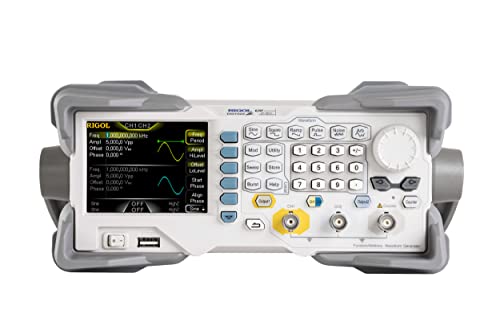
The front panel centers around a 3.5-inch TFT color LCD with a resolution that is adequate for waveform previews and numeric readouts. Below the screen are six soft keys whose functions change with context. To the right sits a rotary encoder with a press-to-select action, surrounded by dedicated buttons for waveform type, modulation, sweep, burst, and utility functions. Two BNC outputs and a BNC input for the frequency counter round out the front.
On the rear you get USB device and host ports, a LAN port for remote control, and a 10 MHz reference in/out. The LAN port is the differentiator against most budget generators: it enables VXI-11 and socket-based remote control, which means you can script the DG1022Z from Python or MATLAB without tethering a USB cable. An eBay reviewer specifically praised the build quality, calling it top-notch and comparable to Keysight on specs considering the price difference.
Performance & Specifications Deep Dive
The DG1022Z’s 25 MHz maximum frequency is lower than budget competitors, but the quality of those 25 MHz is what matters. Rigol specifies harmonic distortion below -65 dBc for signals under 10 MHz and below -55 dBc up to 30 MHz. Total harmonic distortion is under 0.075% from 10 Hz to 20 kHz. In practical terms, that means a 1 kHz sine into an audio preamp will introduce less distortion than many op-amps in the signal chain. Independent bench tests confirm these numbers are achievable, not marketing fiction.
The 14-bit DAC running at 200 MSa/s gives the DG1022Z a vertical resolution advantage over 12-bit budget generators. When generating complex arbitrary waveforms or low-amplitude signals, the extra bits translate to smoother curves and less quantization noise. Waveform length goes up to 2 Mpts standard, with a 16 Mpts option available. For most users, 2 Mpts is plenty for simulating power-on ramps, sensor outputs, or communication preamble sequences.
Output amplitude into 50 Ω is 1 mVpp to 10 Vpp below 10 MHz, dropping to 5 Vpp up to 30 MHz. The genuine 50 Ω output impedance is a big deal for RF work: you can drive transmission lines, mixers, and filters without guessing whether the generator is contributing its own mismatch. Rise time on square waves is under 10 ns typical, with overshoot specified at 5% or less.
One documented weak point is the frequency counter. An EEVblog user reported erratic behavior when measuring a 1 Hz microcontroller square wave, with the counter jumping to MHz readings and eventually failing completely. Others confirmed the counter works fine for audio-band and modest RF signals but can be fiddly at extremes. The lesson: treat the counter as a convenience feature, not a replacement for a dedicated instrument.
Software & User Experience
The DG1022Z’s front panel interface is menu-driven, which means you will spend time navigating soft menus rather than hitting single-purpose buttons. After a few hours of use, the muscle memory sets in, but the first session can feel slow compared to the direct-access layout of a Siglent or the simplicity of a JDS6600. An eBay reviewer noted that it is easy to use once you get used to the menu system and the options.
Remote control is where the DG1022Z shines. The LAN interface supports VXI-11, raw socket, and USBTMC protocols. Rigol publishes the SCPI command set, and community libraries exist for Python (PyVISA) and MATLAB. If you are automating a test rack or sweeping a filter response under script control, the DG1022Z integrates cleanly. The USB host port allows loading arbitrary waveforms from a thumb drive, which is faster than PC transfer for large files.
Rigol also offers software integration with its oscilloscopes. Owners of the SDS1104X-E or SDS1204X-E can connect the DG1022Z via USB and display Bode plots directly on the scope screen. That eliminates the need for a separate tracking generator or manual frequency stepping, saving bench space and time. Elektor Magazine highlighted this as a significant advantage for analog designers.
Real-World Use Cases
In audio and analog filter testing, the DG1022Z is excellent. The low THD means your generator is not the limiting factor when measuring distortion in amplifiers or crossover networks. The sweep function supports linear and log ramps with programmable start, stop, and dwell times. Coupled with a Rigol scope’s Bode plot feature, you can characterize a filter’s magnitude and phase response in minutes rather than hours.
For embedded development, the modulation options are genuinely useful. AM, FM, PM, ASK, FSK, PSK, and PWM are all built in, with internal or external modulation sources. Testing an FM receiver frontend, simulating a modulated RFID carrier, or verifying PWM servo response are all straightforward. The built-in harmonic generator can add up to eight harmonics with independently set amplitude and phase, which is a powerful tool for distortion testing and power-line simulation.
In RF work, the 25 MHz ceiling is the obvious limitation. You can drive HF circuits directly, but for VHF and above you need an upconverter or a dedicated RF generator. Within its bandwidth, though, the clean output and true 50 Ω impedance make the DG1022Z a better driver for mixers and modulators than any budget generator. One EEVblog user even generated a working NTSC composite video test signal using the arbitrary waveform mode, demonstrating the DAC’s fidelity at the pattern level.
Who Should Buy (And Who Shouldn't)
Buy the DG1022Z if you are a serious hobbyist, student, or embedded engineer who needs clean signals, modulation capability, and remote control. It is the obvious companion to a Rigol oscilloscope, and even as a standalone generator it outperforms the budget tier in the ways that matter for precision work. If you spend more than a few hours a week on the bench, the time savings from better software integration and more reliable output justify the $249 price.
Do not buy it if you need raw frequency above 25 MHz for RF work, if you want a dead-simple front panel with no menu diving, or if you are on a strict sub-$100 budget. For occasional use by a pure beginner, the JDS6600 or FeelTech FY6600 deliver 80% of the functionality at one-third the price. Also avoid it if the frequency counter is a make-or-break feature for you; community reports suggest it is the weakest link in an otherwise solid instrument.
Alternatives Worth Considering
The Siglent SDG1032X at $299 is the direct upgrade path. You get 30 MHz bandwidth, IQ baseband output for SDR work, 16K arbitrary waveform points, and Siglent’s EasyWave software, which many users consider the best PC application in this class. The spectral purity is measurably better than the Rigol, particularly on sine waves. Whether the $50 premium is worth it depends on whether you need IQ output or the extra waveform memory.
The FeelTech FY6600 at $100 is the budget alternative. It reaches 60 MHz on sine and has a large hobbyist community, but the signal quality falls behind the Rigol at higher frequencies, and the firmware history is checkered. Buy it if you need more raw frequency and can tolerate rougher edges.
For those already in the Keysight or Tektronix ecosystem, used 33220A or AFG3021B generators appear on the surplus market around $300-400. They offer superior build quality and calibration support but lack modern connectivity. The DG1022Z is the better buy for anyone who values LAN control and current software support.
Frequently Asked Questions
Is the Rigol DG1022Z good for audio work?
Can I control the DG1022Z remotely?
How reliable is the frequency counter?
What is the difference between the DG1022Z and DG1032Z?
Does the DG1022Z work with non-Rigol oscilloscopes?
How many arbitrary waveforms can it store?
Rigol DG1022Z
$359 — 25 MHz · 2ch