AURSINC
AURSINC NanoVNA-H
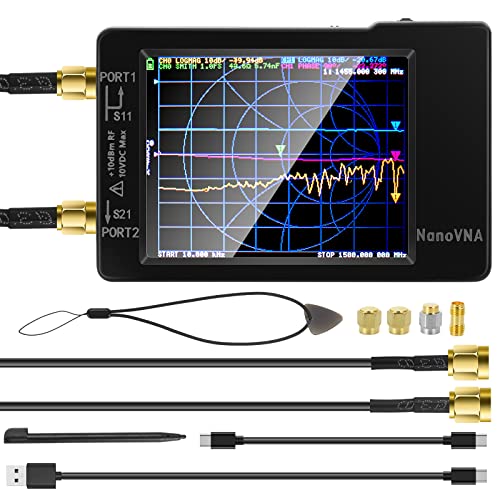
The NanoVNA-H is the entry point into vector network analysis for RF hobbyists. For under $75 you get a 2-port VNA with Smith chart display, battery power, and a calibration kit included. It won't replace a $5,000 Keysight VNA, but for antenna tuning, filter characterization, and transmission line analysis, it delivers genuine value. This is the oscilloscope equivalent of the FNIRSI — cheap, capable, and the right first tool.
Key Specifications
| Frequency Range | 50 kHz – 1.5 GHz |
| Ports | 2 |
| Dynamic Range | 50 dB |
| Smith Chart Support | Yes |
| Calibration Kit Included | Yes |
| Display | 2.8" color LCD |
| Battery Powered | Yes |
| Connectivity | USB (PC software) |
What We Like
- ✓Under $75 for a genuine 2-port VNA that measures S11 and S21
- ✓Smith chart display built-in — see impedance and reactance directly on screen
- ✓Battery powered and pocket-sized — tune antennas in the field
- ✓Massive community with extensive tutorials, mods, and calibration guides
- ✓Calibration kit included (open, short, load, through) — ready to use out of the box
Limitations
- ✗2.8-inch screen is small — you'll zoom in a lot for detailed readings
- ✗Frequency range stops at 1.5 GHz — not suitable for WiFi or cellular antenna work
- ✗Dynamic range is modest — fine for antennas and filters, not for high-isolation measurements
- ✗PC software exists but is basic compared to professional VNA suites
Overview
The AURSINC NanoVNA-H is the instrument that fundamentally changed what hobbyist RF measurement looks like. At $71.99, it delivers vector network analysis -- real S-parameter measurement, Smith chart display, VSWR readings, and impedance characterization -- in a device smaller than a smartphone. Before the NanoVNA, this capability required instruments costing thousands of dollars. After the NanoVNA, an entire generation of ham radio operators, antenna builders, and RF experimenters has access to measurement tools that were previously restricted to professional labs and well-funded workshops.
The NanoVNA-H, developed by Hugen, is the refined iteration of the original open-source NanoVNA design. It covers 50 kHz to 1.5 GHz using the SI5351 clock generator's fundamental output and odd harmonic extension. The hardware version 3.6 adds a microSD card slot for data storage, a 650 mAh battery for portable operation, an ABS protective case, and improved PCB layout with lower power supply noise compared to earlier revisions. It is a 2-port T/R (transmission/reflection) VNA, meaning it measures S11 (reflection) and S21 (transmission) directly. S12 and S22 require manual rewiring of the ports -- possible, but tedious.
The core question is not whether the NanoVNA-H is good value -- at $71.99, it is unquestionably the best dollar-per-measurement tool in RF -- but rather what it can and cannot do compared to professional VNAs costing 50-100x more. After extensive community testing and real-world use, the answer is that the NanoVNA-H is remarkably capable for antenna tuning, filter characterization, cable testing, and impedance matching through 1.5 GHz. Its limitations -- dynamic range that falls off above 900 MHz, 101 fixed scan points on the device, and calibration that drifts over time -- are real but manageable for hobbyist work. This is a tool that teaches you RF by letting you see what you're building, and at this price, that is transformative.
Design & Build Quality
The NanoVNA-H is compact at approximately 75 x 133 x 18 mm and weighs around 130 grams with the battery installed. The ABS case is a significant improvement over the bare-PCB or 3D-printed enclosures of earlier versions -- it provides physical protection, dust resistance, and a more professional feel. The 2.8-inch 320 x 240 resistive touchscreen is small but readable indoors. Like most resistive screens, it responds better to the included stylus than to fingertip operation, and direct sunlight visibility is poor.
RF connectivity uses two SMA female ports labeled CH0 (stimulus output / reflection input) and CH1 (transmission input). The calibration kit included in the package contains SMA male open, short, load, and through standards -- adequate for basic calibration, though the quality of these budget standards is a known limiting factor for ultimate accuracy. Community comparisons against HP precision calibration kits show the supplied standards are surprisingly good at HF and VHF, with deviations becoming noticeable above 500 MHz. For most hobbyist work, they are sufficient.
Power comes from the internal 650 mAh lithium battery providing approximately two hours of operation, or via USB-C for charging and PC connectivity. The USB-C port supports CDC serial communication for PC control. A microSD card slot (up to 32 GB, SPI mode only, FAT/FAT32 format) stores screenshots, calibration data, and Touchstone S-parameter files. The redesigned PCB in HW version 3.6 adds battery management circuitry for safer charging and lower power supply noise, which directly improves measurement stability especially when using harmonic mixing above 300 MHz.
Performance & Specifications Deep Dive
The frequency coverage uses two distinct mechanisms. From 50 kHz to 300 MHz, the SI5351 clock chip outputs the fundamental frequency, providing the best dynamic range and measurement accuracy. Above 300 MHz, odd harmonic extension generates the stimulus signal, with a corresponding degradation in performance. The specified dynamic range is better than 70 dB from 50 kHz to 300 MHz, better than 60 dB from 300 MHz to 900 MHz, and better than 40 dB from 900 MHz to 1.5 GHz. These numbers are realistic based on community testing.
The 70 dB dynamic range at HF is genuinely impressive for a $72 instrument. It enables precise measurement of well-matched antennas (VSWR below 1.2:1), accurate characterization of low-loss filters, and reliable cable fault detection using the built-in time-domain reflectometry (TDR) function. At 300-900 MHz, the 60 dB range is still useful for most antenna work, though measurement of very low reflection coefficients becomes noisier. Above 900 MHz, the 40 dB range limits you to antennas with moderate mismatch and filters with moderate insertion loss. Measuring a well-matched 1.2 GHz antenna with VSWR 1.1:1 is at the edge of the NanoVNA-H's capability.
The Smith chart display is the NanoVNA-H's signature feature, and it works well across the full frequency range. The touchscreen lets you place markers directly on the Smith chart to read impedance (R + jX), VSWR, return loss, and reflection coefficient magnitude. The display updates in real time as you adjust matching networks, trim antenna elements, or sweep through frequencies. This immediate visual feedback is what makes the NanoVNA-H so effective as a learning tool -- you can see exactly how adding a capacitor or shortening an antenna element moves the impedance.
Calibration stability is the practical limitation that separates the NanoVNA-H from professional VNAs. The unit uses SOL (Short-Open-Load) calibration with an optional Through calibration for S21 measurement. Once calibrated, temperature changes, cable movement, and time all cause drift. Community experience suggests recalibration is needed after 15-30 minutes of operation, whenever cables are moved, or when temperature changes significantly. The calibration standards themselves have frequency-dependent behavior that introduces error, especially above 500 MHz. For precise work, some users purchase higher-quality calibration standards or build their own from known components. The NanoVNA-H measures accurately enough to build working antennas and filters; it does not measure accurately enough for metrology or precise production tolerance verification.
Software & User Experience
The on-device firmware provides a functional interface with four simultaneous display traces, four markers, and five save slots for calibration states. The menu structure is navigated via touchscreen taps and a physical jog switch. Common operations -- setting frequency range, selecting display format (Smith chart, log magnitude, phase, VSWR, polar), placing markers, and saving calibrations -- are accessible within a few taps. The learning curve is moderate; new users should budget an hour with the manual and online tutorials.
The fixed 101 scan points on the device is a hardware limitation of the STM32F072 processor and available memory in the NanoVNA-H. One hundred and one points across your frequency span means resolution is coarse for wide spans -- a span of 1-500 MHz gives 5 MHz resolution between points, which can miss narrow resonances. For detailed characterization of narrowband devices, reduce the frequency span or connect to a PC where the scan point limitation is removed. The newer NanoVNA-H4 with its larger processor removes this limitation, which is one reason to consider the upgrade.
PC connectivity via NanoVNASaver transforms the NanoVNA-H from a field checker into a serious measurement tool. NanoVNASaver runs on Windows, Linux, and macOS, provides unlimited scan points, larger displays, data export to Touchstone .snp files, and more sophisticated analysis tools. The ability to export S-parameters and import them into RF simulation software (QUCS, ADS, Sonnet, etc.) bridges the gap between measurement and design. The USB-C connection is reliable, and most modern systems do not require driver installation. Android phone connectivity is also supported via a direct USB-C cable, providing a larger display than the 2.8-inch screen in the field.
Firmware updates come from the Hugen repository and are actively maintained. New features like TDR, enhanced display modes, and improved calibration algorithms continue to appear. The open-source nature of the project means alternative firmwares exist, including versions optimized for specific measurement types. As with any community-supported hardware, reading release notes and staying on a stable firmware version is recommended.
Real-World Use Cases
Antenna tuning is the NanoVNA-H's killer application. Whether you're building a dipole for 40 meters, tuning a Yagi for 2 meters, or matching a vertical for 6 meters, the NanoVNA-H shows you exactly where the antenna resonates and how wide the bandwidth is. Connect the antenna to CH0, calibrate with the supplied standards, and sweep. The Smith chart shows impedance versus frequency, the VSWR trace shows where the match is best, and markers let you read exact values at any frequency. Trim elements, add matching networks, adjust gamma matches -- every change is visible immediately. For ham radio operators who previously tuned antennas by transmitter SWR meter or cut-and-try methods, the NanoVNA-H is revolutionary.
Filter characterization covers low-pass, high-pass, bandpass, and notch filters. Insert the filter between CH0 and CH1 (using the through calibration for normalization), sweep the frequency range, and read insertion loss, passband ripple, cutoff frequency, and stopband attenuation from the S21 trace. The 70 dB dynamic range at HF handles most homebrew filters comfortably. Above 500 MHz, the reduced dynamic range means very high attenuation stopbands cannot be measured accurately -- a filter with 60 dB stopband attenuation at 1 GHz may read only 40 dB due to instrument limitations. For typical hobbyist filters with 20-40 dB stopband requirements, this is not a problem.
Cable fault detection using the TDR function is surprisingly capable. The NanoVNA-H sends a step function down the cable and measures the reflected waveform, displaying distance to fault versus impedance discontinuity. You can find the location of a short, open, or impedance mismatch in coaxial cable with reasonable accuracy -- typically within a few percent of cable length. For ham radio operators debugging feedlines, or for checking patch cables in the shack, this eliminates the need for a separate cable tester. The TDR resolution is limited by the frequency bandwidth (higher frequency range gives better spatial resolution), so short cable faults are easier to resolve than long ones.
Impedance matching and network design is where the Smith chart display proves its worth. When you're designing a matching network to transform an antenna impedance to 50 ohms, the NanoVNA-H shows you the starting impedance and lets you watch the effect of each component addition. Add a series capacitor -- see the impedance move along a constant-resistance circle. Add a shunt inductor -- see it move along a constant-conductance circle. The visual, interactive nature of this process makes matching network design intuitive in a way that calculation alone never achieves. For L-networks, Pi networks, and stub matching, the NanoVNA-H is an essential design companion.
Who Should Buy (And Who Shouldn't)
Buy the NanoVNA-H if you are a ham radio operator of any experience level. Whether you're a new technician building your first antenna or an extra-class operator optimizing a stacked Yagi array, the NanoVNA-H provides measurement feedback that improves your results. At $71.99, it pays for itself in avoided frustration alone -- no more cutting and guessing, no more transmitter SWR meters that only tell you something is wrong without telling you why.
Buy it if you build RF circuits -- amplifiers, filters, mixers, oscillators, matching networks. The ability to measure S-parameters, see impedance on a Smith chart, and verify filter response transforms RF design from guesswork into engineering. Even experienced builders find that having immediate measurement feedback accelerates iteration and improves final results.
Buy it if you work with antennas for IoT, WiFi, Bluetooth, or other wireless devices below 1.5 GHz. The NanoVNA-H handles 2.4 GHz WiFi antennas at the edge of its range (with reduced accuracy), and covers 433 MHz, 868 MHz, 915 MHz ISM bands, GPS L1, and most amateur bands with good to excellent accuracy.
Don't buy it if you need to measure above 1.5 GHz regularly -- the NanoVNA-H4, NanoVNA-F V3, or LiteVNA extend to higher frequencies. Don't buy it if you need 4-port measurement, high dynamic range above 60 dB, or calibration stability that holds for hours without drift -- these require professional VNAs. Don't buy it if the 2.8-inch screen is a dealbreaker; the NanoVNA-H4's 4-inch screen is a meaningful upgrade for users who do extended on-device work. And don't buy it expecting laboratory-grade accuracy; it is a hobbyist instrument that measures well enough to build working RF systems, not well enough for metrology.
Alternatives Worth Considering
The NanoVNA-H4 at $89.99 is the most direct upgrade. It adds a 4-inch 320 x 480 touchscreen, a faster STM32F303 processor with more memory, 401 scan points on-device (versus 101), an 8-hour battery life from a 1950 mAh cell, and the ability to run more advanced firmware features. The larger screen alone transforms the user experience for extended bench work. For an extra $18, the H4 is the better choice if you plan to do serious on-device measurement without a PC.
The NanoVNA-F V3 at $164.99 extends coverage to 6.3 GHz using a fundamentally different architecture with discrete mixers and an FPGA. It offers significantly better dynamic range at microwave frequencies, a larger 4.3-inch IPS display, and capacitive touchscreen. If you need to measure 5.8 GHz antennas, characterize 3-6 GHz filters, or work with WiFi 6E devices, the F V3 is the entry point. It costs more than double the NanoVNA-H but delivers capability that the H simply cannot match above 1.5 GHz.
The LiteVNA-64 at approximately $140 also covers 50 kHz to 6.3 GHz with a 4-inch display and 2000 mAh battery. It uses a different architecture than the NanoVNA-F but achieves similar frequency coverage. Some users prefer its interface and faster scan speeds. It sits between the H4 and F V3 in price and capability.
For those considering a used professional VNA, the HP/Agilent 8753 series covers 30 kHz to 3 GHz or 6 GHz with exceptional accuracy and dynamic range (100+ dB). Units in the $500-1500 range provide laboratory-grade measurement but are benchtop-only, heavy, power-hungry, and lack portability. The NanoVNA-H wins on price, portability, and ease of use; professional gear wins on every performance metric. Many hobbyists start with a NanoVNA and upgrade to professional gear only when their projects demand it.
Frequently Asked Questions
What is the difference between the NanoVNA-H and the original NanoVNA?
How accurate are the S-parameter measurements?
How often do I need to recalibrate?
Can the NanoVNA-H measure 2.4 GHz WiFi antennas?
What cables and accessories do I need?
Can I use the NanoVNA-H as a scalar network analyzer?
Does the NanoVNA-H require a PC to operate?
What is the maximum power I can apply to the NanoVNA-H ports?
AURSINC NanoVNA-H
$48.99 — 50 kHz – 1.5 GHz · 2-port