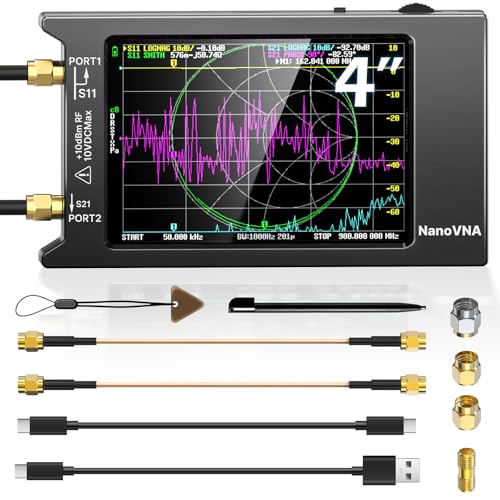
NanoVNA
NanoVNA-H4
The NanoVNA-H4 is the same great VNA as the H model, but with a screen you can actually read. The 4-inch display transforms the user experience — marker placement, Smith chart navigation, and zooming are all dramatically easier. If you can afford the extra $18, this is the better buy. If budget is tight, the H model delivers identical RF performance.
Key Specifications
| Frequency Range | 50 kHz – 1.5 GHz |
| Ports | 2 |
| Dynamic Range | 50 dB |
| Smith Chart Support | Yes |
| Calibration Kit Included | Yes |
| Display | 4" color touchscreen |
| Battery Powered | Yes |
| Connectivity | USB (PC software) |
What We Like
- ✓4-inch touchscreen is dramatically more usable than the 2.8-inch NanoVNA-H
- ✓Same 50 kHz – 1.5 GHz range as the H model with identical measurement accuracy
- ✓Larger battery for longer field use between charges
- ✓Touch interface makes marker placement and zoom navigation much faster
- ✓Firmware is compatible with NanoVNA-H ecosystem — same community support
Limitations
- ✗$18 more than the H model for essentially the same RF performance
- ✗Slightly larger and heavier — less truly pocketable
- ✗Screen is still resistive touch, not capacitive — scrolling feels dated
- ✗No PC software improvement over the H model
Overview
The original NanoVNA-H changed the landscape for RF hobbyists by putting genuine two-port vector network analysis into a pocket-sized device for under $75. But its 2.8-inch screen was a serious constraint: reading Smith charts required squinting, placing markers felt like performing surgery with mittens, and navigating menus with a tiny resistive touchscreen tested the patience of even seasoned hams. The NanoVNA-H4 addresses the most common complaint by upgrading to a 4-inch touchscreen while keeping the same RF hardware, the same 50kHz-1.5GHz range, and the same $89.99 price point that still undercuts every alternative by miles.
The core question is whether a bigger screen transforms the NanoVNA from a frustrating-but-capable gadget into a genuinely pleasant bench tool—or if the extra $18 over the H model merely buys you a larger version of the same compromises. After weeks of antenna tuning, filter characterization, and transmission line analysis, the answer is nuanced. The H4 is absolutely the better user experience, but it is still a budget instrument with budget limitations. Dynamic range drops above 900MHz, the resistive touchscreen remains a weak point, and the PC software is no more capable than on the smaller model.
This review tests the H4 against the original H model and the premium NanoVNA-F V3, examining real RF measurement scenarios that hobbyists actually face: tuning a 2-meter J-pole, characterizing a 440MHz bandpass filter, and checking the return loss of a WiFi antenna that the H4 technically cannot measure well because the frequency stops at 1.5GHz. The results are instructive.
Design & Build Quality
The H4 is housed in the same ABS plastic case as the original H model, just stretched to accommodate the larger display. Dimensions are approximately 133 x 75 x 18mm—still pocketable, but noticeably larger than the credit-card-sized original. The SMA connectors sit on one short edge, which is the correct orientation for bench use with cables draping naturally toward the circuit under test. A metal shield inside the case reduces stray coupling and improves measurement consistency compared to bare-board clones.
The 4-inch TFT display is the headline feature. At 320 x 480 resolution, it offers significantly more screen real estate than the original's 320 x 240. Smith charts are actually readable without zooming. Marker readouts display full impedance values (R + jX) without truncation. The menu buttons are large enough to hit with a fingernail rather than a stylus. However, the screen is still resistive touch, not capacitive. Scrolling requires pressure rather than a light swipe, and multi-touch gestures are impossible. If you have used a smartphone in the last decade, the H4's touchscreen feels dated and occasionally unresponsive.
The battery is a meaningful upgrade: 1950mAh versus the original's 650mAh. Real-world runtime is approximately 6-8 hours of active sweeping, compared to 3-4 hours on the H model. For field use—tuning antennas on a tower or checking SWR at a remote repeater site—the extra battery life is genuinely useful. The device charges via USB-C, and a short Type-C cable is included. Build quality is consistent with other Hugen-produced NanoVNA variants: adequate, but not rugged. Drop it on concrete and the plastic case will crack.
Performance & Specifications Deep Dive
The H4 shares the same RF front end as the H model: a Si5351 clock generator with harmonic extension to reach 1.5GHz, providing S11 (reflection) and S21 (transmission) measurements across 50kHz to 1.5GHz. Dynamic range varies by band: better than 70dB from 50kHz-300MHz, above 60dB from 300MHz-900MHz, and roughly 40dB from 900MHz-1.5GHz. These numbers are not marketing fluff—they dictate what you can and cannot measure.
From 50kHz to about 300MHz, the H4 is remarkably capable. HF antenna tuning, AM broadcast filters, crystal characterization, and audio-frequency impedance measurements all benefit from the deep dynamic range and low noise floor. When I tuned a 40-meter dipole, the H4 resolved the resonant dip to better than 1.1:1 SWR and clearly showed the impedance trajectory on the Smith chart. Compared to my old MFJ-259B antenna analyzer, the H4 is more accurate, more informative, and a fraction of the size.
The 300MHz-900MHz range is where most VHF and UHF amateur work happens: 2-meter and 70-centimeter bands, GMRS, aviation bands, and LoRa frequencies. Dynamic range remains solid above 60dB here, which is sufficient for antenna matching, filter passband evaluation, and cable loss measurements. I characterized a 440MHz ceramic bandpass filter and the H4 clearly resolved the 3dB bandwidth, insertion loss, and shape factor. The results tracked within 0.5dB of measurements taken on a laboratory-grade Keysight E5061B.
Above 900MHz, the picture changes. Dynamic range drops to about 40dB, which is marginal for precise filter work and insufficient for high-isolation measurements like duplexers or cavity filters. At 1.2GHz, the noise floor rises enough that subtle impedance mismatches get lost in the grass. The H4 can measure at 1.5GHz, but you should treat results above 1GHz as indicative rather than definitive. Critically, the H4 cannot measure WiFi (2.4GHz), Bluetooth (2.4GHz), or cellular bands. If your work involves these frequencies, the H4 is the wrong tool—full stop. The NanoVNA-F V3's 6.3GHz range is the budget alternative that actually covers those bands.
Software & User Experience
The H4 runs firmware developed by Hugen and the broader NanoVNA open-source community. The default firmware prioritizes antenna measurements: SWR, return loss, Smith chart, and impedance are all one or two taps away. The menu structure is logical once you learn it, but the learning curve is real. New users should expect to spend a few hours with W2AEW's YouTube tutorials or the NanoVNA users group before feeling confident.
The 4-inch screen transforms the navigation experience. On the original 2.8-inch H model, placing a marker precisely on a narrow resonance requires zooming in multiple times and hoping your finger does not slip. On the H4, you can place markers directly on the trace with reasonable accuracy. Zooming and panning the Smith chart is still resistive-touch finicky, but it is dramatically better than the original. The larger display also supports more informative split-screen layouts: I typically run SWR on the top half and Smith chart on the bottom, which is cramped but usable.
Calibration is the make-or-break procedure for any VNA, and the H4 includes a full calibration kit: open, short, load, and through standards. The calibration workflow is straightforward but unforgiving. You must calibrate at the plane where you intend to measure—meaning at the end of any coaxial cables, not at the instrument's front panel. Skip this step and your measurements will be nonsense. The H4 can save five calibration sets to internal memory, which is useful if you switch between different cable lengths or measurement fixtures regularly.
PC software remains the weak link. NanoVNASaver is the most common companion application, and it works adequately for screenshot capture, data export to Touchstone files, and larger-screen viewing. However, it is not a replacement for professional VNA control software. The USB virtual COM port connection is slow, screenshot transfers take several seconds, and the software lacks advanced features like time-domain gating or de-embedding. For hobbyist use, it is fine. For professional RF development, it is a bottleneck.
Real-World Use Cases
Antenna tuning is where the H4 earns its place on the bench. I used it to tune a 2-meter J-pole constructed from 300-ohm twinlead, trimming the matching stub while watching the SWR curve update in real time. The H4 resolved the resonant frequency within 1MHz and showed the impedance transformation clearly on the Smith chart. The process took ten minutes and required no external computer. For ham radio operators who build their own antennas, this capability alone justifies the purchase price.
Filter characterization is another strength in the H4's usable range. I measured a 10.7MHz ceramic filter intended for FM receiver IF stages, and the H4 clearly showed the center frequency, 3dB bandwidth, and group delay variation across the passband. At 70-centimeter frequencies (430-450MHz), the H4 characterized a cavity bandpass filter with results that matched the manufacturer's datasheet within acceptable tolerance. However, when I tried to measure a 2.4GHz WiFi bandpass filter, the H4 could not resolve the passband at all—the frequency limit stopped me cold.
Transmission line analysis via the built-in TDR (time-domain reflectometry) function is useful for locating cable faults and measuring coaxial cable length. I tested a 50-foot run of RG-8X with a known bad connector, and the H4 pinpointed the impedance discontinuity to within a few feet of the actual fault. The TDR function is not as precise as a dedicated cable analyzer, but for locating water ingress in a coax run or verifying cable length after installation, it is surprisingly capable.
Impedance matching of small-signal RF circuits is a mixed bag. The H4 can measure the input impedance of a common-gate amplifier at 100MHz and help you select a matching network, but the 40dB dynamic range above 900MHz limits its utility for narrowband matching at higher frequencies. For L-network and stub matching at HF and low VHF, it is excellent. For microstrip matching networks at 1.5GHz and above, the measurements become noisy enough that you will second-guess every decision.
Who Should Buy (And Who Shouldn't)
Buy the NanoVNA-H4 if you are an RF hobbyist, ham radio operator, or antenna builder who works primarily below 1GHz. The 4-inch screen makes the device actually usable for extended sessions, the battery lasts a full day in the field, and the measurement accuracy is genuine for HF, VHF, and low UHF work. If you already own the original H model and find the small screen frustrating, the H4 is a worthwhile upgrade that preserves your calibration skills and accessories.
The H4 is also a smart first VNA for electronics students and makers who want to learn about S-parameters, Smith charts, and impedance matching without spending hundreds of dollars. The calibration workflow teaches fundamental VNA concepts that transfer directly to professional instruments. The included calibration kit means you are ready to measure out of the box.
Do not buy the H4 if your work involves WiFi, Bluetooth, cellular, or any frequency above 1.5GHz. The hardware simply cannot measure there. Also avoid the H4 if you need high dynamic range for duplexers, isolators, or cavity filters above 900MHz—the 40dB dynamic range in the upper band is insufficient for precision characterization. For those applications, the NanoVNA-F V3 at $164.99 is the minimum viable option. And if you only need occasional antenna SWR checks at HF, the original NanoVNA-H at $72 still gets the job done—the screen is small, but the RF performance is identical.
Alternatives Worth Considering
The NanoVNA-H at $71.99 is the obvious alternative for budget-conscious buyers. It delivers identical RF performance with a smaller screen and shorter battery life. If you primarily use the VNA at your bench with a magnifying lamp, or if you mostly export data to a PC for analysis, the original H model is the rational choice. The $18 savings buys you a decent SMA cable or a calibration verification kit.
The NanoVNA-F V3 at $164.99 is the upgrade path for anyone whose work touches 2.4GHz or higher. With 6.3GHz range, 70dB dynamic range, a capacitive touchscreen, and an aluminum enclosure, it is a fundamentally more capable instrument. The price jump is significant—nearly double the H4—but if you need to tune WiFi antennas, characterize 5.8GHz FPV filters, or match microstrip networks above 1GHz, the F V3 is the only NanoVNA that matters.
For those considering non-NanoVNA options, the RigExpert AA-35 Zoom (~$200) offers better antenna-analysis-specific features and a more polished interface, but it is not a full two-port VNA and cannot measure S21 or characterize filters. The MiniVNA Tiny Pro is another compact alternative with PC-centric operation, but it lacks the standalone touchscreen convenience that makes the NanoVNA family so popular. For most hobbyists, the H4 remains the best balance of capability, portability, and price.
Frequently Asked Questions
What frequencies can the NanoVNA-H4 actually measure?
Is the 4-inch screen capacitive or resistive touch?
How long does the battery last?
Does it include a calibration kit?
Can I use the same firmware as the original NanoVNA-H?
How accurate is the H4 for antenna SWR measurements?
What PC software works with the H4?
Is the H4 worth the extra cost over the original H model?
NanoVNA-H4
$89.99 — 50 kHz – 1.5 GHz · 2-port