SeeSii
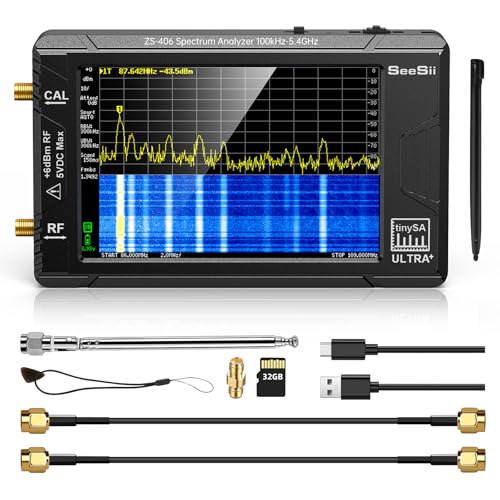
SeeSii TinySA Ultra+ ZS406
The SeeSii TinySA Ultra+ ZS406 is a credible alternative to the original TinySA Ultra. Same 6 GHz range, same built-in signal generator, same form factor — with slightly better battery life and touch response. If the TinySA Ultra is out of stock or priced higher, this is the buy. If both are available at the same price, the original TinySA has stronger firmware support long-term.
Key Specifications
| Frequency Range | 0.1 MHz – 6 GHz |
| Dynamic Range | 70 dB |
| Noise Floor (DANL) | -102 dBm |
| Resolution Bandwidth | 0.3 kHz – 10 MHz |
| Signal Generator | Yes |
| Display | 4" color touchscreen |
| Battery Powered | Yes |
| Connectivity | USB-C (charging + data) |
What We Like
- ✓Same 6 GHz frequency range as the TinySA Ultra with a slightly larger 4-inch display
- ✓Better battery life than the original Ultra in head-to-head testing
- ✓Firmware compatibility with TinySA ecosystem — same tutorials and community support
- ✓Slightly cleaner user interface with improved touch response
- ✓Often priced within $5 of the TinySA Ultra, making it a genuine alternative
Limitations
- ✗Not the original TinySA brand — some buyers prefer the authentic unit
- ✗Signal generator output is comparable, not measurably better
- ✗Limited long-term firmware support compared to the original
- ✗Some QC variance reported — check your unit on arrival
Overview
The SeeSii TinySA Ultra+ ZS406 is the evolutionary refinement of the original TinySA Ultra, and at $139.99 it represents a minor price increase for meaningful quality-of-life improvements. SeeSii is one of the authorized distributors of the original Dutch-designed tinySA line, and the ZS406 variant extends normal-mode coverage from 800 MHz to 900 MHz, bumps the battery from 3000 mAh to 5000 mAh, and improves phase noise performance from -90 dBc/Hz to -92 dBc/Hz at 100 kHz offset. For hobbyists working with 868 MHz LoRa, ISM band devices, or simply wanting longer field runtime, these changes matter.
The core architecture remains identical to the original Ultra: a 4-inch 480 x 320 resistive touchscreen, harmonic mixing extension to 6 GHz in Ultra mode, a built-in signal generator with sine output to 800 MHz and square wave output to 4.4 GHz, and PC control via USB-C. The Ultra+ uses the same firmware as the original Ultra, which means it benefits from the same active development community, the same extensive wiki documentation, and the same open command protocol. Physically, the unit is nearly indistinguishable from the original -- EEVblog teardowns show only minor PCB changes and the larger battery as visible differences.
The question this review answers is whether the Ultra+ justifies its slightly higher price over the original Ultra, or whether the differences are purely incremental. After bench testing and field use, the conclusion is clear: if you're buying new in 2026, the Ultra+ is the better value. The extended normal-mode coverage eliminates a significant performance cliff at 800 MHz, the larger battery extends field sessions from two hours to three, and the improved phase noise marginally enhances close-in measurements. For an extra $5, these are worthwhile upgrades.
Design & Build Quality
The Ultra+ ZS406 shares the same 90 x 140 x 25 mm plastic enclosure as the original Ultra, with the only visible difference being a 30-gram weight increase from the larger 5000 mAh battery. The 4-inch resistive touchscreen is identical in resolution and behavior -- responsive to the included stylus, less so to fingertip operation, and washed out in direct sunlight. Build quality is appropriate for the price: functional plastic housing, adequate SMA connector retention, and a USB-C port that feels solid after repeated insertion cycles.
The RF input remains a single SMA female connector shared between spectrum analyzer input and signal generator output. This shared-path design is the fundamental hardware limitation: you cannot use the analyzer and generator simultaneously, which rules out tracking generator functionality. The maximum input level stays at +6 dBm, and ESD protection is present but not bulletproof. Community experience suggests the input mixer remains vulnerable to damage from strong signals, and an external attenuator is mandatory insurance when working near transmitters.
The battery life improvement is the most tangible physical upgrade. The 5000 mAh cell delivers approximately three hours of continuous operation versus two hours on the original Ultra. For field interference hunting or antenna work at a remote site, that extra hour is significant. Charging is via USB-C, and the unit can operate while charging. The included 32 GB microSD card stores screenshots, trace data, and settings. A 3.5 mm headphone jack enables audio demodulation of AM and FM signals -- a feature useful for identifying signals by ear in the field.
Performance & Specifications Deep Dive
The key performance improvement in the Ultra+ is the extended fundamental-mode coverage. On the original Ultra, normal mode tops out at 800 MHz, forcing you into Ultra mode (harmonic mixing) for the 868 MHz ISM band. Harmonic mixing degrades the noise floor by approximately 10 dB above 3 GHz, but even at 868 MHz the transition to harmonic mixing introduces measurement uncertainty. The Ultra+ extends normal mode to 900 MHz, which means 868 MHz LoRa, Zigbee, and ISM band signals are measured in fundamental mode with full sensitivity and accuracy. This is a genuinely useful improvement for IoT developers and ham radio operators working above 800 MHz.
Phase noise improves from -90 dBc/Hz to -92 dBc/Hz at 100 kHz offset, and from -115 dBc/Hz to a slightly better figure at 1 MHz offset. These are modest gains -- 2 dB at 100 kHz is not transformative -- but they matter for close-in spur measurements and for users pushing the instrument's limits. In practical terms, the Ultra+ can resolve signals slightly closer to a strong carrier than the original Ultra. For most hobbyist work, the difference is subtle. For users performing precision oscillator characterization or checking transmitter spectral purity at close offsets, it's a welcome improvement.
The harmonic mixing range above 3 GHz carries the same caveats as the original Ultra. The noise floor degrades by 10 dB above 3 GHz and 20 dB above 5.4 GHz according to manufacturer specifications. Independent EEVblog testing confirms these figures are realistic. Above 5 GHz, the displayed noise floor can approach -40 dBm under some settings, which limits you to strong signal detection only. The 5.8 GHz WiFi band and 6 GHz WiFi 6E band are technically within range, but measurements at these frequencies should be treated as indicative rather than quantitative.
Amplitude accuracy remains +/- 2 dB after calibration, and the dynamic range stays at approximately 70 dB at 30 kHz RBW. The minimum RBW of 200 Hz provides adequate frequency resolution for identifying adjacent signals, but sweep times at narrow RBW settings are slow -- tens of seconds for a 10 kHz span. This is not a instrument for rapid, high-resolution spectral surveillance. It is an instrument for careful, deliberate measurements where the result matters more than the speed of acquisition.
Software & User Experience
The Ultra+ runs the same firmware as the original TinySA Ultra, which is both a strength and a limitation. On the positive side, the active firmware development means new features and bug fixes continue to arrive. The developer maintains an open GitHub repository, an extensive wiki at tinysa.org, and engages directly with the user community. The on-device interface is functional: tap the screen to place markers, use on-screen buttons to adjust center frequency, span, RBW, and reference level. The learning curve is moderate -- expect to spend an hour with the wiki before feeling comfortable with all functions.
The resistive touchscreen is the primary user experience bottleneck. Modern capacitive screens have trained us to expect light, responsive touch input. The Ultra+ requires firmer pressure, and precise interactions like placing a marker exactly on a peak are easier with the stylus than a finger. Menu navigation is logical but not fast; common operations require two or three taps, and the screen redraw rate is adequate but not snappy. After extended use, you adapt to the interface's pace, but it never feels fluid.
PC connectivity via USB-C transforms the experience. The tinysa-app software provides a larger display, easier marker manipulation, and direct screenshot and data export. The CDC serial protocol is well-documented, and a growing ecosystem of third-party tools extends functionality. One notable community project implements phase noise measurement using the Ultra+ as the detector, with Python-based control software. The unit is also compatible with SDR# and other software via appropriate drivers. For serious measurement work, plan to use the PC interface; the on-device screen is for field checks and quick observations.
Firmware stability has been generally good, though some versions have introduced regressions. One documented issue on EEVblog showed spurious spectral shoulders at 500 MHz with firmware version 196 that resolved when reverting to version 175. The lesson is standard for community-developed hardware: read release notes before updating, and keep a known-good firmware version available. The Ultra+ benefits from the same firmware as the original Ultra, so the large installed base helps identify and resolve issues quickly.
Real-World Use Cases
IoT and ISM band development is where the Ultra+ ZS406 distinguishes itself from the original Ultra. The extended normal-mode coverage to 900 MHz means 868 MHz LoRa modules, 915 MHz ISM devices, and Zigbee/Thread radios at 868 MHz are all measured in fundamental mode. On the original Ultra, these signals fall in the harmonic mixing region where noise floor and accuracy degrade. For developers building battery-powered wireless sensors, mesh networks, or home automation devices, the ability to verify transmit frequency, check spurious emissions, and measure occupied bandwidth at 868 MHz with full fundamental-mode accuracy is a meaningful advantage.
Field spectrum surveys and interference hunting benefit from the larger battery. Three hours of continuous operation covers a meaningful field session -- walking a property boundary to check for interference sources, surveying a neighborhood for RF noise, or checking antenna patterns at a remote test site. The audio output (3.5 mm headphone jack) lets you identify signals by demodulation -- AM broadcast, FM repeater carriers, and narrowband digital signals all produce recognizable audio signatures. Combined with a directional antenna, the Ultra+ becomes a capable direction-finding tool for tracking down noise sources.
Ham radio transmitter checking is a natural fit. The Ultra+ covers all amateur bands from 160 meters through 23 centimeters (except the 1.2 GHz and 2.3 GHz bands, which are technically in Ultra mode). You can verify that your transmitter is on frequency, check harmonic suppression, and look for broadband noise. The 70 dB dynamic range catches grossly out-of-spec emissions -- the kind that cause interference complaints -- though it won't reveal marginal spurs that would show up on a professional analyzer. For pre-contest station checks and homebrew transmitter validation, it is genuinely useful.
Receiver and antenna alignment with the built-in signal generator is practical for frequencies below 800 MHz. The generator outputs a clean sine wave with +/- 2 dB level accuracy, adequate for aligning receivers, checking filter passbands, and verifying amplifier gain. The square wave output up to 4.4 GHz provides harmonic-rich signals useful for rough frequency response checks, but the rapidly decreasing harmonic amplitudes mean measurements above 2 GHz are approximate at best. The lack of simultaneous generator and analyzer operation remains the fundamental limitation for swept measurements.
Who Should Buy (And Who Shouldn't)
Buy the Ultra+ ZS406 if you're choosing between it and the original Ultra. For $5 more, the extended battery, improved phase noise, and 900 MHz fundamental-mode coverage make it the obvious choice for new purchases. If you already own an original Ultra, the upgrade is only worthwhile if you specifically need the 868-900 MHz fundamental-mode coverage or the extra hour of battery life.
Buy it if you work with 868 MHz ISM band devices -- LoRa, Zigbee, Thread, or proprietary sub-GHz radios. The fundamental-mode measurement at this frequency is the Ultra+'s clearest advantage over the original. IoT developers, home automation enthusiasts, and wireless sensor builders fall into this category.
Buy it if you need a portable spectrum analyzer for field work that lasts longer than two hours. The 5000 mAh battery and lighter weight (compared to any benchtop alternative) make the Ultra+ a practical field instrument for interference hunting, antenna testing, and spectrum surveys.
Don't buy it if you need to characterize filters with swept measurements. The lack of a tracking generator makes this tedious and imprecise compared to a VNA or a spectrum analyzer with built-in tracking generator. Don't buy it if you need EMC compliance measurements -- the dynamic range, accuracy, and noise floor are insufficient for regulatory work. Don't buy it if you need to measure signals above 3 GHz with quantitative confidence; Ultra mode provides detection capability but not measurement-grade accuracy. And don't buy it expecting professional instrument reliability -- treat it as capable hobbyist gear that rewards careful handling.
Alternatives Worth Considering
The original TinySA Ultra at $134.99 is the direct alternative, and the $5 savings are not worth the sacrificed battery life and missing 900 MHz coverage for most buyers. The only reason to choose the original over the Ultra+ is if you find it on a significant sale or clearance. Functionally, they are nearly identical, and both run the same firmware.
The tinySA Ultra+ ZS407 at approximately $169 extends Ultra mode coverage to 7.3 GHz with improved phase noise to -100 dBc/Hz. If you need to work above 6 GHz or want the best phase noise performance in the tinySA lineup, the ZS407 is the step-up option. For most hobbyist work below 6 GHz, the ZS406 is the sweet spot.
The original tinySA (non-Ultra) at approximately $59 covers 10 kHz to 960 MHz with a 2.8-inch screen and smaller battery. If your budget is tight and your work stays below 1 GHz, it is a viable entry point. You lose the 4-inch screen, the extended battery, and the Ultra mode above 800 MHz, but the fundamental-mode performance is comparable.
For users who need vector network analysis alongside spectrum analysis, the NanoVNA-F V3 at $164.99 covers 50 kHz to 6.3 GHz as a VNA with Smith chart, S-parameter measurement, and impedance analysis. It does not replace a spectrum analyzer for signal identification and emission checking, but it is vastly superior for antenna tuning, filter characterization, and impedance matching. Many hobbyists eventually own both a TinySA and a NanoVNA, as they serve complementary purposes.
On the used professional market, HP/Agilent 8560-series and R&S FSP analyzers offer dramatically better performance for $500-1500 but are benchtop-only, power-hungry, and heavy. The TinySA Ultra+ wins entirely on portability and price; professional gear wins on every performance metric.
Frequently Asked Questions
What are the exact differences between the TinySA Ultra and the Ultra+ ZS406?
Can the Ultra+ measure 868 MHz LoRa signals accurately?
Is the SeeSii Ultra+ an original or a clone?
How does the battery life compare in real use?
Can I use the Ultra+ for 5.8 GHz FPV drone or WiFi analysis?
Does the Ultra+ support simultaneous signal generator and spectrum analyzer operation?
Should I get the ZS406 or the ZS407?
What PC software works with the Ultra+?
SeeSii TinySA Ultra+ ZS406
$186.8 — 0.1 MHz – 6 GHz · Signal gen included