Klein Tools
Klein Tools MM400
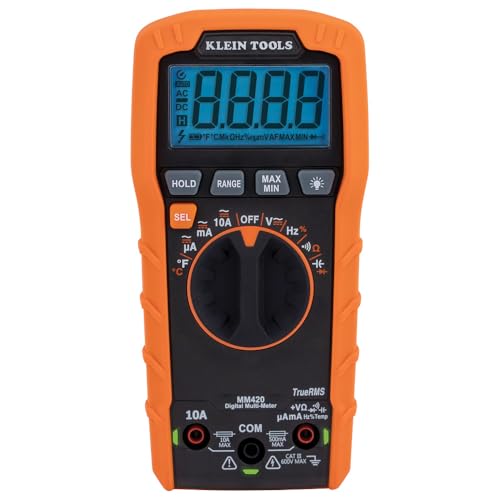
Klein Tools built its reputation with tradespeople, and the MM400 shows why. It's rugged, accurate, and designed to be used one-handed in an awkward spot. Not as technically impressive as the UT61E+, but it's the meter you want if you're doing real electrical work.
Specifications
| Display Count | 4,000 |
| CAT Rating | CAT III 600V |
| DC Voltage | 0.1mV – 600V |
| AC Voltage | 0.1V – 600V |
| Current | 0.1mA – 10A |
Features
What We Like
- ✓Rugged overmold design survives drops that would destroy cheaper meters
- ✓True RMS with CAT III 600V rating for real electrical work
- ✓Built-in NCV (non-contact voltage) tester
- ✓Temperature measurement via K-type thermocouple
- ✓Easy one-handed operation with large, well-spaced controls
Limitations
- ✗4000-count display is lower resolution than UT61E+ at similar price
- ✗No data logging or PC connectivity
- ✗Slightly bulkier than the Fluke 117 — less comfortable in tight spaces
Overview
Klein Tools built its reputation making gear for electricians who get paid to finish jobs, not admire their meters. The MM400 sits at an interesting intersection: at roughly $60, it undercuts the Fluke 117 by nearly $100 while offering true RMS measurement, CAT III 600V safety, built-in non-contact voltage detection, and temperature measurement. For tradespeople and serious DIYers, that's a compelling package.
But the MM400 isn't a Fluke clone at a discount. The 4000-count display is lower resolution than competitors at similar prices. It has no data logging, no PC connectivity, and no microamp range. The question isn't whether Klein made a good meter — they did — it's whether the trade-offs they made align with your actual work.
I've used the MM400 for home electrical projects, automotive troubleshooting, and bench work. It has never failed me on safety or delivered a reading I couldn't trust. But I've also been annoyed by its default-to-AC behavior, wished for better resolution on small signals, and noticed the bulk when working in tight electrical boxes. This review covers where the MM400 shines and where it falls short of its more expensive rivals.
Design & Build Quality
The MM400's defining physical characteristic is its ruggedness. The double-molded rubber case with integrated bump guards is built for drops — Klein rates it for 1-meter falls, and user reports suggest it survives worse. The orange and black color scheme is instantly recognizable as Klein, which matters when you're trying to find your meter in a cluttered toolbox.
At 167 x 85 x 50 mm, it's slightly bulkier than the Fluke 117. The difference is noticeable when you're reaching into a crowded electrical box with one hand. The dial is large and easy to grip with work gloves, and the button layout is logical. A magnetic hanger is built into the back — a genuinely useful feature for hands-free operation on metal panels.
The display is backlit and readable, though several users note that contrast drops at certain viewing angles, particularly with the backlight on. The included test leads are decent PVC cables with adequate shrouding. The K-type thermocouple for temperature measurement is included in the box, which is a nice touch. Battery access requires removing one screw under the rubber holster — not as convenient as Fluke's slide-out tray, but manageable.
Performance & Specifications Deep Dive
The 4000-count display is the MM400's weakest spec on paper. Compared to the UNI-T UT61E+'s 22000 counts at a lower price, the Klein looks underwhelming. In real electrical work, the difference rarely matters — you're measuring 120V AC or 12V DC, not trying to resolve microvolts. But for bench electronics, the coarser resolution is felt when checking precision references or small signal levels.
True RMS is present and verified. The MM400 handles non-sinusoidal waveforms from VFDs, dimmers, and switching power supplies accurately. AC and DC voltage accuracy is ±(0.5% + 2), matching the Fluke 117. The CAT III 600V rating is independently certified, which means you can trust this meter in breaker panels and distribution equipment.
Temperature measurement via the included thermocouple is a genuine differentiator at this price. The range covers typical HVAC and automotive needs, though accuracy depends on thermocouple quality and contact method. Capacitance measurement is included, with ranges up to 4000µF. Frequency measurement covers 0.5Hz to 50kHz.
The continuity threshold is fixed (unlike the adjustable threshold on some Fluke meters), but the beeper is fast enough for typical wiring checks. The NCV detector works for preliminary live-circuit detection, though like all integrated NCV features, it should be treated as a first check rather than definitive proof a circuit is dead.
Software & User Experience
There is no software and no connectivity. The MM400 is a standalone analog-digital hybrid in the classic sense — you turn the dial, read the display, and move on. For electricians who just need a number and don't want to fuss with drivers, cables, or apps, this is actually a feature. For data-oriented users, it's a limitation.
The user experience is built for speed in electrical work. Auto-ranging is fast and reliable. The meter defaults to AC measurement for voltage and current, which makes sense for electricians who spend most of their time on AC circuits but annoys electronics users who primarily measure DC. You must press the SEL button to switch to DC every time you power on or change ranges — a small friction point that adds up over a day of mixed work.
The data hold function works as expected. Relative mode lets you zero out a baseline reading for comparison. Min/Max recording captures the highest and lowest values since activation. The backlight stays on for a few seconds per press, which is adequate for dark cabinets but not as convenient as a meter with an always-on option.
One genuine quality-of-life issue: the dial's off position is adjacent to the voltage position, and it's easy to overshoot when turning the meter off quickly. After a few weeks of use, muscle memory fixes this, but it's a minor annoyance out of the box.
Real-World Use Cases
Residential electrical work is the MM400's home turf. Testing outlets, tracing switch legs, verifying GFCI function, and checking breaker panel voltages are all within its wheelhouse. The CAT III 600V rating provides genuine safety margin, and the NCV detector speeds up preliminary checks. The magnetic hanger is surprisingly useful when you need both hands free in a panel.
HVAC applications benefit from the temperature measurement. Checking supply and return air temperatures, measuring refrigerant line temps, and verifying thermostat wiring are straightforward. The true RMS helps with blower motor diagnostics, particularly on variable-speed systems. The fixed continuity threshold is fast enough for control wiring checks.
Automotive work covers the basics well: battery voltage, alternator output, starter current draw, and fuse continuity. The 10A current range handles most automotive circuits, though high-draw starters may need a clamp meter. The lack of a milliamp range limits its usefulness for modern sensor circuits and parasitic draw testing.
Electronics bench work is where the MM400 feels limited. The 4000-count resolution, default-to-AC behavior, and lack of microamp ranges make it slower for circuit debugging than dedicated electronics meters. It works in a pinch, but if your primary work is Arduino, Raspberry Pi, or analog circuit design, you'll find yourself wanting more resolution and DC-oriented convenience.
Who Should Buy (And Who Shouldn't)
Buy the Klein MM400 if you're a homeowner, DIY enthusiast, tradesperson, or electrician who needs a rugged, safe meter for general electrical work. The CAT III 600V rating, true RMS, temperature measurement, and rugged build make it excellent value at $60. It's the meter I recommend to friends who need something reliable for home improvement projects without breaking the bank.
Don't buy the MM400 if you're primarily an electronics hobbyist who needs high resolution, data logging, or frequent DC measurements. The 4000-count display, default-to-AC behavior, and lack of connectivity make it frustrating for bench work. For pure electronics, the UNI-T UT61E+ offers dramatically better specs at a lower price. Also avoid it if you need dedicated milliamp ranges for sensor or control loop work — the single 10A range is too coarse for precision low-current measurements.
Alternatives Worth Considering
The Fluke 117 at ~$160 is the obvious upgrade for professionals. It offers the same CAT III 600V rating with better brand recognition, superior test leads, and legendary durability. The MM400 matches most of the 117's electrical capabilities but lacks the refinement, display contrast, and long-term reliability reputation. For electricians who use their meter daily, the 117's extra cost amortizes quickly.
The UNI-T UT61E+ at ~$50 is a radically different alternative. It has no temperature measurement and questionable safety ratings, but offers 22000 counts, USB data logging, and higher DC accuracy. For bench-bound electronics work, the UT61E+ is the better tool. For field electrical work, the MM400's safety certification and ruggedness win decisively.
The AstroAI AM33D at ~$23 is the budget option. It lacks true RMS, auto-ranging, and temperature measurement, but handles basic voltage and continuity checks. If you only need a meter for occasional battery testing and fuse checks, the AM33D saves money. Anyone doing regular electrical work will quickly appreciate the MM400's auto-ranging and true RMS enough to justify the extra $35.
Frequently Asked Questions
Does the Klein MM400 have true RMS?
Why does the MM400 default to AC measurement?
How accurate is the temperature measurement?
Can the MM400 measure milliamp or microamp currents?
Is the NCV detector reliable?
How durable is the MM400 really?
Does the backlight stay on continuously?
Klein Tools MM400
$59.99 — CAT III 600V · 4,000 count