Micsig MHO14-200 vs Rigol DHO914S
Head-to-head spec comparison to help you pick the right scope for your bench.
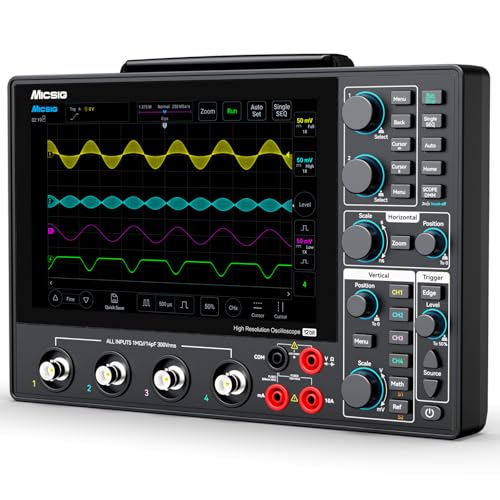
Micsig
$799.99
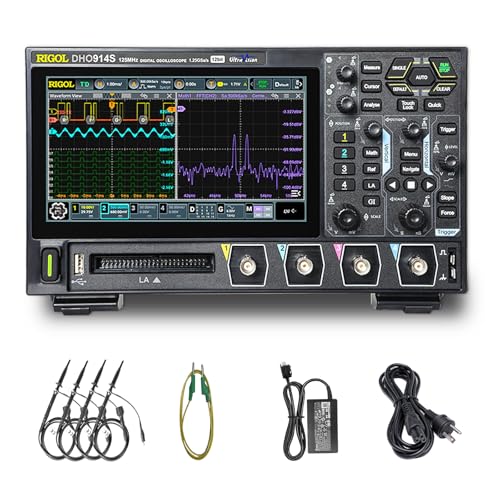
Rigol
$769
Spec-by-Spec Comparison
| Spec | Micsig MHO14-200 | Rigol DHO914S |
|---|---|---|
| Bandwidth | 200 MHz | 125 MHz |
| Sample Rate | 1 GSa/s | 1.25 GSa/s |
| Channels | 4 | 4 |
| Memory Depth | 110 Mpts | 50 Mpts |
| Display Size | 8" | 7" |
| Weight | 1.5 kg | 1.78 kg |
| Price | $799.99 | $769 |
| Rating | 7.5/10 | 8.0/10 |
| Protocol Decoder | Yes | Yes |
| Function Gen | No | Yes |
| WiFi | Yes | Yes |
| Battery | Yes | No |
| Buy on Amazon | Buy on Amazon |
Pros & Cons
Micsig MHO14-200
Pros
- 12-bit ADC with 200MHz bandwidth in a tablet form factor — nothing else combines these specs portably
- 16000mAh battery provides genuine all-day field use without power anxiety
- 8-inch anti-glare IPS display at 1280x800 — sharp and usable outdoors
- 110Mpt memory depth is exceptional for a portable instrument
- Built-in multimeter — one less tool to carry in the field
- Only 31mm thin and 1.5kg — genuinely tablet-sized portability
Cons
- At ~$888, this is significantly more expensive than benchtop alternatives with similar specs
- Micsig is a smaller brand — community support and documentation are limited compared to Rigol or Siglent
- 1GSa/s sample rate is modest for 200MHz bandwidth
- No function generator
- The portability premium is steep — a DHO924S at $449 outperforms it on a bench
Rigol DHO914S
Pros
- Built-in 25MHz arbitrary waveform generator — saves buying a separate signal source
- 16 digital channels available via optional logic probe — true mixed-signal capability
- 12-bit ADC with 125MHz bandwidth is a solid all-around combination
- 50Mpt memory depth matches the DHO924S
- Same compact DHO form factor with USB-C power support
- Bode plot analysis built in — useful for filter and feedback loop characterization
Cons
- At ~$549, you're paying $100 more than the DHO924S which has 250MHz bandwidth
- 125MHz bandwidth is lower than the DHO924S's 250MHz
- Logic analyzer probe is an additional purchase — not included
- Fan noise is present, consistent with the DHO series
- The DHO924S also includes a function generator, making the price gap harder to justify
Our Verdicts
Micsig MHO14-200
The Micsig MHO14-200 is the most impressive portable oscilloscope I've seen — a 12-bit, 200MHz, 4-channel scope with 110Mpt memory and an all-day battery in a package thinner than most tablets. For field work where you genuinely need oscilloscope capability away from a bench — automotive diagnostics, industrial maintenance, on-site embedded debugging — nothing else comes close to this combination of specs and portability. The 16000mAh battery and anti-glare display are clearly designed by people who've actually used scopes outdoors. At ~$888, you're paying a substantial portability premium. A Rigol DHO924S at $449 will outperform it on every spec except portability and battery life. This scope makes perfect sense for field engineers and automotive technicians. For bench-only hobbyists, it's hard to justify over the benchtop alternatives at half the price.
Rigol DHO914S
The Rigol DHO914S is Rigol's Swiss Army knife oscilloscope — 4 analog channels, a 25MHz function generator, optional 16-channel logic analyzer, and Bode plot analysis in the compact DHO form factor. The mixed-signal capability is the real differentiator: if you're debugging embedded systems where you need to correlate analog and digital signals simultaneously, the logic analyzer option makes this genuinely useful in ways a pure analog scope isn't. The built-in AWG saves you $100-200 on a standalone function generator. The catch is the DHO924S at $449 — it also has a function generator and offers 250MHz bandwidth for $100 less. The DHO914S only pulls ahead if you need the logic analyzer capability or the Bode plot feature for control loop design. For pure oscilloscope work, the DHO924S remains the better value.