FNIRSI 1014D vs Rigol DHO914S
Head-to-head spec comparison to help you pick the right scope for your bench.
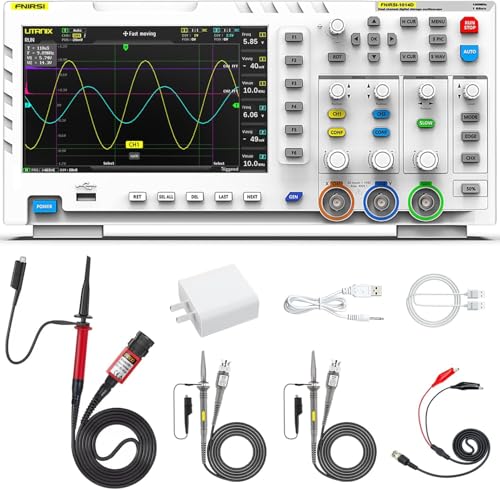
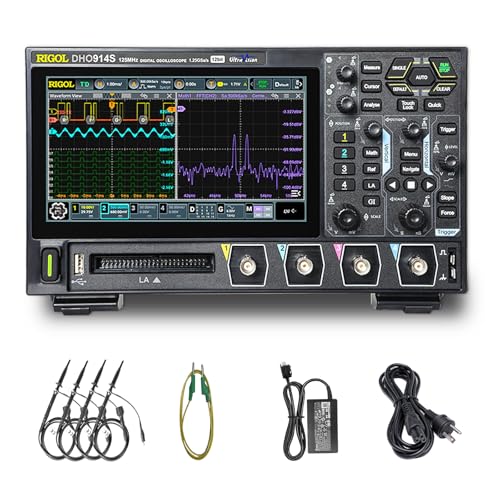
Spec-by-Spec Comparison
| Spec | FNIRSI 1014D | Rigol DHO914S |
|---|---|---|
| Bandwidth | 100 MHz | 125 MHz |
| Sample Rate | 1 GSa/s | 1.25 GSa/s |
| Channels | 2 | 4 |
| Memory Depth | 240 Kpts | 50 Mpts |
| Display Size | 7" | 7" |
| Weight | 0.68 kg | 1.78 kg |
| Price | $169.99 | $769 |
| Rating | 5.5/10 | 8.0/10 |
| Protocol Decoder | No | Yes |
| Function Gen | Yes | Yes |
| WiFi | No | Yes |
| Battery | No | No |
| Buy on Amazon | Buy on Amazon |
Pros & Cons
FNIRSI 1014D
Pros
- Affordable entry point around $170
- Built-in function generator is rare at this price
- 7-inch touchscreen in a portable tablet form factor
- Touchscreen interface is genuinely intuitive for beginners
- 100MHz bandwidth is impressive for a sub-$200 scope
Cons
- 240Kpt memory depth is dangerously shallow — you'll hit this limit fast
- Build quality is plasticky; the corners flex under light pressure
- Calibration and accuracy lag well behind established brands
- No protocol decoding — can't decode SPI or I2C
- Firmware updates have been inconsistent
Rigol DHO914S
Pros
- Built-in 25MHz arbitrary waveform generator — saves buying a separate signal source
- 16 digital channels available via optional logic probe — true mixed-signal capability
- 12-bit ADC with 125MHz bandwidth is a solid all-around combination
- 50Mpt memory depth matches the DHO924S
- Same compact DHO form factor with USB-C power support
- Bode plot analysis built in — useful for filter and feedback loop characterization
Cons
- In the upper-$700s, it costs more than the DHO804 while offering lower bandwidth than the DHO924S
- 125MHz bandwidth is lower than the DHO924S's 250MHz
- Logic analyzer probe is an additional purchase — not included
- Fan noise is present, consistent with the DHO series
- The DHO924S also includes a function generator, making the price gap harder to justify
Our Verdicts
FNIRSI 1014D
The FNIRSI 1014D is one of the cheapest ways to get a real oscilloscope on your bench. At around $170, it's hard to complain about 100MHz bandwidth and a built-in signal generator — both of which would cost more from many established bench-scope brands. The honest limitation is the 240Kpt memory depth, which is genuinely painful the moment you try to capture anything longer than a few milliseconds at full sample rate. I'd call this a learning tool, not a precision instrument. If you just want to see what your Arduino signals look like and learn what triggering means, it's a solid starting point. But if you need to trust your measurements or capture serial transactions, save up for a Rigol or Siglent — you'll thank yourself later.
Rigol DHO914S
The Rigol DHO914S is Rigol's Swiss Army knife oscilloscope — 4 analog channels, a 25MHz function generator, optional 16-channel logic analyzer, and Bode plot analysis in the compact DHO form factor. The mixed-signal capability is the real differentiator: if you're debugging embedded systems where you need to correlate analog and digital signals simultaneously, the logic analyzer option makes this genuinely useful in ways a pure analog scope isn't. The built-in AWG saves you $100-200 on a standalone function generator. The catch is that pure oscilloscope buyers can either spend less on a DHO804 or spend more on the 250MHz DHO924S. The DHO914S only pulls ahead if you need the logic analyzer capability or the Bode plot feature for control loop design.