FNIRSI 1014D vs Hantek DSO5072P
Head-to-head spec comparison to help you pick the right scope for your bench.
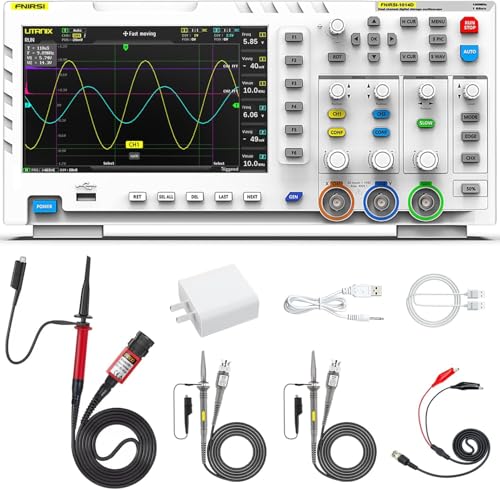
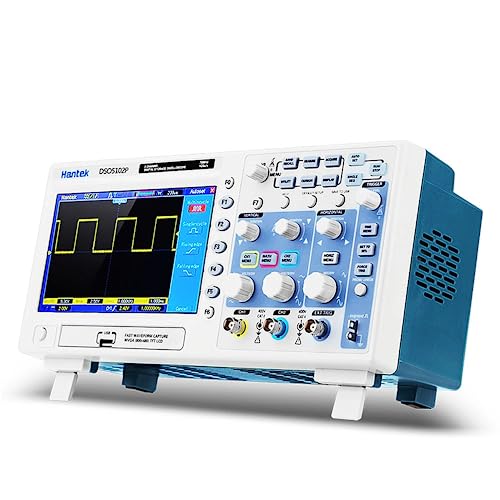
Spec-by-Spec Comparison
| Spec | FNIRSI 1014D | Hantek DSO5072P |
|---|---|---|
| Bandwidth | 100 MHz | 70 MHz |
| Sample Rate | 1 GSa/s | 1 GSa/s |
| Channels | 2 | 2 |
| Memory Depth | 240 Kpts | 40 Kpts |
| Display Size | 7" | 7" |
| Weight | 0.68 kg | 2 kg |
| Price | $169.99 | $454.89 |
| Rating | 5.5/10 | 6.0/10 |
| Protocol Decoder | No | No |
| Function Gen | Yes | No |
| WiFi | No | No |
| Battery | No | No |
| Buy on Amazon | Buy on Amazon |
Pros & Cons
FNIRSI 1014D
Pros
- Affordable entry point around $170
- Built-in function generator is rare at this price
- 7-inch touchscreen in a portable tablet form factor
- Touchscreen interface is genuinely intuitive for beginners
- 100MHz bandwidth is impressive for a sub-$200 scope
Cons
- 240Kpt memory depth is dangerously shallow — you'll hit this limit fast
- Build quality is plasticky; the corners flex under light pressure
- Calibration and accuracy lag well behind established brands
- No protocol decoding — can't decode SPI or I2C
- Firmware updates have been inconsistent
Hantek DSO5072P
Pros
- Traditional benchtop form factor — looks and feels like a real scope
- 70MHz bandwidth handles most hobbyist signals without complaint
- Traditional bench layout is useful if you find it discounted below $200
- Simple, button-based interface is easy to learn
Cons
- Only 2 channels limits simultaneous signal debugging
- 40Kpt memory depth is embarrassingly shallow by modern standards
- No protocol decoding — SPI and I2C debugging is impossible
- Fan can be noisy enough to notice in a quiet room
- No software update path to improve functionality
Our Verdicts
FNIRSI 1014D
The FNIRSI 1014D is one of the cheapest ways to get a real oscilloscope on your bench. At around $170, it's hard to complain about 100MHz bandwidth and a built-in signal generator — both of which would cost more from many established bench-scope brands. The honest limitation is the 240Kpt memory depth, which is genuinely painful the moment you try to capture anything longer than a few milliseconds at full sample rate. I'd call this a learning tool, not a precision instrument. If you just want to see what your Arduino signals look like and learn what triggering means, it's a solid starting point. But if you need to trust your measurements or capture serial transactions, save up for a Rigol or Siglent — you'll thank yourself later.
Hantek DSO5072P
The Hantek DSO5072P only makes sense as a budget benchtop scope when you find it below about $200. At the current marketplace price near $455, skip it. The 70MHz bandwidth and 7-inch display are fine for basic analog checks, but the 40Kpt memory depth is almost unusably shallow next to modern alternatives, and there is no protocol decoding for SPI or I2C. If you need a real first scope, the Rigol DS1054Z gives you 4 channels, deep memory, protocol decoding, and far better community support for less money. If you want a modern touchscreen workflow, the Rigol DHO804 is the cleaner buy.