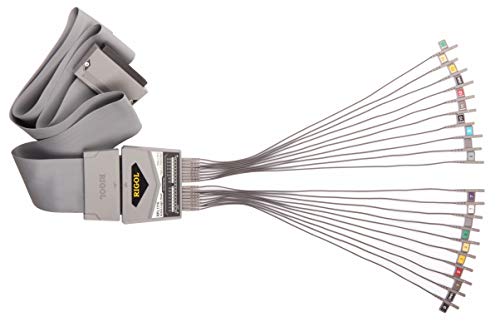
Rigol
Rigol RP2200A
If you own a Rigol scope, the RP2200A is the probe you should have. It's designed to compensate correctly with Rigol's hardware, ships with all the accessories you need, and the 200MHz bandwidth handles everything a hobbyist throws at it.
Specifications
| Bandwidth | 200 MHz |
| Attenuation | 1X/10X switchable |
| Probe Type | Passive |
| Lead Length | 1.2 m |
| Input Capacitance | 16 pF |
| Rise Time | 1.75 ns |
| Includes Accessories | Yes |
Compatible Scopes
What We Like
- ✓Designed to compensate correctly with Rigol oscilloscopes
- ✓200MHz bandwidth matches or exceeds most hobbyist scope bandwidth
- ✓Complete accessory kit included (hook tip, ground spring, IC clip)
- ✓Rigol brand warranty and consistent quality control
- ✓Auto-detection on DHO-series scopes — sets attenuation automatically
Limitations
- ✗Compensation may need tweaking on non-Rigol scopes
- ✗$35 vs $20 for the Hantek — worth it only if you own a Rigol
- ✗1X mode is rarely useful at 200MHz — mostly a 10X probe in practice
Overview
The Rigol RP2200A is the probe Rigol wants you to use with their scopes. At $35, it costs nearly twice what generic alternatives like the Hantek PP-250 charge, but it ships with a complete accessory kit and compensates correctly with Rigol hardware out of the box. For Rigol scope owners, that compatibility is worth paying for.
With 200MHz bandwidth, 1X/10X switching, and an accessory pouch that includes a ground spring (take note, Hantek), the RP2200A removes the guesswork from probe selection. The auto-detection feature on DHO-series scopes automatically sets channel attenuation when you plug in the probe -- a small convenience that adds up over a long debugging session.
I have used RP2200A probes on a Rigol DS1054Z and DHO924S. The compensation is consistently closer to ideal than third-party probes, and the build quality inspires more confidence than budget alternatives. This review examines whether the RP2200A's OEM premium is justified or whether you are paying for a logo.
Design & Build Quality
The RP2200A feels like a proper probe. The body is denser plastic than the Hantek PP-250, with a smooth matte finish that resists fingerprints. The 1X/10X switch has a firmer detent and a clearer label. At 1.2 meters, the cable length matches industry standard, and the cable itself is more supple than the stiffer Hantek equivalent.
The accessory kit is where the RP2200A justifies its price over generics. Included are: compensation adjustment tool, sprung hook tip, ground lead, ground spring, locating sleeve, IC clip, and color-coded rings. The ground spring is the standout item -- it is essential for clean high-frequency measurements, and its inclusion saves you a separate purchase.
The BNC connector is standard and fits securely. On DHO-series scopes, the probe's auto-sense pin communicates attenuation to the scope automatically, eliminating the manual channel setup step. This is a genuine quality-of-life improvement that you miss when switching to generic probes.
One minor gripe: the 1X mode is rarely useful at 200MHz. In practice, this is a 10X probe with a 1X option for low-frequency work. The 1X bandwidth drops to about 6MHz, same as other passive probes.
Performance & Specifications Deep Dive
The 200MHz bandwidth is well-matched to Rigol's most popular hobbyist scopes. A DS1054Z (50MHz) or MSO5074 (70MHz) will never challenge this probe. A DS1104Z-S (100MHz) is comfortable. Even a DHO924S (200MHz) is adequately served, though at the upper limit you are starting to push the probe's capability.
Rise time is specified at 1.75ns, which is consistent with 200MHz bandwidth. In practice, the RP2200A shows cleaner edges than the Hantek PP-250 on Rigol scopes, not because the Hantek is worse, but because the Rigol probe is factory-tuned for Rigol's input capacitance. Generic probes can achieve equivalent performance with careful compensation, but the RP2200A gets there faster and holds compensation better across temperature changes.
Input capacitance of 16pF is slightly lower than the Hantek PP-250's 18pF. This small difference reduces circuit loading on high-impedance nodes and can matter when probing sensitive analog circuits. The compensation range covers 10-30pF, accommodating all common scope inputs.
The 300V RMS rating in 10X mode is standard for this class. It handles typical electronics voltages but is not a high-voltage probe. Do not use it for direct mains measurements.
Software & User Experience
The RP2200A has no software, but the auto-detection feature on compatible Rigol scopes creates a software-like convenience. When you plug the probe into a DHO-series scope, the scope reads the probe's coding pin and automatically sets the channel attenuation to 10X. No manual menu diving, no forgotten attenuation settings causing confusing readings.
For scopes without auto-detection, setup is standard: connect BNC, set the probe switch, adjust compensation using the scope's calibrator output, and verify the channel attenuation setting matches the probe. The compensation trimmer is accessible and adjusts smoothly.
The hook tip is well-designed and holds securely on component leads and test points. The included IC clip is genuinely useful for grabbing IC legs without shorting adjacent pins. The ground spring provides a much shorter ground path than the alligator lead, dramatically improving signal fidelity on fast edges.
One user experience advantage over generics: Rigol's consistent quality control means probe-to-probe variation is minimal. With budget probes, you occasionally get a unit with a scratchy trimmer or loose BNC. The RP2200A's QC is noticeably tighter.
Real-World Use Cases
Rigol scope owners should consider the RP2200A their default probe. Whether you are debugging an Arduino project, characterizing a switching power supply, or verifying digital communication protocols, the probe's matched compensation and auto-detection streamline the workflow. On a DHO924S, the automatic attenuation setting alone saves enough menu-diving time to justify the price premium over generics.
Educational and lab environments benefit from the consistent quality. When multiple students or technicians share equipment, having probes that compensate reliably and communicate their settings to the scope reduces setup errors. The included accessory kit means you have the right tip for almost any probing situation without raiding the parts bin.
The RP2200A is particularly good for mixed-signal work where you switch between analog and digital domains. The 10X mode handles DC rails and analog signals with minimal loading, while the 1X mode provides full sensitivity for low-voltage logic and audio work. The quick switch between modes is faster than swapping probes.
Where it is less ideal: non-Rigol scopes. While the probe will physically connect and compensate on any scope with a standard BNC, you lose the auto-detection feature and the factory-matched compensation optimization. On a Siglent or Keysight scope, a generic probe or that scope's OEM equivalent is usually the better choice.
Who Should Buy (And Who Shouldn't)
Buy the Rigol RP2200A if you own a Rigol oscilloscope and want a hassle-free probe that matches your hardware. The auto-detection on DHO-series scopes, included ground spring, and factory-matched compensation make it the logical choice. At $35, it is not cheap compared to generics, but the time saved and accessories included make it good value.
Also buy it if you run a lab, classroom, or shared workspace where probe consistency and reduced setup errors matter. The tight quality control and complete accessory kit minimize the support burden.
Do not buy the RP2200A if you do not own a Rigol scope. The premium is largely for Rigol-specific optimization, and without auto-detection, you are paying for a feature you cannot use. Generic probes like the Hantek PP-250 provide equivalent bandwidth at half the price for non-Rigol owners. Also skip it if you need bandwidth above 200MHz -- look at 350MHz or 500MHz probes instead.
Alternatives Worth Considering
The Hantek PP-250 at ~$20 for two probes is the obvious budget alternative. You get more bandwidth (250MHz) and two probes for less than the price of one RP2200A. The trade-off is no ground spring, lighter build quality, and no Rigol auto-detection. For hobbyists on tight budgets, the Hantek is the smarter buy unless you specifically need the Rigol integration.
The Siglent PP215 at ~$30 is the equivalent for Siglent scope owners. It offers a spring-loaded hook tip and optimized compensation for Siglent hardware. With 150MHz bandwidth, it is more limited than the RP2200A but perfectly matched to Siglent's SDS1000X-E series. Siglent owners should buy this instead of the Rigol probe.
For users who need more bandwidth, the Siglent SP2035A at ~$60 offers 350MHz with auto-sense capability. It is a significant step up from the RP2200A and worth considering if you own a 200MHz+ scope and want a probe that will not limit your instrument's performance.
Frequently Asked Questions
Does the RP2200A work with non-Rigol scopes?
What is auto-detection and which scopes support it?
Is the included ground spring actually useful?
What is the real bandwidth in 1X mode?
How does the RP2200A compare to the older RP2200?
Can I use the RP2200A for high-voltage measurements?
Rigol RP2200A
$199 — 200 MHz passive probe