Pomona
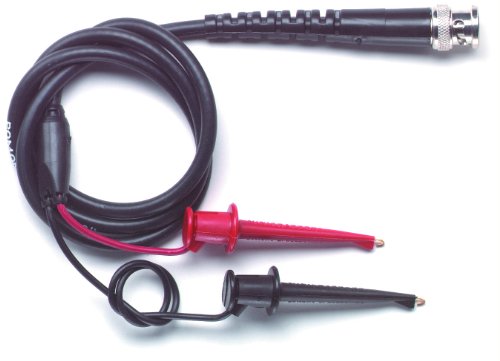
Pomona 5518 Micro-Grabber Clip Set
When you need to hold a probe on a tiny IC pin with both hands free, the Pomona micro-grabbers are what professionals use. These are a must-buy if you do any SMD work — the alligator clips that come with your scope are useless for fine-pitch components.
Specifications
| Bandwidth | 50 MHz |
| Attenuation | 1X (direct) |
| Probe Type | Passive |
| Lead Length | 0.3 m |
| Input Capacitance | 5 pF |
| Rise Time | 7 ns |
| Includes Accessories | No |
Compatible Scopes
What We Like
- ✓Micro-grabbers hold securely on fine-pitch IC pins and SMD pads
- ✓Pomona is the professional standard — labs and field engineers use these
- ✓Spring mechanism is durable and holds without slipping
- ✓Works with any probe tip adapter or direct banana connection
- ✓Frees both hands for component manipulation while probing
Limitations
- ✗These are clip accessories, not a complete probe — you need a probe too
- ✗Not suitable for high-frequency signals above ~50MHz
- ✗Learning curve to properly grab fine-pitch pins without bridging
Overview
The Pomona 5518 is not a probe -- it is a precision grip for probes. At $29 for a set of micro-grabbers, it solves a problem that every electronics hobbyist eventually faces: how to hold a probe on a tiny SMD pin without shorting the adjacent three. Pomona has been the professional standard for test accessories since 1951, and the 5518 shows why.
These clips grab securely onto 0.5mm-pitch IC legs, SMD resistor pads, and microconnector pins. The spring mechanism is precise, the grip is positive, and the insulation keeps you from bridging pins you did not intend to touch. But they are not a complete measurement solution -- you still need a probe to attach them to, and their 50MHz bandwidth limit means they are useless for high-speed digital work.
I have used Pomona 5518s for SMD rework verification, I2C bus debugging on densely packed PCBs, and holding scope probes on fine-pitch components while both hands manipulate a soldering iron. They are one of those tools you do not know you need until the first time you use them, and then you wonder how you worked without them. This review covers when they are essential and when cheaper alternatives will do.
Design & Build Quality
The 5518 consists of four miniature grabber clips attached to color-coded 6-inch leads that terminate in standard 0.025-inch square sockets. The clips themselves are precision-machined stainless steel with a heat-resistant plastic body. The spring tension is calibrated to hold securely on 0.3mm to 1.0mm leads without slipping or crushing.
Build quality is exactly what you expect from Pomona -- professional-grade, consistent, and durable. The clips open smoothly, close positively, and maintain tension after hundreds of cycles. The insulation on the leads is flexible silicone that resists melting if you accidentally touch a soldering iron to it. The color coding (red, black, yellow, green) helps keep track of multiple signals in a crowded setup.
The included leads are only 6 inches long, which is both a feature and a limitation. The short length minimizes inductance and keeps your probe setup compact, but it also means you need to position your scope close to the circuit under test. For most bench work, 6 inches is plenty. For debugging inside an enclosure, you may need extension leads.
One thoughtful detail: the clips are small enough to fit side-by-side on standard 0.1-inch headers, making them useful for Arduino and Raspberry Pi debugging as well as fine-pitch SMD work.
Performance & Specifications Deep Dive
The 50MHz bandwidth and 7ns rise time are the hard limits of this accessory. These numbers are not about the clip mechanism itself -- the metal clip could conduct much higher frequencies -- but about the lead inductance and the practical realities of gripping tiny components. For I2C, SPI, UART, and analog signals below about 20MHz, the 5518 performs flawlessly. For USB, high-speed SPI, or RF work, the ringing and signal degradation become unacceptable.
Input capacitance is approximately 5pF, which is remarkably low and minimizes circuit loading. This is a genuine advantage over hook tips and alligator clips, which present more capacitance to the circuit. When probing high-impedance analog nodes or crystal oscillator pins, the lower loading of the 5518 can mean the difference between a circuit that oscillates correctly and one that stops when probed.
The clips grip with enough force to maintain contact through moderate vibration but not so much that they damage delicate component leads. On 0402 resistors and capacitors, the clips grab the pad edges rather than the component body, which is the correct technique. On SOIC and TQFP packages, they clip individual pins securely without touching neighbors on 0.5mm pitch.
Current handling is not specified by Pomona, but the clip cross-section suggests a few hundred milliamps maximum. These are signal clips, not power clips. Do not use them for current shunt measurements or power supply testing.
Software & User Experience
There is no software. The Pomona 5518 is purely mechanical, and the user experience is all about physical dexterity. Attaching a clip to a 0.5mm-pitch pin requires a steady hand and good lighting. The first few attempts will feel awkward, and you will occasionally bridge adjacent pins. After an hour of practice, the motion becomes natural.
The clips connect to any standard probe tip or banana plug via the 0.025-inch socket. Most scope probe accessories include an adapter that fits this socket. The Rigol RP2200A and Siglent PP215 both include tips that mate directly with Pomona sockets. If your probe does not, a simple banana-to-socket adapter bridges the gap.
The real user experience benefit is hands-free operation. Once clipped, the probe stays put. You can scroll through scope menus, adjust the circuit, or pick up a soldering iron without losing your measurement point. This is transformative for debugging sessions that involve iterative changes and repeated measurements.
Color coding helps when using multiple clips. I standardize on red for clock, yellow for data, green for chip select, and black for ground. This convention makes dense logic analyzer and scope captures easier to interpret at a glance.
Real-World Use Cases
SMD debugging is where the 5518 earns its keep. Probing a QFN package with a standard hook tip is an exercise in frustration -- the tip slips, bridges adjacent pins, or applies enough pressure to shift the component. The 5518 clips onto individual pins and stays there, freeing both hands for oscilloscope operation or soldering work. I have used them to debug I2C communication on a 0.5mm-pitch accelerometer where no other probing method was reliable.
Arduino and Raspberry Pi prototyping also benefits. The clips fit standard 0.1-inch header pins and provide a more secure connection than loose jumper wires. When debugging SPI or I2C buses on breadboards, the 5518s eliminate the intermittent contacts that plague loose connections.
Rework verification is another strong use case. After replacing a fine-pitch IC, you need to verify power, ground, and critical signals before declaring success. The 5518s let you attach probes to the new chip's pins without risking mechanical damage during the fragile post-rework phase.
The 5518 is not suitable for through-hole work on standard 0.1-inch grids -- regular hook tips or clips are faster and cheaper for that. It is also useless for high-speed digital above 20MHz or any RF work. Know its limits and it will serve you well.
Who Should Buy (And Who Shouldn't)
Buy the Pomona 5518 if you work with SMD components, fine-pitch ICs, or densely packed PCBs where standard probe tips cannot reliably contact individual pins. It is essential for anyone debugging modern electronics where 0.5mm pitch is common and 0.4mm pitch is not unusual. The time saved and frustration avoided justify the $29 price after just a few debugging sessions.
Also buy it if you do frequent rework and need a gentle, precise way to verify signals on freshly soldered components. The clip force is calibrated for delicate work in a way that cheap alternatives rarely match.
Do not buy the 5518 if you only work with through-hole components, large connectors, or standard 0.1-inch headers. A standard hook tip or grabber clip handles those situations at a fraction of the cost. Also skip it if your work involves signals above 20MHz -- the bandwidth limitation makes it unsuitable for USB, high-speed SPI, or RF debugging.
Alternatives Worth Considering
Cheap generic micro-grabbers at ~$8-12 for a set of 10 are the obvious budget alternative. They look similar to the Pomona 5518 but the difference in quality is immediately apparent. Generic clips have weaker springs, looser tolerances, and insulation that melts at lower temperatures. For occasional use, they are adequate. For daily work, the Pomona is worth the premium.
The Pomona 6242-0 set offers a different tip style -- needle probes instead of grabbers -- for $35. These are better for piercing insulation or probing through conformal coating but less secure on smooth component leads. Choose based on your specific probing needs.
For high-speed digital work where the 5518's 50MHz bandwidth is limiting, consider solder-in probe tips or a logic analyzer with dedicated grabber probes. Saleae and similar logic analyzers include fine-pitch clips that handle much higher speeds than passive probe accessories, though they measure digital-only.
Frequently Asked Questions
Do I need a separate probe to use the Pomona 5518?
What pitch can the 5518 reliably grip?
Can the 5518 handle high frequencies?
How durable are the clips?
Are there cheaper alternatives that work as well?
Can I use these with a multimeter?
Pomona 5518 Micro-Grabber Clip Set
$40.09 — 50 MHz passive probe