Fluke
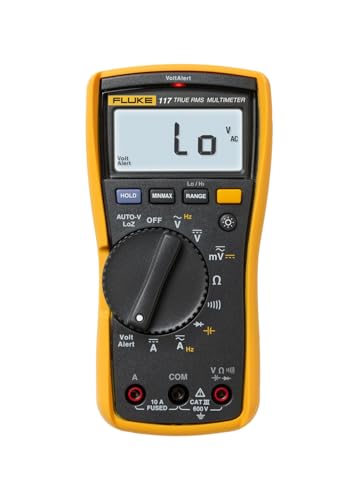
Fluke 117
The Fluke 117 is what every electrician has in their bag. True RMS, built-in non-contact voltage tester, and Fluke's legendary durability. It's expensive, but it'll outlast every cheap meter you've ever owned combined.
Specifications
| Display Count | 6,000 |
| CAT Rating | CAT III 600V |
| DC Voltage | 0.1mV – 600V |
| AC Voltage | 0.1V – 600V |
| Current | 0.01mA – 10A |
Features
What We Like
- ✓Built-in non-contact voltage tester (VolTect) — fastest way to confirm hot wires
- ✓True RMS handles motor loads, variable frequency drives, and non-sinusoidal waveforms
- ✓CAT III 600V safety rating for panel work and residential electrical
- ✓Fluke's legendary build quality — will outlast most tools you own
- ✓Low-impedance mode (LoZ) prevents false readings from phantom voltage
Limitations
- ✗$160 is expensive compared to capable alternatives under $60
- ✗No PC connectivity or data logging
- ✗6000-count display is lower resolution than some competitors at half the price
Overview
At $160, the Fluke 117 sits in that uncomfortable middle ground where hobbyists wince and electricians nod knowingly. It's not the cheapest true RMS meter you can buy, and it lacks the flashy feature lists of meters half its price. But walk onto any job site and you'll see the 117 clipped to belts, stuffed in bags, and trusted with live circuits that would make cheaper meters catch fire.
The core question this review answers is simple: does the Fluke 117 earn its price tag for someone who isn't billing by the hour? With a 6000-count display, CAT III 600V safety rating, built-in non-contact voltage detection (VoltAlert), and true RMS measurement, it covers the fundamentals well. But there's no PC connectivity, no data logging, and no milliamp or microamp range — features that electronics hobbyists often expect.
I've used the 117 for everything from tracing live wires in a breaker panel to checking continuity on guitar pedals. It has never let me down on safety or accuracy. But I've also reached for other meters when I needed higher resolution or computer logging. This review is about where the 117 shines, where it frustrates, and whether it deserves a spot on your bench.
Design & Build Quality
The Fluke 117 is compact — 167 x 84 x 46 mm — and surprisingly light at 550g with the battery installed. It fits in one hand comfortably, which matters more than you'd think when you're holding probes in the other and trying to read a display in a dark electrical cabinet. The rubber overmold holster is integrated rather than a slip-on sleeve, and it survives drops that would shatter the cases of lesser meters.
The rotary dial has a satisfying detent action with clear position stops. Unlike cheap meters where the dial feels like it's grinding through sand, the 117's switch is precise. The buttons — yellow for secondary functions, blue for backlight and hold — are well-spaced and usable with gloved hands.
The included TL-75 test leads are a common complaint. They're PVC, not silicone, which means they get stiff in cold weather and have significant memory. Several electricians on forums recommend upgrading to Fluke's TL-71 silicone leads. The probes themselves are shrouded and meet the CAT III rating, but the cable flexibility is disappointing on a $160 tool. There's also no carry case in the box — a puzzling omission at this price.
Performance & Specifications Deep Dive
The 6000-count display is the first spec that raises eyebrows. The UNI-T UT61E+ offers 22000 counts for one-third the price, and even budget meters are hitting 4000-6000 counts now. In practice, the 117's resolution is fine for electrical work — you're rarely measuring anything where 0.1mV resolution matters when checking a 120V outlet. But on a bench, comparing power supply ripple or measuring small signal voltages, the coarser resolution is noticeable.
Where the 117 earns its keep is accuracy and safety. The true RMS converter handles non-sinusoidal waveforms from variable frequency drives and dimmer switches with ±(1.0% + 3) accuracy on AC volts. DC voltage accuracy is ±(0.5% + 2), which is solid if not exceptional. The AutoVolt feature automatically detects AC or DC and switches ranges — genuinely useful when you're not sure what you're probing.
The LoZ (low impedance) mode is underrated. It places a ~3kΩ load across the inputs, which eliminates phantom voltage readings from capacitive coupling in long wire runs. On forums, electricians call this feature a time-saver for troubleshooting ghost voltages in residential wiring. The downside is that LoZ mode can trip RCD/GFCI breakers, so you need to be aware of what you're connected to.
The biggest spec limitation is current measurement. The 117 has a single 10A range with 1mA resolution. There is no dedicated milliamp or microamp range. For HVAC work or 4-20mA loop testing, this is genuinely annoying. One user on Fluke's site noted that reading a 4-20mA sensor signal shows as 0.004-0.020A, which works but feels clumsy compared to a meter with a dedicated mA jack.
Software & User Experience
There is no software. No USB port, no Bluetooth, no data logging, no firmware updates. The Fluke 117 is deliberately analog in its approach — you read the display and write down the number. For electricians who just need a reliable reading and move on, this is fine. For hobbyists who want to log power supply drift over an hour or capture min/max values automatically, it's a limitation.
The interface itself is excellent. The display is backlit with a white LED that's bright enough for dark cabinets without washing out at angles. The bar graph updates at 32 segments per second, giving you a useful analog feel for changing signals. Auto-ranging is fast and accurate; manual override is available when you want to lock a range.
Min/Max/Average recording is available and works well for capturing intermittent events. Data Hold freezes the display. The continuity beeper is fast — it responds to opens and shorts of 500μs or longer, which is quick enough for most troubleshooting. The VoltAlert non-contact voltage detector has high and low sensitivity modes. In practice, the low mode is more useful for distinguishing live wires from nearby induced voltage, though NCV in any handheld meter should be treated as a preliminary check, not gospel.
Real-World Use Cases
Residential electrical troubleshooting is where the 117 dominates. Tracing a dead outlet, confirming a switch leg, checking for phantom voltage in a three-way switch circuit — the combination of true RMS, LoZ mode, and VoltAlert makes these jobs faster than with any meter I've used under $100. The CAT III 600V rating means I trust it in breaker panels, though I still treat live bus bars with appropriate caution.
For automotive work, the 117 is adequate but not ideal. Checking battery voltage, alternator output, and fuse continuity works fine. But the lack of a dedicated milliamp range hurts when testing sensor circuits or parasitic draw. You can measure 10A max, but resolution is limited. I've used it successfully for basic car diagnostics, but I reach for a clamp meter or a meter with µA/mA ranges when the job gets more complex.
Electronics bench work is where the 117 shows its limitations. The 6000-count resolution is just enough for checking 3.3V and 5V rails, but measuring precise reference voltages or small signal levels is frustrating compared to a 22000-count or 50000-count meter. The test lead tips are fine for through-hole work but feel oversized for SMD probing. And without data logging, characterizing power supply behavior over time means babysitting the meter.
HVAC applications are a mixed bag. The true RMS handles blower motor current draw accurately, and frequency measurement works for checking VFD output. But again, the lack of a milliamp range complicates flame sensor and control signal testing.
Who Should Buy (And Who Shouldn't)
Buy the Fluke 117 if you do residential or commercial electrical work, need a meter that will survive rough handling, and value safety certification over feature count. Electricians, HVAC technicians, and facilities maintenance staff are the core audience. The CAT III 600V rating, true RMS, and LoZ mode solve real problems that cheaper meters simply don't address well. If your meter lives in a truck and gets used daily, the 117's durability pays for itself.
Don't buy the 117 if you're primarily an electronics hobbyist working on low-voltage circuits. The lack of milliamp/microamp ranges, the 6000-count display, and absence of any connectivity make it a poor value for bench work. At $160, you could buy a Brymen BM869s for slightly less and get 60000 counts, dual display, and significantly better DC accuracy. Or spend $50 on the UNI-T UT61E+ and get 22000 counts with USB logging. The 117 is a tradesman's tool, and buying one for occasional Arduino projects is like using a framing hammer to assemble a watch.
Alternatives Worth Considering
The Klein MM400 at ~$60 is the most direct competitor for electrical work. It matches the 117's CAT III 600V rating and adds temperature measurement via K-type thermocouple. The MM400 is slightly bulkier but includes NCV detection and a rugged overmold design. The trade-off is lower display resolution (4000 count) and Klein's test leads, while decent, aren't Fluke-grade. For electricians on a budget, the MM400 gets you 80% of the 117's capability at 40% of the price.
The UNI-T UT61E+ at ~$50 is a completely different animal. It's an electronics hobbyist's meter with 22000 counts, true RMS, and USB data logging. But it's CAT II only — not rated for panel work — and the build quality doesn't inspire confidence for daily field use. If you need a bench meter with logging, the UT61E+ is unbeatable value. If you're checking live circuits in walls, it's the wrong tool.
For those who want premium specs without the Fluke tax, the Brymen BM869s at ~$140 offers 60000 counts, CAT IV 600V (safer than the 117's CAT III), dual simultaneous display, and 0.025% DC accuracy. It's physically larger and lacks built-in NCV, but for serious bench work with occasional high-energy circuit exposure, it's arguably the better meter. EEVblog forum regulars frequently recommend Brymen as the 'engineer's choice' over Fluke in the sub-$200 category.
Frequently Asked Questions
Does the Fluke 117 have a dedicated milliamp or microamp range?
Is the Fluke 117 good for electronics hobbyists?
What does the LoZ mode actually do?
How accurate is the built-in VoltAlert NCV detector?
Can the Fluke 117 measure capacitance?
Why doesn't the Fluke 117 come with a carrying case?
How long does the battery last?
Fluke 117
$252.99 — CAT III 600V · 6,000 count