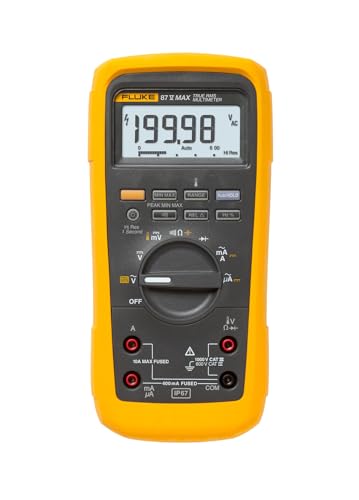
Brymen
Brymen BM869s
The Brymen BM869s is the meter that engineers who know meters actually use. 60000-count resolution, CAT IV rating (the safest), dual display for simultaneous readings, and accuracy that embarrasses most meters at twice the price. If you want the best under-$200 meter, this is it.
Specifications
| Display Count | 60,000 |
| CAT Rating | CAT IV 600V / CAT III 1000V |
| DC Voltage | 0.1µV – 1000V |
| AC Voltage | 0.1mV – 1000V |
| Current | 0.01µA – 10A |
Features
What We Like
- ✓60000-count display — more resolution than any Fluke under $400
- ✓CAT IV 600V rating — the safest category, suitable for utility service entrance
- ✓Dual display shows two measurements simultaneously (e.g. AC+DC, V+Hz)
- ✓0.025% basic DC accuracy embarrasses meters at twice the price
- ✓AC+DC simultaneous measurement for true total RMS on mixed signals
Limitations
- ✗Brymen brand is unknown to most buyers — requires research to discover
- ✗$140 is a premium price that needs justification over the UT61E+
- ✗No built-in NCV — requires a separate non-contact tester
Overview
The Brymen BM869s is the meter that engineers buy when they have outgrown flashy feature lists and want something that just measures correctly. At roughly $140, it occupies a fascinating niche: more accurate than the Fluke 117, higher resolution than the UNI-T UT61E+, and safer than both with a genuine CAT IV 600V / CAT III 1000V rating. Yet Brymen remains virtually unknown outside of test equipment forums, which means buyers often discover it through EEVblog threads rather than marketing.
The headline specs are almost excessive: 60000 counts in normal mode (500000 in high-resolution DCV), 0.025% basic DC accuracy, dual simultaneous display, AC+DC true RMS, dual-channel Type-K temperature, and a feature list that reads like a wishlist from a metrology enthusiast. The question is not whether the BM869s is good -- it objectively is. The question is whether you need what it offers, or whether you are paying for precision you will never use.
I have logged hundreds of hours with the BM869s on my bench, and it has become my reference meter. But I have also watched friends buy it, get overwhelmed by the feature set, and realize they really just needed a Fluke 117 for outlet-testing. This review separates the genuine capabilities from the spec-sheet appeal, and helps you decide if the BM869s belongs on your bench or if it is overkill for your actual work.
Design & Build Quality
The BM869s is a substantial meter -- 210 x 103 x 64 mm and 642g with batteries installed. It is larger than the Fluke 117 and significantly heavier than the UNI-T UT61E+. The size accommodates the large dual-line LCD and the generous input protection hardware, but it is not a meter you will forget is in your hand.
Build quality is excellent. The red rubber holster is thick and properly fitted. The tilting bail on the back doubles as a hanger and is sturdy enough to support the meter's weight. The rotary switch has precise detents and a satisfying mechanical feel. Buttons are large, well-labeled, and provide clear tactile feedback. This is a meter designed for daily professional use, and it feels like it.
The included silicone test leads are notably better than what ships with most meters in this price range. They are soft, flexible, and rated for the full CAT IV 1000V. The shrouded banana plugs and threaded adapter system let you configure the tips for different safety categories. One EEVblog user described them as better than Fluke's included leads, which is high praise. The included K-type thermocouple is adequate, though serious temperature work benefits from higher-quality probes.
Performance & Specifications Deep Dive
The 60000-count display is the spec that first grabs attention. In high-resolution DCV mode, the BM869s actually pushes to 500000 counts (0.1 microvolt resolution on the 500mV range), which is resolution you would expect from a bench multimeter costing $500+. For characterizing voltage references, measuring thermocouple outputs, or watching power supply drift, this resolution is genuinely useful -- not just a marketing number.
Accuracy is where the BM869s separates from the competition. The 0.025% basic DCV accuracy embarrasses the Fluke 117's 0.5% and the UT61E+'s 0.1%. In practice, this means if you are measuring a 5.0000V reference, the BM869s will read within about plus or minus 1.25mV, while the Fluke 117 could be off by plus or minus 25mV. For most electrical work, this does not matter. For calibration, precision circuit design, and reference verification, it is transformative.
The dual display is more than a gimmick. You can simultaneously show VAC and Hz, DC and AC components, temperature differential (T1-T2), or current and frequency. This is genuinely useful for power supply ripple analysis, VFD troubleshooting, and differential temperature measurements without switching modes. The 41-segment analog bar graph updates at 60 segments per second -- fast enough to track changing signals in real time.
Safety is independently verified CAT IV 600V / CAT III 1000V with 12kV transient protection. EEVblog forum users have noted this is among the safest handheld meters available at any price under $400. The BeepJack feature audibly and visually warns if test leads are plugged into the wrong jacks -- a simple but effective safety enhancement that prevents costly mistakes.
Software & User Experience
The BM869s supports PC connectivity via an optional optical USB cable (BU-86X), which is a separate purchase. The included Windows software is functional if dated, capturing measurements and supporting basic logging. Forum users have developed third-party interfaces and Python scripts for more modern workflows. The optical isolation is a nice touch -- there is no galvanic connection between the meter and your PC, which eliminates ground loop concerns.
On-meter operation is sophisticated but learnable. The yellow SELECT button cycles through dual-display combinations for each rotary position. RANGE switches between auto and manual ranging. The REL button zeros relative readings, and holding it activates the 500000-count high-resolution mode. CREST captures 1ms peak values, while REC records min/max/average over time.
The learning curve is real. New users often fumble with the dual-display combinations and wonder why the bar graph disappeared (it hides when the secondary display shows voltage or current). But after a few hours, the interface becomes intuitive. The meter remembers your last selection for each range position, which speeds up repetitive tasks. One minor frustration: the backlight turns off after 15 seconds with no option for continuous operation, and auto-power-off hits at about 17 minutes.
The VFD mode deserves special mention. It applies a low-pass filter and displays both the fundamental voltage and frequency of variable frequency drive outputs -- a genuinely useful feature for industrial electricians that most competing meters lack.
Real-World Use Cases
Precision bench work is where the BM869s justifies its existence. Calibrating voltage references, measuring op-amp offset voltages, characterizing low-noise power supplies, and logging temperature drift all benefit from the high resolution and accuracy. I have used the 500000-count mode to verify a 2.5V precision reference was actually 2.50003V -- something no 6000-count meter could even display. The dual temperature channels are excellent for thermal management testing, measuring heat sink efficiency, or checking for hot spots on PCBs.
Industrial electrical work benefits from the CAT IV rating and VFD mode. Troubleshooting motor drives, checking three-phase power, and verifying control voltage are all within scope. The true RMS with AC+DC mode correctly measures total RMS on mixed signals -- critical when DC bias and AC ripple coexist on power supply rails. The 4-20mA loop percentage display is a time-saver for process control technicians.
Power supply development and repair is another sweet spot. The dual display lets you watch DC output voltage and AC ripple component simultaneously without switching modes. The crest (peak) capture helps identify transient spikes that average readings would miss. Capacitance measurement handles up to 25mF, and the X-Speed mode measures large capacitors in seconds rather than minutes.
Where it does not make sense is casual household electrical work. Checking if an outlet is live or verifying a doorbell transformer does not need 0.025% accuracy or 500000 counts. The meter's size and weight also make it less convenient for quick one-handed checks than the compact Fluke 117.
Who Should Buy (And Who Should Not)
Buy the Brymen BM869s if you are a serious electronics hobbyist, bench technician, calibration enthusiast, or engineer who needs precision, resolution, and genuine safety certification. It is the best meter under $200 for anyone doing precision measurement, power supply design, temperature logging, or industrial electrical work. The EEVblog community's consistent recommendation of Brymen over Fluke in this price bracket is well-earned.
Do not buy the BM869s if you primarily do casual household electrical checks, occasional car battery testing, or simple continuity verification. The precision is wasted, the size is inconvenient, and the learning curve is unnecessary. For basic home electrical work, the Klein MM400 at $60 or even the Fluke 117 at $160 are more practical choices. Also skip it if you need built-in non-contact voltage detection -- the BM869s does not have NCV, requiring a separate tester for quick live-circuit checks.
Alternatives Worth Considering
The Fluke 117 at ~$160 is the obvious comparison. The Fluke is more compact, includes built-in NCV, and has better brand recognition. But the Brymen outperforms it on every measurable spec: 60x the resolution, 20x the DC accuracy, better safety rating, dual display, and more features. The Fluke wins on size, durability reputation, and convenience for basic electrical work. For bench work, the Brymen is the clear choice.
The EEVblog 121GW at ~$180 is designed by the community for the community. It offers SD card logging, open-source firmware, and a 15V diode test mode. However, it is CAT III 600V (less safe than Brymen's CAT IV), slower in measurement speed according to forum reports, and has had more firmware issues. The BM869s is the more polished, reliable product for most users, while the 121GW appeals to tinkerers who want hackability.
For those who want Brymen quality at a lower price, the BM235 (EEVblog-branded) offers similar core performance with fewer features at ~$100. It lacks the dual display and some advanced functions but maintains the excellent accuracy and build quality. If the BM869s's feature list feels overwhelming, the BM235 is a sensible compromise.
Frequently Asked Questions
Is Brymen a reliable brand?
What is the difference between 60000-count and 500000-count modes?
Does the BM869s include a USB cable?
Can the BM869s measure temperature?
Is the BM869s good for beginners?
How does the BM869s compare to the Fluke 87V?
What is BeepJack?
Brymen BM869s
$461.91 — CAT IV 600V / CAT III 1000V · 60,000 count