Micsig MHO14-200 vs Rigol DHO924S
Head-to-head spec comparison to help you pick the right scope for your bench.
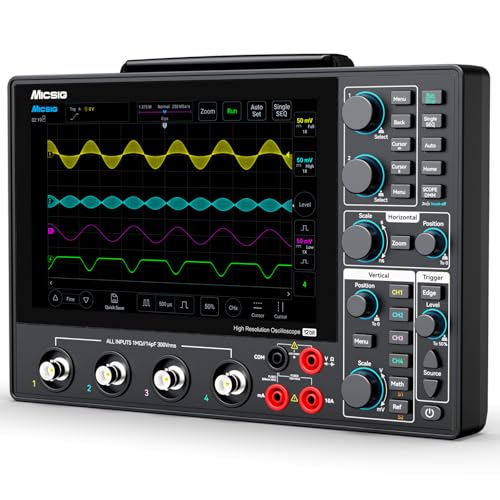
Micsig
$799.99
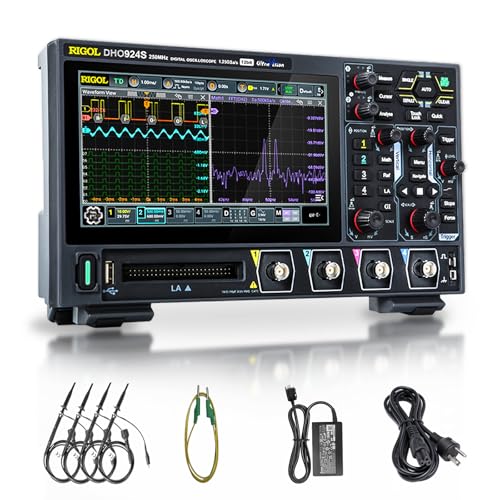
Rigol
$899
Spec-by-Spec Comparison
| Spec | Micsig MHO14-200 | Rigol DHO924S |
|---|---|---|
| Bandwidth | 200 MHz | 250 MHz |
| Sample Rate | 1 GSa/s | 1.25 GSa/s |
| Channels | 4 | 4 |
| Memory Depth | 110 Mpts | 50 Mpts |
| Display Size | 8" | 7" |
| Weight | 1.5 kg | 3.8 kg |
| Price | $799.99 | $899 |
| Rating | 7.5/10 | 9.0/10 |
| Protocol Decoder | Yes | Yes |
| Function Gen | No | Yes |
| WiFi | Yes | Yes |
| Battery | Yes | No |
| Buy on Amazon | Buy on Amazon |
Pros & Cons
Micsig MHO14-200
Pros
- 12-bit ADC with 200MHz bandwidth in a tablet form factor — nothing else combines these specs portably
- 16000mAh battery provides genuine all-day field use without power anxiety
- 8-inch anti-glare IPS display at 1280x800 — sharp and usable outdoors
- 110Mpt memory depth is exceptional for a portable instrument
- Built-in multimeter — one less tool to carry in the field
- Only 31mm thin and 1.5kg — genuinely tablet-sized portability
Cons
- At ~$888, this is significantly more expensive than benchtop alternatives with similar specs
- Micsig is a smaller brand — community support and documentation are limited compared to Rigol or Siglent
- 1GSa/s sample rate is modest for 200MHz bandwidth
- No function generator
- The portability premium is steep — a DHO924S at $449 outperforms it on a bench
Rigol DHO924S
Pros
- 250MHz bandwidth with 4 channels for under $500 — exceptional value
- 7-inch IPS touchscreen with 1024x600 resolution — sharp and responsive
- 50Mpt memory depth for extended captures
- Built-in function generator and WiFi connectivity included
- Modern phone-like interface has almost no learning curve
- Protocol decoding for SPI, I2C, UART, CAN, and LIN
Cons
- 1.25GSa/s sample rate could be higher given the 250MHz bandwidth
- Newer platform means less community documentation than the DS1054Z
- Some early firmware bugs have been reported — check version before updating
- Fan can be audible in a quiet room
Our Verdicts
Micsig MHO14-200
The Micsig MHO14-200 is the most impressive portable oscilloscope I've seen — a 12-bit, 200MHz, 4-channel scope with 110Mpt memory and an all-day battery in a package thinner than most tablets. For field work where you genuinely need oscilloscope capability away from a bench — automotive diagnostics, industrial maintenance, on-site embedded debugging — nothing else comes close to this combination of specs and portability. The 16000mAh battery and anti-glare display are clearly designed by people who've actually used scopes outdoors. At ~$888, you're paying a substantial portability premium. A Rigol DHO924S at $449 will outperform it on every spec except portability and battery life. This scope makes perfect sense for field engineers and automotive technicians. For bench-only hobbyists, it's hard to justify over the benchtop alternatives at half the price.
Rigol DHO924S
The Rigol DHO924S is the best hobbyist oscilloscope under $500 in 2026, and I say that having used the DS1054Z for years before switching. The 7-inch IPS touchscreen transforms the experience — pinch to zoom, tap to place cursors, swipe to scroll through captures — in a way that button-based scopes simply can't match. Add 250MHz bandwidth, 4 channels, 50Mpt memory, a function generator, WiFi, and CAN/LIN protocol decoding at $449, and it obsoletes the DS1054Z in every spec column except community documentation and proven long-term reliability. If you're buying a scope in 2026 and can spend $449, this is the one to get. The only reasons to look elsewhere: you need deeper memory (Siglent SDS2104X Plus), you want proven track record over specs (DS1054Z), or you need CAN/LIN included free and can save $30 (Siglent SDS1104X-U at $419).