◆ At a Glance
◆ Best For
◆ Overview
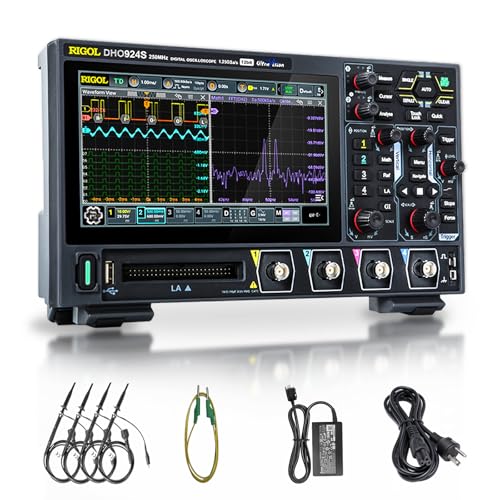
The Rigol DHO924S is the premium hobbyist oscilloscope to consider in 2026 if your budget reaches about $899. At that price, this scope delivers 250 MHz bandwidth, 4 channels, a 7-inch IPS touchscreen at 1024x600 resolution, 50 Mpt memory depth, a built-in function generator, WiFi, and protocol decoding for SPI, I2C, UART, CAN, and LIN. It is powerful, but it no longer belongs in the beginner-value tier.
I've used the Rigol DS1054Z for years -- it was my daily driver and the scope I recommended to everyone who asked. Switching to the DHO924S wasn't just an upgrade; it felt like jumping a generation. The IPS touchscreen transforms the entire workflow: pinch to zoom on a waveform, tap to place cursors, swipe through deep memory captures, drag trigger levels with your finger. These interactions sound gimmicky until you've spent an afternoon debugging SPI and realize you haven't touched a single menu button in hours. The interface gets out of the way and lets you focus on the signals, which is exactly what a good scope should do.
The 250 MHz bandwidth is the spec that seals it for buyers who need headroom. The DS1054Z offers 50 MHz stock (100 MHz with the hack). The Siglent SDS1104X-U offers 100 MHz for $419. The SDS1202X-E offers 200 MHz but only 2 channels. The DHO924S gives you 250 MHz with 4 channels for $899, which makes it the bandwidth-and-workflow upgrade rather than the cheapest rational first scope.
◆ Pros & Cons
Pros
- 250MHz bandwidth with 4 channels and a modern touchscreen workflow
- 7-inch IPS touchscreen with 1024x600 resolution — sharp and responsive
- 50Mpt memory depth for extended captures
- Built-in function generator and WiFi connectivity included
- Modern phone-like interface has almost no learning curve
- Protocol decoding for SPI, I2C, UART, CAN, and LIN
Cons
- 1.25GSa/s sample rate could be higher given the 250MHz bandwidth
- Newer platform means less community documentation than the DS1054Z
- Some early firmware bugs have been reported — check version before updating
- Fan can be audible in a quiet room
Precision bench / four jobs
Build the signal path, not a pile of gear
This scope already supplies the test signal. Add only the measurement tools it does not include.
2 separate add-ons; 1 instrument already included
- 01See the signal
See the signal
Rigol DHO924S
250 MHz · 4 channels · 50 Mpts · generator included
Selected scope - 02Reach the circuit
Reach the circuit
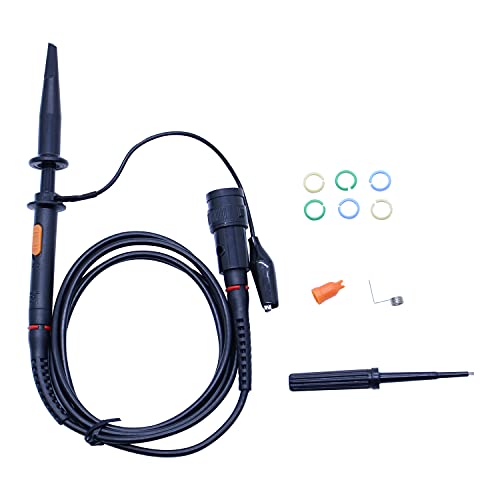
Hantek PP-250 (2-Pack)
250 MHz · 1X/10X switchable · 1.2 m lead
- 03Check voltage
Check voltage
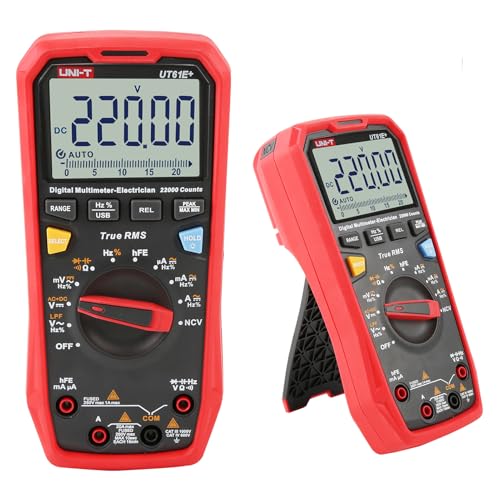
UNI-T UT61E+
true RMS · 22,000 count · capacitance · frequency
- 04Create a test signal
Create a test signal
DHO924S built-in function generator
Included in this scope, so start here before adding a separate signal source.
Already includedNo extra box
Prices and availability can change. These are separate buying links, and each instrument uses its category-specific Amazon Associates tag.
Rigol DHO924S
Prices may change · Free shipping with Prime
◆ Design & Build Quality
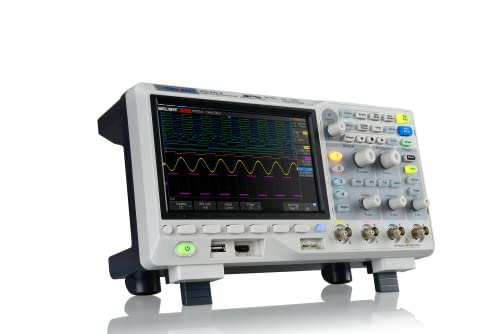
The DHO924S is a 350 x 210 x 120 mm benchtop scope weighing 3.8 kg -- slightly larger and heavier than the DS1054Z, but the weight feels justified by what's inside. The chassis is solid without being overbuilt, and the industrial design is a clear generation ahead of the DS1000Z series. Where the DS1054Z looked like an oscilloscope from 2014 (because it was), the DHO924S looks like it belongs in 2026.
The 7-inch IPS display is the centerpiece. The IPS panel delivers consistent color and contrast at wide viewing angles, which matters more than you'd think -- oscilloscopes sit on benches below your eye line, and a display that washes out at a downward viewing angle is more frustrating than it sounds. The 1024x600 resolution is sharp enough that measurement values, protocol decode overlays, and cursor readouts are all comfortably readable without squinting.
The touchscreen implementation deserves specific praise because Rigol got it right in ways that other manufacturers haven't. Touch response is fast -- there's no perceptible lag between your finger input and the scope's response. Multi-touch gestures (pinch to zoom, two-finger pan) work reliably. The on-screen controls are sized appropriately for finger use rather than stylus-only precision. And critically, the scope still has physical knobs for vertical scale, horizontal scale, and trigger level -- so you can use touch for navigation and knobs for precision adjustment. It's the best of both input methods.
The fan is present and audible in a quiet room, which is the only physical design criticism worth noting. It's not loud enough to be distracting during normal work, but in a dead-silent home lab at 2 AM, you'll hear it. The included probes are standard quality -- adequate for general work but not exceptional. Budget $50-80 for a set of better probes if you plan to work at the higher end of the 250 MHz bandwidth range.
◆ Performance & Specifications Deep Dive
Let's start with what matters most: 250 MHz bandwidth across all 4 channels. This is not a shared bandwidth spec where enabling more channels reduces bandwidth -- each channel gets the full 250 MHz. In practical terms, 250 MHz lets you accurately measure signals up to roughly 80-100 MHz with full amplitude accuracy, and provides useful (if slightly attenuated) visibility up to 250 MHz. For hobbyist work, this covers everything: Arduino at 16 MHz, STM32 at 72-180 MHz clock speeds (you'll see the harmonics), SPI at 50 MHz clock speeds, USB low/full speed, CAN, LIN, I2C, UART at any speed, audio signals, and RF up to VHF frequencies.
The 1.25 GSa/s sample rate is solid but worth contextualizing. At 250 MHz bandwidth, Nyquist requires 500 MSa/s, so 1.25 GSa/s provides 2.5x oversampling. This is adequate for clean waveform reconstruction and accurate measurements, but it's lower oversampling than the 5-10x that some engineers prefer. The Siglent SDS2104X Plus's 2 GSa/s provides better oversampling at its 100 MHz bandwidth. In practice, the difference is most noticeable when measuring very fast rise times at the upper end of the bandwidth range.
The 50 Mpt memory depth is the second-best in our lineup (after the SDS2104X Plus's 200 Mpts). At 1.25 GSa/s, 50 million points gives you 40 milliseconds of continuous capture at full sample rate. That's enough to capture complete protocol transactions, boot sequences, and intermittent glitches that shorter-memory scopes would miss. When you reduce the sample rate for longer captures, the deep memory lets you maintain useful resolution over seconds of recording.
The trigger system is comprehensive and one of the best at any price. Edge, pulse, slope, video, pattern, duration, timeout, runt, window, delay, setup/hold, and Nth edge triggers give you 12 distinct trigger types. The pattern trigger lets you trigger on specific logic combinations across all 4 channels -- invaluable for catching specific bus states. The setup/hold trigger catches timing violations on digital interfaces. The runt trigger catches glitches. Together, they give you the ability to capture almost any signal anomaly you might encounter.
◆ Software & User Experience
The DHO924S runs Rigol's new UltraVision II platform, and the software experience is a dramatic improvement over the DS1000Z series. The interface takes clear inspiration from modern smartphone design: clean icons, swipe gestures, intuitive layout, and minimal menu depth. Where the DS1054Z required memorizing multi-level button sequences to access features, the DHO924S puts most functions within two taps.
The autoset function is fast and accurate, which matters for beginners more than experienced users realize. When you connect a probe to an unfamiliar signal for the first time, a good autoset saves minutes of manual adjustment. The DHO924S consistently finds appropriate scale, offset, and trigger settings on the first try.
Measurement configuration is straightforward. Automatic measurements for frequency, period, amplitude, peak-to-peak, RMS, rise time, fall time, duty cycle, phase, and more are available from a single menu. You can display up to 5 simultaneous measurements per channel, and the results are positioned cleanly on the display without obscuring waveform data. The measurement accuracy is consistent with Rigol's specifications and matches what you'd expect from a $899 scope.
FFT analysis is available with configurable window functions and a split-screen display that shows both time-domain and frequency-domain simultaneously. The implementation is good for basic frequency analysis, identifying harmonics, and checking for spectral content. It's not a replacement for a dedicated spectrum analyzer, but it handles the most common frequency-domain tasks well.
The WiFi connectivity deserves mention because it's actually useful, not just a spec-sheet checkbox. You can access the scope's display and controls from a web browser on any device on the same network. For long-running tests, monitoring from your desk while the scope sits across the room is a genuine convenience. Screen captures and data export also work over WiFi, which is faster and more convenient than USB.
◆ Protocol Decoding & Advanced Features
Protocol decoding on the DHO924S covers SPI, I2C, UART, CAN, and LIN -- all included in the base price. This is the complete set that covers virtually all hobbyist embedded development needs, from basic microcontroller debugging to automotive protocol analysis.
SPI decoding is clean and reliable. Configure clock polarity, phase, data order (MSB/LSB first), chip select polarity, and word size, and the scope displays decoded data values alongside the analog waveform. At 250 MHz bandwidth, the scope handles SPI clocks up to about 60-80 MHz without issue, which covers the vast majority of SPI peripherals you'll encounter.
I2C decoding displays addresses (7-bit and 10-bit), read/write direction, data bytes, ACK/NACK status, and start/stop conditions. The 4 channels mean you can watch SDA, SCL, and two additional signals (power rail, interrupt line, reset, etc.) simultaneously. Combined with the deep memory, you can capture hundreds or thousands of I2C transactions in a single acquisition.
CAN bus decoding handles standard and extended frame formats at all common baud rates. Message IDs, data fields, DLC, CRC, and error frames are all decoded and displayed. The DHO924S includes CAN decoding at no extra cost -- this used to be a paid option on Rigol scopes, and its inclusion in the base price is a significant value improvement. LIN bus decoding is similarly comprehensive, handling standard LIN frame formats and displaying headers, data, and checksums.
The built-in function generator outputs sine, square, ramp, pulse, and noise waveforms up to the generator's rated frequency. It's a convenient bench companion for stimulus-response testing, and having it built into the scope means one fewer instrument on your bench and one fewer power cable. It doesn't replace a dedicated function generator for precision work, but for most hobbyist signal-generation needs, it's more than adequate.
The pattern trigger deserves special attention as an advanced feature. By setting each channel to high, low, or don't-care, you can trigger on specific combinations of logic states across all 4 channels. This is enormously useful for catching specific bus conditions -- triggering when chip select goes low AND a clock edge occurs AND a data line is high, for example. Combined with the deep memory, this lets you search for and capture very specific events in complex systems.
◆ Real-World Use Cases
The DHO924S is the scope I now reach for every time I sit down at the bench, and the use cases span nearly everything a hobbyist encounters. Here's where it genuinely excels.
Embedded development with Arduino, ESP32, STM32, and similar platforms is where the DHO924S feels most at home. Four channels let you watch clock, data, chip select, and a debug signal simultaneously. The protocol decoding shows you what's happening at the data level while the waveform shows you what's happening at the electrical level. The touchscreen lets you drag cursors to measure timing, pinch to zoom into a specific transaction, and swipe through a deep capture to find anomalies. The entire workflow is seamless.
Automotive embedded work benefits from the included CAN and LIN decoding. Debugging a CAN-connected device, monitoring OBD-II traffic, or verifying LIN bus timing are all first-class tasks on the DHO924S. The 250 MHz bandwidth also gives you headroom for CAN-FD, which runs at data rates up to 8 Mbps.
RF and analog work up to VHF frequencies is practical with 250 MHz bandwidth. You can verify oscillator circuits, analyze filter responses, measure amplifier bandwidth, and check impedance matching on HF and VHF circuits. This isn't a substitute for an RF spectrum analyzer, but for basic RF debugging and verification, the bandwidth is more than sufficient.
Power supply debugging is excellent. The 50 Mpt memory captures complete load transient events, the 4 channels let you monitor input, output, and intermediate nodes simultaneously, and the trigger system can catch glitches and runt pulses that indicate instability.
Education and learning are where the touchscreen interface pays the biggest dividends. New users don't need to learn a menu system -- they interact with the scope the same way they interact with their phone. Pinch to zoom on a waveform is more intuitive than adjusting timebase and voltage scale knobs when you're still learning what those concepts mean. If you're buying a scope to learn electronics, the DHO924S's interface minimizes the time spent learning the scope and maximizes the time spent learning about signals.
◆ Who Should Buy This (And Who Shouldn't)
Buy the Rigol DHO924S if you're buying an oscilloscope in 2026 and your budget can reach $899. Full stop. For the vast majority of hobbyist use cases -- embedded development, Arduino projects, protocol debugging, analog circuit work, basic RF, power supply design, learning electronics -- this is the best scope available. The combination of 250 MHz bandwidth, 4 channels, an IPS touchscreen, 50 Mpt memory, a function generator, WiFi, and comprehensive protocol decoding at $899 is unmatched.
Buy it as your first serious scope if you're stepping up from a cheap USB scope or pocket instrument. The touchscreen interface makes the learning curve gentle, and the specifications give you room to grow into more complex work without hitting limitations.
Buy it as a replacement for your DS1054Z if you've been using one for years. The upgrade in bandwidth (250 MHz vs 50 MHz stock), display (IPS touchscreen vs TFT), memory (50 Mpts vs 12 Mpts), and features (WiFi, function gen, CAN/LIN) is substantial enough to justify the cost.
The only reasons to look elsewhere: you need deeper memory for extended captures (Siglent SDS2104X Plus at $1,399 with 200 Mpts), you need proven long-term reliability over cutting-edge specs (Rigol DS1054Z at $349 with a decade of community support), you want the cheapest CAN/LIN scope possible (Siglent SDS1104X-U at $419), or you need a multi-instrument solution with a logic analyzer (Digilent Analog Discovery 3 at $379). For everything else, the DHO924S is the answer.
◆ Alternatives Worth Considering
The Rigol DS1054Z at $349 is still a viable alternative if you want the safety of a proven platform. It has a decade of community support, thousands of tutorials, and a well-understood firmware. The bandwidth hack to 100 MHz makes it a more capable instrument than the stock specs suggest. If you're risk-averse, learning electronics, or prioritizing budget, the DS1054Z is still the safer first buy.
The Siglent SDS1104X-U at $419 includes CAN/LIN decoding on a proven Siglent platform. Its advantages are Siglent's firmware maturity, SPL scripting support, and lower price. Its disadvantages are 100 MHz bandwidth, a non-touch TFT display, 14 Mpt memory, and no function generator or WiFi. It is the budget CAN/LIN pick, not the premium workflow pick.
The Rigol DHO804 at $439 shares the DHO924S's IPS touchscreen and platform but with 70 MHz bandwidth, 25 Mpt memory, and no function generator. At current pricing, it is the sensible modern Rigol pick under $500. Choose it if you want the DHO interface without paying for the DHO924S bandwidth tier.
The Siglent SDS2104X Plus at $1,399 is the step-up option for users who need deeper memory (200 Mpts), a larger display (10.1 inches), and more comprehensive protocol decoding (FlexRay, I2S, MIL-STD-1553). It's a better scope in many ways, but with less bandwidth (100 MHz vs 250 MHz), it's a different value proposition entirely.
The Digilent Analog Discovery 3 at $379 takes a completely different approach -- it's a USB multi-instrument with a 16-channel logic analyzer, 2-channel scope, function generator, and more. If you need a logic analyzer more than you need an oscilloscope, the AD3 is worth considering as a complement to (not replacement for) the DHO924S.
Our Verdict
The Rigol DHO924S is no longer the default hobbyist oscilloscope recommendation now that Amazon pricing is around $899. The 7-inch IPS touchscreen is still excellent — pinch to zoom, tap to place cursors, swipe to scroll through captures — and the spec stack is serious: 250MHz bandwidth, 4 channels, 50Mpt memory, a function generator, WiFi, and CAN/LIN protocol decoding. But at this price it belongs in the premium-upgrade tier, not the beginner tier. Buy it if you need the bandwidth, mixed-signal-ready feature set, and modern Rigol workflow. Most first-time buyers should start with the DS1054Z or DHO804 instead.
Rigol DHO924S
$899
Prices may change · Free shipping with Prime
◆ Full Specifications
| Full Specifications | |
|---|---|
| Bandwidth | 250MHz |
| Sample Rate | 1.25GSa/s |
| Channels | 4 |
| Memory Depth | 50 Mpts |
| Display Size | 7" |
| Display Type | IPS Touchscreen |
| Form Factor | Benchtop |
| Weight | 3.8kg |
| Dimensions | 350 x 210 x 120 mm |
| Protocol Decoder | SPI, I2C, UART, CAN, LIN |
| Function Generator | Yes |
| WiFi | Yes |
| Battery Option | No |
| Trigger Types | Edge, Pulse, Slope, Video, Pattern, Duration, Timeout, Runt, Window, Delay, Setup/Hold, Nth Edge |
◆ Frequently Asked Questions
Is the DHO924S still a beginner-value pick?
Should I buy the DHO924S or the DS1054Z?
How does the touchscreen compare to the DS1054Z's button interface?
Is 1.25 GSa/s enough sample rate for 250 MHz bandwidth?
Does the DHO924S have any known firmware issues?
Can I use the DHO924S as my only bench instrument?
How does the WiFi feature work?
Is the DHO924S good for automotive CAN bus debugging?
◆ Related Buying Guides
Compare With Similar Scopes
◆ Head-to-Head Comparisons
Rigol DHO924S
$899
Prices may change · Free shipping with Prime