Digilent Analog Discovery 3 vs Rigol DHO814
Head-to-head spec comparison to help you pick the right scope for your bench.
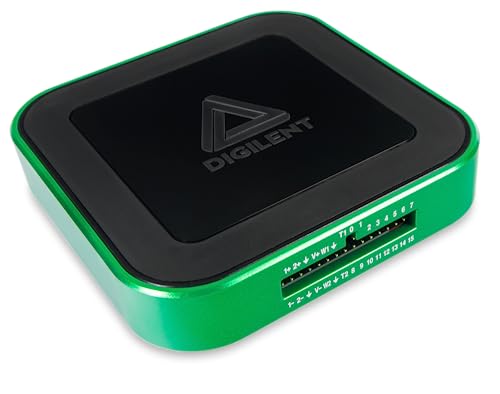
Digilent
$379
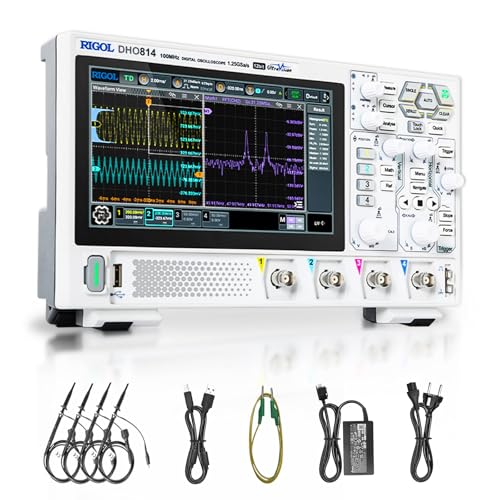
Rigol
$549
Spec-by-Spec Comparison
| Spec | Digilent Analog Discovery 3 | Rigol DHO814 |
|---|---|---|
| Bandwidth | 50 MHz | 100 MHz |
| Sample Rate | 0.125 GSa/s | 1.25 GSa/s |
| Channels | 2 | 4 |
| Memory Depth | 32 Kpts | 25 Mpts |
| Display Size | N/A | 7" |
| Weight | 0.15 kg | 1.78 kg |
| Price | $379 | $549 |
| Rating | 7.5/10 | 7.5/10 |
| Protocol Decoder | Yes | Yes |
| Function Gen | Yes | No |
| WiFi | No | Yes |
| Battery | No | No |
| Buy on Amazon | Buy on Amazon |
Pros & Cons
Digilent Analog Discovery 3
Pros
- 14 instruments in one: scope, logic analyzer, protocol analyzer, function gen, power supplies, network analyzer, and more
- WaveForms software is excellent, free, and regularly updated
- 16-channel logic analyzer is invaluable for digital protocol debugging
- Fits in a pocket — genuinely portable full lab capability
- Great for students and educators who need multiple instrument types
Cons
- Only 125MSa/s — significantly lower than benchtop scopes
- Requires a PC to operate — no standalone use in the field
- 2 analog channels with limited bandwidth compared to benchtop alternatives
- 32Kpt analog memory depth is very shallow for longer captures
- Not a replacement for a dedicated scope when analog performance matters
Rigol DHO814
Pros
- 12-bit ADC — the Reddit community now considers this mandatory for new scope purchases
- Compact form factor is noticeably smaller and lighter than the DHO900 series
- Same modern touchscreen interface as the DHO924S — intuitive and responsive
- 100MHz bandwidth handles most hobbyist and embedded signals comfortably
- USB-C power input means you can run it from a power bank in the field
- CAN decoding included — Rigol doesn't always include this on lower-tier models
Cons
- Fan noise is a known complaint in the DHO800 series — audible in quiet rooms
- At ~$549, you're only $10 below the DHO924S which has 250MHz bandwidth
- 25Mpt memory is half the DHO924S's 50Mpts
- No built-in function generator
- The Siglent SDS804X HD offers similar 12-bit performance for $100 less at 70MHz
Our Verdicts
Digilent Analog Discovery 3
The Digilent Analog Discovery 3 isn't really an oscilloscope — it's a multi-instrument lab that happens to include a 2-channel oscilloscope alongside 13 other tools. The 16-channel logic analyzer is its killer feature for embedded work: you can monitor SPI, I2C, GPIO pins, and PWM outputs simultaneously, something a 4-channel scope simply cannot do. WaveForms software is genuinely excellent — one of the best oscilloscope software experiences on any platform. As a pure oscilloscope, the 125MSa/s sample rate and 32Kpt memory are real limitations that you'll notice on any non-trivial analog signal. This is the right tool if you need a logic analyzer AND a scope AND a function generator and can only buy one device — especially for embedded development and student labs. If you primarily need to measure analog signals or capture long waveforms, a dedicated benchtop scope will serve you better.
Rigol DHO814
The Rigol DHO814 is the mid-tier entry in Rigol's 12-bit DHO800 lineup, offering 100MHz bandwidth and 4 channels in a compact, USB-C-powered package. The 12-bit ADC is the real story here — the Reddit community has essentially made 12-bit resolution the new baseline for oscilloscope recommendations, and the DHO814 delivers. The compact form factor and power bank compatibility are genuine advantages over the larger DHO900 series. The uncomfortable truth is pricing: at ~$549, you're within striking distance of the DHO924S at $449 which gives you 250MHz bandwidth and 50Mpt memory. The DHO814 only makes sense if you specifically value the smaller size or find it on sale significantly below MSRP.