Siglent
Siglent SDS2104X Plus Review
Reviewed by HobbyistScope Team · Updated May 2026
$1399
◆ At a Glance
◆ Best For
◆ Overview
The Siglent SDS2104X Plus is the scope you buy when you've decided that electronics is more than a passing hobby and you want an instrument you genuinely won't outgrow. At $1,399, it sits at the upper boundary of what most hobbyists will spend -- but what you get for that money is a professional-grade oscilloscope that happens to be affordable enough for dedicated amateurs. This is the scope that makes you stop thinking about your scope and start thinking about your circuits.
The headline specification is 200 Mpt memory depth -- by far the deepest in our lineup and enough to capture minutes of continuous data at full sample rate. Pair that with a 10.1-inch IPS touchscreen that's genuinely gorgeous to work with, 4 channels at 100 MHz bandwidth, 2 GSa/s sample rate, a built-in 25 MHz AWG function generator, and protocol decoding that includes FlexRay, I2S, and MIL-STD-1553 alongside the standard SPI/I2C/UART/CAN/LIN, and you have an instrument that competes with scopes costing two to three times as much.
The surprise in the spec sheet is the 100 MHz bandwidth. At $1,399, you might expect 200 or 350 MHz. Siglent chose to invest the engineering budget elsewhere -- into memory depth, display quality, protocol support, and build quality -- and the result is a scope that's exceptional at deep analysis and feature-rich debugging but won't catch the fastest digital edges. Whether that trade-off works for you depends entirely on what you measure.
◆ Pros & Cons
Pros
- 200Mpt memory depth is exceptional — capture minutes of data at full sample rate
- 10.1-inch IPS touchscreen is genuinely gorgeous to work with
- 2GSa/s sample rate handles fast signals better than 1GSa/s scopes
- Comprehensive protocol decoding including FlexRay, I2S, and MIL-STD-1553
- Built-in 25MHz AWG function generator
- Feels like a professional instrument — because it is one
Cons
- Around $1,400, it's at the top of hobbyist budgets
- 100MHz bandwidth is surprisingly low for this price tier
- Large and heavy — needs permanent bench space
- Overkill for casual Arduino projects or simple bench work
You'll Also Need
Common accessories that pair well with this scope.
Hantek PP-200 200MHz Probe Set (2x)
Replacement 200MHz passive probes compatible with most bench scopes
Buy on Amazon · $18 →DEVMO USB Logic Analyzer 8-Channel
8-channel logic analyzer for debugging digital signals and protocols
Buy on Amazon · $14 →Coaxial BNC Cable 50Ω (3-pack)
BNC to BNC 50Ω coax cables for signal connections
Buy on Amazon · $12 →◆ More Bench Gear We've Reviewed
Beyond the scope: other instruments hobbyists keep on the bench.
See signals in the frequency domain
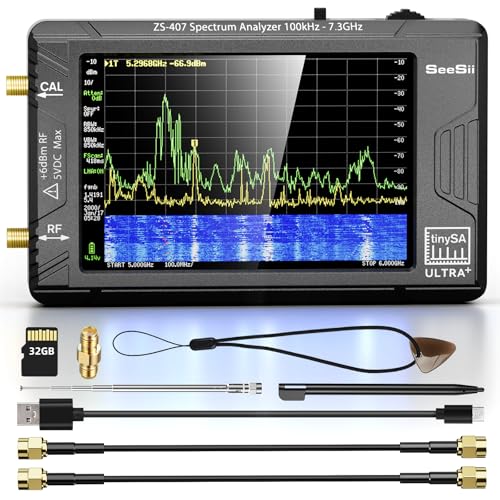
TinySA Ultra
$260.9
See all see signals in the frequency domain picks →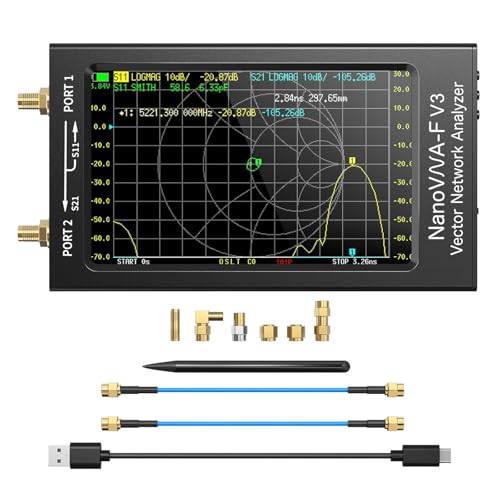
Sweep RF and antenna performance
NanoVNA-F V3
$299.99
See all sweep rf and antenna performance picks →Siglent SDS2104X Plus
Prices may change · Free shipping with Prime
◆ Design & Build Quality
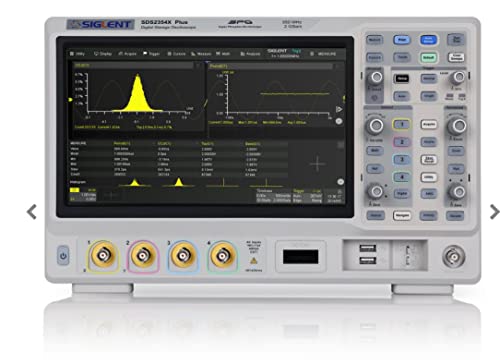
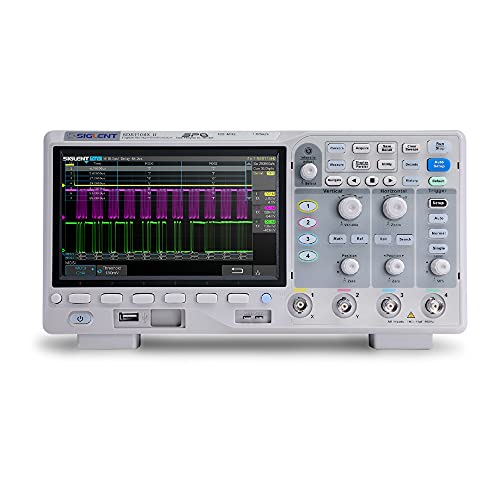
The SDS2104X Plus is a substantial instrument. At 410 x 205 x 150 mm and 4.5 kg, it needs permanent bench space -- this isn't something you slide into a drawer between sessions. The extra size is justified by the 10.1-inch display, which dominates the front panel and transforms the working experience. Waveform detail that's cramped on a 7-inch display breathes on this screen. Four channels running simultaneously with protocol decode overlays remain readable without constant zooming and scrolling.
Build quality is a clear step above the SDS1104X-U and SDS1202X-E. The chassis feels more rigid, the knobs have better rotational damping, and the BNC connectors are tight without being stiff. This feels like a professional instrument because it is one -- Siglent positions the SDS2000X Plus series for both professional and advanced hobbyist use, and the build quality reflects that dual purpose.
The IPS touchscreen is excellent. Color accuracy is high, viewing angles are wide (important when the scope is sitting on a bench below your eye line), and touch response is consistent without noticeable lag even during heavy processing. The panel runs at a resolution that makes text and measurement values crisp and easy to read. After using this display for an extended session, going back to a 7-inch TFT feels like a significant downgrade.
The included probes are Siglent's better models, appropriate for the scope's price point. They're noticeably superior to the probes shipped with the SDS1104X-U, with better high-frequency compensation and more comfortable ground lead connections. For most work within 100 MHz, they're perfectly adequate.
◆ Performance & Specifications Deep Dive
The 200 Mpt memory depth is the specification that defines this scope. To put it in perspective: the Rigol DS1054Z has 12 Mpts, the Siglent SDS1104X-U has 14 Mpts, the Rigol DHO924S has 50 Mpts, and the OWON XDS3064AE has 40 Mpts. The SDS2104X Plus has 200 Mpts -- a 4x to 14x advantage over everything else in our lineup. At the full 2 GSa/s sample rate on a single channel, that translates to 100 milliseconds of continuous capture. At lower sample rates, you can capture seconds or even minutes of data.
Why does deep memory matter? Because it lets you capture an entire event at full resolution, then zoom into any moment after the fact. With a 12 Mpt scope, you face constant trade-offs: either capture a short window at full sample rate (high resolution but you might miss the event) or capture a long window at reduced sample rate (you'll catch the event but lose detail). With 200 Mpts, that trade-off largely disappears for all but the longest captures.
The 2 GSa/s sample rate is a meaningful step up from the 1 GSa/s scopes in our lineup. At 100 MHz bandwidth, Nyquist requires 200 MSa/s minimum, so 2 GSa/s provides 10x oversampling. This translates to smoother waveform reconstruction, more accurate rise time measurements, and better eye diagram performance for signal integrity work. You'll notice the difference most clearly when looking at fast edges and ringing on digital signals.
The 100 MHz bandwidth is the specification that requires honest discussion. At $1,399, the SDS2104X Plus costs more than the DHO924S while offering less raw bandwidth. If raw bandwidth is your priority, the SDS2104X Plus is not the scope for you. The 100 MHz limit means you're comfortably measuring signals up to about 30-40 MHz with full amplitude accuracy, and the -3 dB point at 100 MHz means faster signals will show amplitude roll-off. For SPI at 50+ MHz clock speeds, faster serial buses, or RF work, you need more bandwidth. For embedded development at typical clock speeds, audio work, power supply analysis, and most protocol debugging, 100 MHz is more than sufficient.
◆ Software & User Experience
The user experience on the SDS2104X Plus is the best of any Siglent scope we've tested. The combination of the 10.1-inch touchscreen, well-organized menus, and responsive firmware creates a workflow that feels professional. Menu navigation is logical, frequently-used functions are accessible with minimal taps, and the scope responds to input without the lag that plagues some touchscreen implementations.
The measurement system is comprehensive. Beyond the standard automatic measurements (frequency, period, amplitude, RMS, rise time, fall time, duty cycle, etc.), the SDS2104X Plus supports histogram analysis, mask testing, and trend plotting. Mask testing is particularly valuable for quality-oriented work -- you can define pass/fail boundaries around a reference waveform and let the scope capture any signal that violates the mask. For production testing or overnight reliability monitoring, this feature alone justifies the price premium over cheaper scopes.
FFT analysis is well-implemented with configurable window functions (Hanning, Hamming, Blackman, Rectangular, Flat Top) and a clean frequency-domain display. The large screen makes FFT results much more readable than on 7-inch displays. Math channels support basic arithmetic plus advanced functions for custom signal processing.
Siglent's SCPI implementation is mature and well-documented, enabling automation with Python, LabVIEW, MATLAB, and other platforms. SPL scripting support adds on-instrument automation capability. The scope also supports LXI (LAN eXtensions for Instrumentation) for network-based control, which is a professional feature rarely seen at this price point.
◆ Protocol Decoding & Advanced Features
The protocol decoding on the SDS2104X Plus is the most comprehensive in our lineup. Standard protocols -- SPI, I2C, UART, CAN, and LIN -- are all included without additional license fees. But the SDS2104X Plus goes further with FlexRay, I2S, and MIL-STD-1553 decoding, covering automotive, audio, and aerospace protocols respectively.
FlexRay decoding is notable because it's rare at this price point. FlexRay is used in modern automotive systems (particularly European vehicles) for safety-critical applications like brake-by-wire and steer-by-wire. If you're working on advanced automotive embedded systems, having FlexRay decoding at $1,399 instead of the $5,000+ scopes that typically include it is a significant cost saving.
I2S decoding is essential for audio electronics work. I2S (Inter-IC Sound) is the standard digital audio interface used between DACs, ADCs, codecs, and audio processors. Being able to decode I2S frames, verify word clock timing, and inspect audio data at the protocol level is invaluable for anyone designing or debugging audio hardware.
MIL-STD-1553 is a specialized military/aerospace serial bus protocol. If you work with avionics or defense systems, having this decoder available at $1,399 is remarkable. For most hobbyists, this protocol is irrelevant -- but for those who need it, it's a feature that would normally require a much more expensive scope.
The 200 Mpt memory depth transforms protocol decoding from a short-window exercise into an extended capture capability. You can capture an entire CAN bus startup sequence, a complete I2C sensor initialization handshake, or minutes of serial traffic, then scroll through the decoded data offline. Combined with the trigger system's serial trigger mode (which can trigger on specific protocol conditions), the SDS2104X Plus is an exceptionally capable protocol analysis platform.
The built-in 25 MHz AWG (Arbitrary Waveform Generator) function generator adds a signal source to your bench without needing a separate instrument. Sine, square, ramp, pulse, and arbitrary waveforms up to 25 MHz are supported. It's not a replacement for a dedicated AWG, but it handles stimulus-response testing, circuit excitation, and signal injection competently.
◆ Real-World Use Cases
The SDS2104X Plus excels in extended debugging sessions where you need to capture long data sequences and analyze them in detail. Embedded system bring-up is a perfect example -- capturing an entire boot sequence with SPI flash reads, I2C sensor initialization, UART debug output, and power rail stabilization, all in a single capture, then zooming into each phase to verify correct operation. On a 14 Mpt scope, you'd need multiple captures and might miss the timing relationship between events. With 200 Mpts, it's all in one trace.
Automotive embedded development benefits from both the deep memory and the comprehensive protocol support. Capturing a full CAN bus arbitration sequence, monitoring FlexRay communication during a vehicle state transition, or debugging CAN/LIN gateway behavior over extended periods becomes practical rather than aspirational.
Audio electronics design leverages the I2S decoding, the large display for detailed waveform analysis, and the scope's accurate measurement system. Characterizing a DAC's output, verifying I2S timing between a codec and a microcontroller, or measuring THD on an amplifier stage are all tasks where the SDS2104X Plus provides a noticeably better experience than cheaper scopes.
Power supply design and characterization benefit from the deep memory (capture complete transient events), the 2 GSa/s sample rate (accurate measurement of fast switching edges), and the mask testing capability (automated pass/fail testing against specifications). The 100 MHz bandwidth is more than sufficient for power supply work, where switching frequencies typically range from 100 kHz to a few MHz.
Where the SDS2104X Plus doesn't make sense is casual Arduino projects, basic learning, or work where you won't use the deep memory and advanced features. If your typical debugging session involves checking a PWM signal or verifying that I2C is working, you don't need around $1,400 worth of scope. The DHO924S around $899 or even the DS1054Z at $349 will serve that level of work perfectly well.
◆ Who Should Buy This (And Who Shouldn't)
Buy the Siglent SDS2104X Plus if you do electronics work regularly -- multiple times per week -- and you want an instrument that won't limit you for years. The deep memory, large display, comprehensive protocol decoding, and professional build quality make this a scope you grow into rather than out of. The investment only makes sense if you'll use it enough to amortize the $1,399 cost.
Buy it if you need deep memory for extended captures. If your work involves capturing long serial transactions, monitoring buses for intermittent errors, analyzing startup sequences, or any task where you need to record seconds of data at high sample rates, the 200 Mpt memory depth is unmatched in our lineup.
Buy it if FlexRay, I2S, or MIL-STD-1553 decoding is relevant to your work. These protocols are rare at this price point, and the SDS2104X Plus delivers them without expensive add-on licenses.
Don't buy it for occasional hobbyist use. If you use a scope once a week or less for basic Arduino and sensor projects, the DHO924S around $899 is more than enough scope and saves you about $500 for other tools and components.
Don't buy it if you need high bandwidth. The 100 MHz specification is limiting at $1,399, and the DHO924S's 250 MHz premium tier is a much better choice if fast signals are your primary concern. The SDS2104X Plus trades bandwidth for depth and features -- make sure that trade-off aligns with your needs.
◆ Alternatives Worth Considering
The Rigol DHO924S around $899 is the most obvious alternative, offering 250 MHz bandwidth, a touchscreen, 50 Mpt memory, a function generator, WiFi, and CAN/LIN decoding for substantially less. For most hobbyists, the DHO924S provides most of the practical capability at roughly two-thirds of the cost. The SDS2104X Plus's advantages are the 4x deeper memory, the larger and better display, the additional protocol decoders, and the more professional build quality.
The OWON XDS3064AE in the mid-$800s shares the SDS2104X Plus's emphasis on depth over bandwidth, with 40 Mpt memory and a 14-bit ADC. If vertical resolution is more important than memory depth for your work, the XDS3064AE is worth considering -- though its 60 MHz bandwidth is even more limiting than the SDS2104X Plus's 100 MHz.
For users who need both high bandwidth and deep memory and can stretch the budget further, Siglent's SDS2104X Plus can be paired with bandwidth upgrade options (Siglent offers higher bandwidth models in the SDS2000X Plus series). The 200 MHz and 350 MHz variants exist but at significantly higher prices, pushing well beyond the hobbyist range.
The Keysight EDUX1052A at $1,099.99 shares the SDS2104X Plus's emphasis on brand prestige and build quality, but offers far less capability (50 MHz, 2 channels, 1 Mpt memory, no protocol decoding). Unless institutional requirements mandate Keysight, the SDS2104X Plus is a dramatically more capable instrument.
For the budget-conscious, the Rigol DS1054Z at $349 and the Siglent SDS1104X-U at $419 are strong alternatives that handle most hobbyist work competently. They lack the deep memory, large display, and advanced protocol decoding of the SDS2104X Plus, but they also cost roughly $980-1,050 less.
Our Verdict
The Siglent SDS2104X Plus is a professional-grade scope that happens to be affordable enough for serious hobbyists, and using it for a long debugging session makes the price feel justified. The 200Mpt memory depth is the headline — you can capture minutes of data at full sample rate, then scroll back and zoom into any moment without re-triggering. The 10.1-inch IPS touchscreen is excellent. The comprehensive protocol decoding (including FlexRay and I2S) makes it the right tool for serious automotive or audio embedded work. The surprise is that all this comes with only 100MHz bandwidth — you're paying for depth, features, and build quality, not raw frequency response. Around $1,400, this is a serious investment. It only makes sense if you do electronics work regularly enough to amortize that cost, and if you want an instrument you genuinely won't outgrow.
Siglent SDS2104X Plus
$1399
Prices may change · Free shipping with Prime
◆ Full Specifications
| Full Specifications | |
|---|---|
| Bandwidth | 100MHz |
| Sample Rate | 2GSa/s |
| Channels | 4 |
| Memory Depth | 200 Mpts |
| Display Size | 10.1" |
| Display Type | IPS Touchscreen |
| Form Factor | Benchtop |
| Weight | 4.5kg |
| Dimensions | 410 x 205 x 150 mm |
| Protocol Decoder | SPI, I2C, UART, CAN, LIN, FlexRay, I2S, MIL-STD-1553 |
| Function Generator | Yes |
| WiFi | No |
| Battery Option | No |
| Trigger Types | Edge, Pulse, Slope, Video, Window, Interval, Dropout, Runt, Pattern, Qualified, Serial |
◆ Frequently Asked Questions
Is the 200 Mpt memory depth actually useful or just a marketing spec?
Why is the bandwidth only 100 MHz at $1,399?
Can the SDS2104X Plus replace a dedicated logic analyzer?
Is the 10.1-inch touchscreen really worth the premium over 7-inch scopes?
What does the built-in function generator offer?
How does the SDS2104X Plus compare to the Rigol DHO924S?
Is the SDS2104X Plus good for power supply design?
Does Siglent offer bandwidth upgrades for the SDS2104X Plus?
◆ Related Buying Guides
Compare With Similar Scopes
◆ Head-to-Head Comparisons
Siglent SDS2104X Plus
$1399
Prices may change · Free shipping with Prime