◆ At a Glance
◆ Best For
◆ Overview
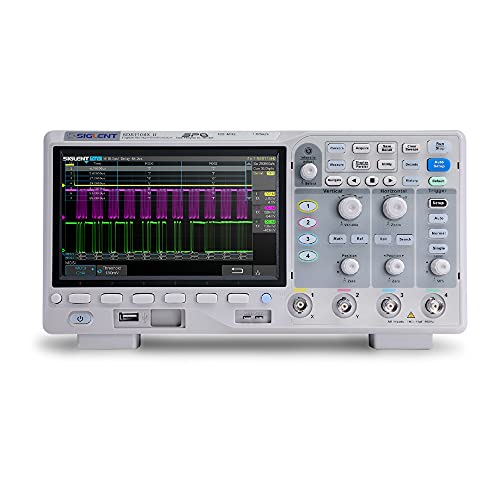
The Siglent SDS1104X-U is Siglent's 4-channel contender in the fiercely competitive sub-$500 oscilloscope market, and it brings one killer differentiator to the table: CAN and LIN protocol decoding included at no extra cost. In a market where many sub-$500 scopes skip automotive protocols entirely, the SDS1104X-U's free CAN/LIN support makes it the most cost-effective path to proper automotive embedded debugging.
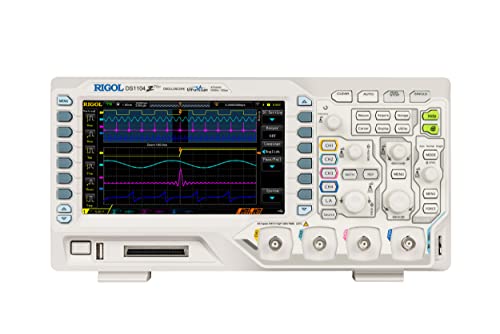
At $419, you get 100 MHz bandwidth, 4 channels, 14 Mpt memory depth, and protocol decoding for SPI, I2C, UART, CAN, and LIN. The sample rate is 1 GSa/s, the display is a 7-inch TFT LCD (no touchscreen), and the trigger system includes edge, pulse, slope, video, window, interval, dropout, runt, and pattern triggers. On paper, it's a strong mid-range offering that competes directly with the Rigol DS1054Z ($349), Rigol DHO804 ($439), and Siglent SDS804X HD ($461).
The challenge for the SDS1104X-U isn't that it's a bad scope -- it genuinely isn't. It's that the user experience is older than the touchscreen scopes around it. You buy this scope when CAN/LIN decoding is essential and every dollar matters, or when Siglent's firmware maturity and reliability history matter more than a modern touch UI.
◆ Pros & Cons
Pros
- 4 channels with 100MHz bandwidth — best of both in Siglent's lineup
- CAN and LIN decoding included — no license fees unlike Rigol
- 14Mpt memory depth for long capture sessions
- Better probe compensation and input specs than older Siglent models
- Siglent's firmware has matured significantly with recent updates
Cons
- ~$419 for a 100MHz, non-touchscreen scope is a stiff ask
- No touchscreen — button navigation only
- 1GSa/s sample rate is adequate but not exceptional
- Touchscreen 12-bit scopes now compete hard at nearby prices
You'll Also Need
Common accessories that pair well with this scope.
Hantek PP-200 200MHz Probe Set (2x)
Replacement 200MHz passive probes compatible with most bench scopes
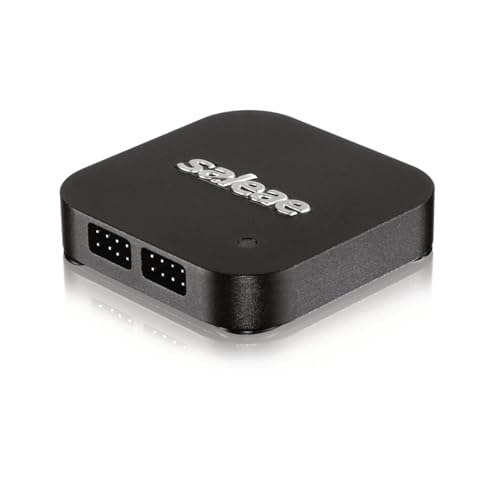
Buy on Amazon · $18 →DEVMO USB Logic Analyzer 8-Channel
8-channel logic analyzer for debugging digital signals and protocols
Buy on Amazon · $14 →Coaxial BNC Cable 50Ω (3-pack)
BNC to BNC 50Ω coax cables for signal connections
Buy on Amazon · $12 →◆ More Bench Gear We've Reviewed
Beyond the scope: other instruments hobbyists keep on the bench.
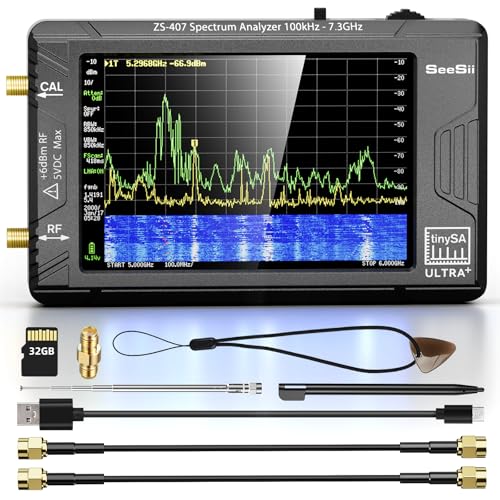
See signals in the frequency domain
TinySA Ultra
$260.9
See all see signals in the frequency domain picks →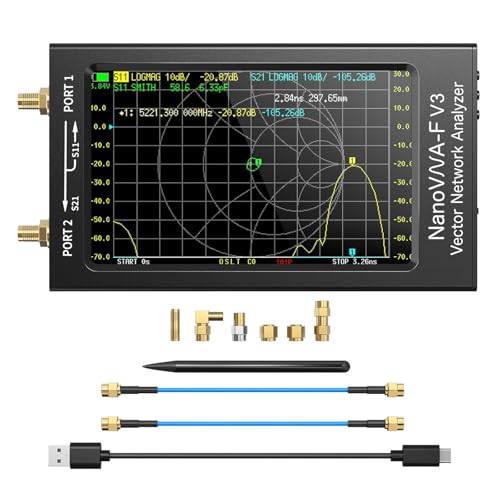
Sweep RF and antenna performance
NanoVNA-F V3
$299.99
See all sweep rf and antenna performance picks →Siglent SDS1104X-U
Prices may change · Free shipping with Prime
◆ Design & Build Quality
The SDS1104X-U follows Siglent's established benchtop design language -- a 312 x 151 x 127 mm chassis weighing 3.1 kg. It's compact for a 4-channel scope and won't dominate a small workbench. Build quality is solid in the way that matters: BNC connectors are secure, knobs have good rotational feel, and the chassis doesn't flex or creak. Siglent has always been reliable in the build-quality department, and the SDS1104X-U maintains that standard.
The 7-inch TFT LCD display is functional but not impressive by 2026 standards. Colors are accurate enough for waveform identification, viewing angles are acceptable, and brightness is adequate for a typical bench environment. It lacks the vibrancy and sharpness of the IPS panels in the Rigol DHO series, and more importantly, it's not a touchscreen. All navigation happens through physical buttons and rotary encoders.
For some users, the button-based interface is actually a preference. Physical controls offer tactile feedback and don't require looking at the screen to make adjustments. If you've used a traditional oscilloscope and like the feel of dedicated knobs for vertical scale, horizontal scale, and trigger level, the SDS1104X-U's control layout will feel natural. If you've been spoiled by the DHO924S's pinch-to-zoom and tap-to-cursor workflow, the button-heavy interface will feel like a step backward.
The included probes have improved over older Siglent models, with better compensation and input characteristics. They're perfectly adequate for 100 MHz work and are a noticeable step up from the probes that shipped with the SDS1202X-E.
◆ Performance & Specifications Deep Dive
The 100 MHz bandwidth is a practical, useful specification for the vast majority of hobbyist work. It comfortably handles Arduino and STM32 GPIO signals, SPI clocks up to about 25 MHz, I2C at any standard speed, UART at any baud rate you'd encounter, and CAN bus signals. The -3 dB point is well-characterized, and Siglent's front-end flatness is good across the passband. You won't encounter any surprises when measuring signals within the rated bandwidth.
The 1 GSa/s sample rate is standard for this class but worth contextualizing. At 100 MHz bandwidth, Nyquist requires 200 MSa/s minimum, so 1 GSa/s gives you 5x oversampling. That's adequate for clean waveform reconstruction and accurate measurements. The Rigol DHO924S's 1.25 GSa/s provides a modest advantage, but it's not a dramatic difference in practical use.
Memory depth at 14 Mpts is solid and competitive. It matches the Siglent SDS1202X-E and exceeds the Rigol DS1054Z's 12 Mpts. At full sample rate, 14 million points gives you 14 milliseconds of continuous capture -- enough for most serial protocol transactions but not for extended monitoring sessions. The DHO924S's 50 Mpts and the Siglent SDS2104X Plus's 200 Mpts significantly exceed this if you need longer captures.
The trigger system is comprehensive for this price: edge, pulse, slope, video, window, interval, dropout, runt, and pattern triggers. The runt and pattern triggers are particularly useful for embedded debugging -- runt triggers catch incomplete pulses that might indicate bus contention, and pattern triggers let you trigger on specific logic combinations across channels. This trigger set matches or exceeds what most competitors offer at this price.
◆ Software & User Experience
Siglent's firmware on the SDS1104X-U has matured significantly with recent updates. The menus are logically organized, measurement configuration is straightforward, and the scope responds to input without frustrating delays. Siglent's learning curve is slightly steeper than Rigol's -- the menu structure is deeper in some areas, and some functions require more button presses to access. But once you learn the layout, navigation becomes muscle memory.
Automatic measurements cover the standard set: frequency, period, amplitude, peak-to-peak, RMS, rise time, fall time, duty cycle, and more. You can display multiple measurements simultaneously, and the measurement accuracy is consistent with the scope's specifications. Math functions include add, subtract, multiply, divide, and FFT, with the FFT implementation being one of Siglent's strengths -- it's well-implemented with configurable window functions and a clean display.
Siglent Programming Language (SPL) support adds automation capabilities that aren't available on cheaper scopes. You can script measurement sequences, automate data capture, and integrate the scope into test systems. This is a genuine advantage for users who need repeatable test procedures.
PC software connectivity is good. Siglent's EasyScope software provides remote control, screen capture, and data export. SCPI command support means you can also use the scope with third-party tools like Python scripts (via pyvisa), LabVIEW, and MATLAB. The USB connectivity is reliable, and Siglent's SCPI implementation is well-documented.
◆ Protocol Decoding & Advanced Features
This is where the SDS1104X-U earns its keep. Protocol decoding for SPI, I2C, UART, CAN, and LIN is included at no extra cost. Let me emphasize that: CAN and LIN decoding, free, at $419. The DS1054Z doesn't include CAN at all without a paid option, and the DHO804 does not include CAN/LIN. For automotive embedded work, the SDS1104X-U is the cheapest path to proper CAN bus visibility.
CAN decoding performance is reliable at standard baud rates (125 kbps, 250 kbps, 500 kbps, 1 Mbps). The scope displays decoded message IDs, data fields, DLC, and CRC status in a tabular format alongside the analog waveform. LIN decoding similarly handles standard LIN bus speeds and displays frame data clearly. If you're debugging automotive ECU communication, monitoring a vehicle's OBD-II traffic, or developing CAN-connected embedded devices, this decoding capability saves you from needing a separate CAN analyzer.
SPI decoding handles clock speeds comfortably within the 100 MHz bandwidth, with configurable polarity, phase, and chip select settings. I2C decoding displays addresses, data bytes, ACK/NACK status, and repeated start conditions. UART decoding supports standard and non-standard baud rates with configurable parity and stop bit settings. All protocol decoders can run simultaneously across different channels, which is valuable when you need to monitor multiple buses at once.
The 4-channel capability is crucial for protocol debugging. With CAN, you typically want one channel on CAN-H, one on CAN-L, and possibly a third on a trigger signal or power rail. With SPI, you need clock, MOSI, MISO, and chip select -- exactly 4 signals. Having 4 channels eliminates the constant probe-swapping that makes 2-channel scopes frustrating for protocol work.
◆ Real-World Use Cases
The SDS1104X-U shines brightest in automotive and vehicle embedded development. If you're building a CAN-connected device -- a custom gauge cluster, an OBD-II reader, a vehicle data logger, or any device that talks to a car's CAN bus -- this scope gives you direct visibility into the bus traffic at a price point that makes it accessible for hobby-level automotive projects. You can verify that your device is transmitting correctly, decode incoming messages, check timing, and diagnose bus errors, all without spending $800+ on a dedicated CAN analyzer.
General embedded development with STM32, ESP32, Arduino, and similar platforms is well-served by the 100 MHz bandwidth and 4 channels. Debugging SPI communication between a microcontroller and a sensor, monitoring I2C traffic while checking a power rail, or verifying PWM output while watching an enable signal -- these are all bread-and-butter tasks that the SDS1104X-U handles without breaking a sweat.
Audio electronics work benefits from Siglent's clean front end and accurate measurements. The 100 MHz bandwidth is far more than audio work requires, and the 14 Mpt memory depth gives you long capture windows for analyzing audio waveforms, measuring THD, and characterizing amplifier behavior.
Where the SDS1104X-U struggles is anything that pushes bandwidth limits. Fast SPI at 50+ MHz clock speeds, RF measurements, high-speed digital signals with sub-nanosecond edges -- these all need more bandwidth than 100 MHz provides. For these applications, the DHO924S's 250 MHz or the Siglent SDS1204X-E's 200 MHz are better choices.
◆ Who Should Buy This (And Who Shouldn't)
Buy the Siglent SDS1104X-U if CAN/LIN protocol decoding is a non-negotiable requirement and you want to minimize cost. At $419, it's the cheapest 4-channel scope with included CAN and LIN decoding. No license keys, no paid upgrades, no hidden costs. If you're doing automotive embedded work on a hobbyist budget, this is the most cost-effective path.
Also buy it if you trust Siglent's firmware maturity over newer touchscreen platforms. The SDS1104X-U is built on a proven platform with a solid track record. If you've been burned by early firmware bugs on new platforms before, the SDS1104X-U's stability is a legitimate selling point.
Don't buy it if your main priority is the easiest beginner experience. The Rigol DHO804 has a modern touchscreen workflow, and the Rigol DS1054Z has a much deeper beginner tutorial ecosystem.
Don't buy it for general hobbyist work without specific CAN/LIN needs. The Rigol DS1054Z at $349 provides 4 channels with better community support and more tutorials. The DHO804 provides a more approachable interface. The SDS1104X-U's value proposition is specifically its free CAN/LIN decoding -- without that requirement, other scopes may fit better.
◆ Alternatives Worth Considering
The Rigol DHO804 at $439 is the most direct non-automotive alternative. It offers a 7-inch IPS touchscreen, 25 Mpt memory, WiFi, and Rigol's modern DHO workflow. It lacks CAN/LIN decoding, so the choice is simple: DHO804 for general beginner work, SDS1104X-U for automotive protocol work.
The Rigol DS1054Z at $349 remains a strong alternative if you don't need CAN/LIN decoding. It offers 4 channels, 12 Mpt memory, comprehensive trigger types, and the largest community support ecosystem of any hobbyist scope. The well-documented bandwidth hack to unlock 100 MHz makes it even more competitive.
The Siglent SDS1202X-E at $379 is worth considering if you prefer bandwidth over channel count. At 200 MHz with 2 channels, it offers double the bandwidth of the SDS1104X-U at a lower price, and still includes CAN/LIN decoding. The trade-off is losing 2 channels, which matters significantly for protocol debugging.
The Rigol DHO924S is the premium alternative if you want 250 MHz bandwidth, a touchscreen, 50 Mpt memory, a function generator, WiFi, and CAN/LIN decoding in one box. It is much more capable, but current pricing puts it in a different tier.
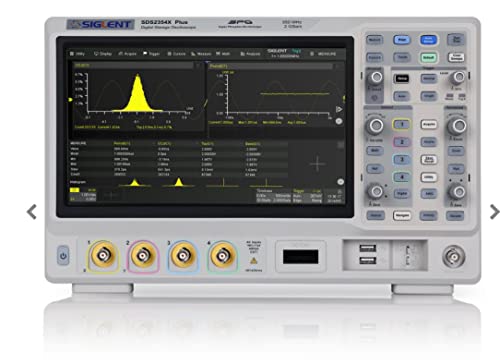
For users who need more capability, the Siglent SDS2104X Plus around $1,400 offers 200 Mpt memory depth, a 10.1-inch IPS touchscreen, a function generator, and comprehensive protocol decoding including FlexRay, I2S, and MIL-STD-1553. It's a major price jump but a substantial capability increase.
Our Verdict
The Siglent SDS1104X-U is Siglent's answer to the 4-channel mid-range market, and its CAN/LIN decoding is its killer differentiator. Rigol charges extra for CAN decoding on most models; Siglent includes it free. If you're doing automotive embedded work — car CAN bus debugging, LIN network analysis, anything that touches vehicle electronics — the SDS1104X-U at $419 is the most cost-effective path to proper protocol support. For general hobbyist use without automotive protocol requirements, the DS1054Z at $349 remains better value, while the DHO804 is the more modern touchscreen alternative near this price. I'd buy the SDS1104X-U specifically if CAN/LIN decoding is non-negotiable.
Siglent SDS1104X-U
$419
Prices may change · Free shipping with Prime
◆ Full Specifications
| Full Specifications | |
|---|---|
| Bandwidth | 100MHz |
| Sample Rate | 1GSa/s |
| Channels | 4 |
| Memory Depth | 14 Mpts |
| Display Size | 7" |
| Display Type | TFT LCD |
| Form Factor | Benchtop |
| Weight | 3.1kg |
| Dimensions | 312 x 151 x 127 mm |
| Protocol Decoder | SPI, I2C, UART, CAN, LIN |
| Function Generator | No |
| WiFi | No |
| Battery Option | No |
| Trigger Types | Edge, Pulse, Slope, Video, Window, Interval, Dropout, Runt, Pattern |
◆ Frequently Asked Questions
Does the SDS1104X-U really include CAN and LIN decoding for free?
How does the SDS1104X-U compare to the Rigol DHO924S?
Is 100 MHz bandwidth enough for most hobbyist work?
Can I use the SDS1104X-U for CAN-FD decoding?
Does the SDS1104X-U support remote control and automation?
What's the probe quality like on the SDS1104X-U?
Is the SDS1104X-U good for beginners?
Does Siglent still update the firmware on the SDS1104X-U?
◆ Related Buying Guides
Compare With Similar Scopes
◆ Head-to-Head Comparisons
Siglent SDS1104X-U
$419
Prices may change · Free shipping with Prime