Micsig MHO14-200 vs Rigol DS1054Z
Head-to-head spec comparison to help you pick the right scope for your bench.
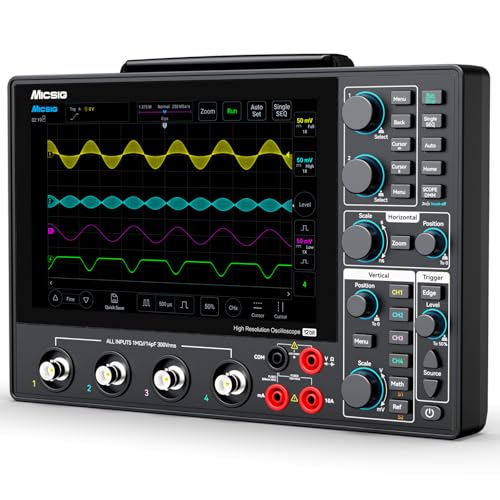
Micsig
$799.99
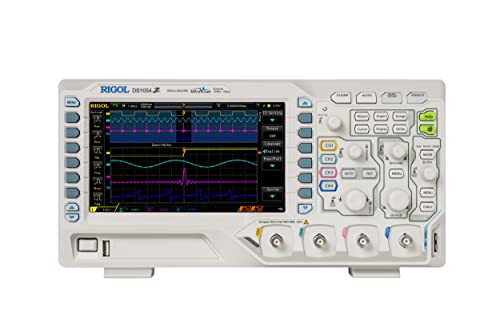
Rigol
$349
Verdict
It's a Tie
The Micsig MHO14-200 and Rigol DS1054Z are evenly matched — your choice depends on which features matter most to you.
Spec-by-Spec Comparison
| Spec | Micsig MHO14-200 | Rigol DS1054Z |
|---|---|---|
| Bandwidth | 200 MHz | 50 MHz |
| Sample Rate | 1 GSa/s | 1 GSa/s |
| Channels | 4 | 4 |
| Memory Depth | 110 Mpts | 12 Mpts |
| Display Size | 8" | 7" |
| Weight | 1.5 kg | 3.2 kg |
| Price | $799.99 | $349 |
| Rating | 7.5/10 | 8.5/10 |
| Protocol Decoder | Yes | Yes |
| Function Gen | No | No |
| WiFi | Yes | No |
| Battery | Yes | No |
| Buy on Amazon | Buy on Amazon |
Pros & Cons
Micsig MHO14-200
Pros
- 12-bit ADC with 200MHz bandwidth in a tablet form factor — nothing else combines these specs portably
- 16000mAh battery provides genuine all-day field use without power anxiety
- 8-inch anti-glare IPS display at 1280x800 — sharp and usable outdoors
- 110Mpt memory depth is exceptional for a portable instrument
- Built-in multimeter — one less tool to carry in the field
- Only 31mm thin and 1.5kg — genuinely tablet-sized portability
Cons
- At ~$888, this is significantly more expensive than benchtop alternatives with similar specs
- Micsig is a smaller brand — community support and documentation are limited compared to Rigol or Siglent
- 1GSa/s sample rate is modest for 200MHz bandwidth
- No function generator
- The portability premium is steep — a DHO924S at $449 outperforms it on a bench
Rigol DS1054Z
Pros
- 4 channels for $349 — nearly every competitor at this price is 2-channel, making it the go-to pick when you need clock, data, enable, and ground all visible at once
- 12Mpt memory depth captures long protocol bursts that 1–2Mpt scopes miss — a full UART session at 115200 baud across hundreds of milliseconds stays in buffer without retriggering
- A well-documented firmware procedure unlocks 100MHz bandwidth from the stock 50MHz — the community has published step-by-step guides since 2015 and it takes under 10 minutes
- SPI, I2C, UART, and RS232 protocol decoding included with no upsell — some competitors charge extra license fees for the same decoders
- Ten years of community answers: searching 'DS1054Z + [your problem]' returns solved threads on EEVblog, r/AskElectronics, and YouTube before you finish typing
Cons
- 50MHz stock bandwidth can't cleanly capture SPI clocks above ~10MHz or RF signals — the firmware unlock helps, but it's still a soft ceiling
- Menu navigation is physical-button-only — no touchscreen, no scroll wheel; takes a few sessions to get fluent
- Interface looks dated next to modern touchscreen scopes; not a functional problem, but noticeable
- Anyone doing daily professional bench work should budget for the DHO924S — the touchscreen and 250MHz bandwidth are genuinely worth the extra $550 at that usage level
Our Verdicts
Micsig MHO14-200
The Micsig MHO14-200 is the most impressive portable oscilloscope I've seen — a 12-bit, 200MHz, 4-channel scope with 110Mpt memory and an all-day battery in a package thinner than most tablets. For field work where you genuinely need oscilloscope capability away from a bench — automotive diagnostics, industrial maintenance, on-site embedded debugging — nothing else comes close to this combination of specs and portability. The 16000mAh battery and anti-glare display are clearly designed by people who've actually used scopes outdoors. At ~$888, you're paying a substantial portability premium. A Rigol DHO924S at $449 will outperform it on every spec except portability and battery life. This scope makes perfect sense for field engineers and automotive technicians. For bench-only hobbyists, it's hard to justify over the benchtop alternatives at half the price.
Rigol DS1054Z
If you're buying your first oscilloscope to learn embedded systems, debug Arduino or ESP32 projects, or study signals at school, buy the DS1054Z — 4 channels, full protocol decoders, and a decade of community support for $349 is a package that still has no real competition at this price. Don't buy it if you do professional bench work daily or need clean capture above 50MHz; for that, the DHO924S at $899 is the right tool. The honest tradeoff: DS1054Z gives you 4 channels and the largest hobbyist knowledge base on the internet; DHO924S gives you 250MHz and a touchscreen for $550 more. For a first scope for a hobbyist, student, or maker, this is the buy.