Rigol DS1054Z vs Siglent SDS2104X Plus
Head-to-head spec comparison to help you pick the right scope for your bench.
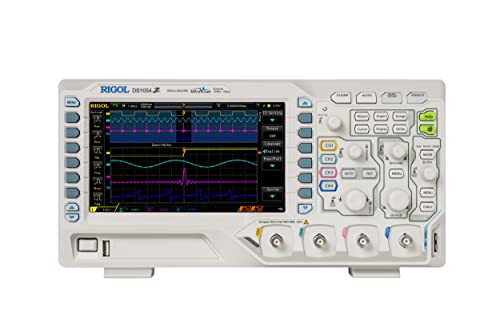
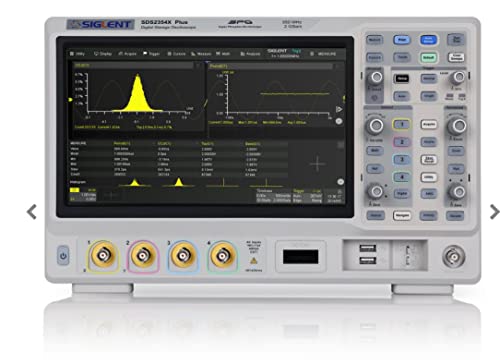
Spec-by-Spec Comparison
| Spec | Rigol DS1054Z | Siglent SDS2104X Plus |
|---|---|---|
| Bandwidth | 50 MHz | 100 MHz |
| Sample Rate | 1 GSa/s | 2 GSa/s |
| Channels | 4 | 4 |
| Memory Depth | 12 Mpts | 200 Mpts |
| Display Size | 7" | 10.1" |
| Weight | 3.2 kg | 4.5 kg |
| Price | $349 | $1399 |
| Rating | 8.5/10 | 8.0/10 |
| Protocol Decoder | Yes | Yes |
| Function Gen | No | Yes |
| WiFi | No | No |
| Battery | No | No |
| Buy on Amazon | Buy on Amazon |
Pros & Cons
Rigol DS1054Z
Pros
- 4 channels for $349 — nearly every competitor at this price is 2-channel, making it the go-to pick when you need clock, data, enable, and ground all visible at once
- 12Mpt memory depth captures long protocol bursts that 1–2Mpt scopes miss — a full UART session at 115200 baud across hundreds of milliseconds stays in buffer without retriggering
- A well-documented firmware procedure unlocks 100MHz bandwidth from the stock 50MHz — the community has published step-by-step guides since 2015 and it takes under 10 minutes
- SPI, I2C, UART, and RS232 protocol decoding included with no upsell — some competitors charge extra license fees for the same decoders
- Ten years of community answers: searching 'DS1054Z + [your problem]' returns solved threads on EEVblog, r/AskElectronics, and YouTube before you finish typing
Cons
- 50MHz stock bandwidth can't cleanly capture SPI clocks above ~10MHz or RF signals — the firmware unlock helps, but it's still a soft ceiling
- Menu navigation is physical-button-only — no touchscreen, no scroll wheel; takes a few sessions to get fluent
- Interface looks dated next to modern touchscreen scopes; not a functional problem, but noticeable
- Anyone doing daily professional bench work should budget for the DHO924S — the touchscreen and 250MHz bandwidth are genuinely worth the extra $550 at that usage level
Siglent SDS2104X Plus
Pros
- 200Mpt memory depth is exceptional — capture minutes of data at full sample rate
- 10.1-inch IPS touchscreen is genuinely gorgeous to work with
- 2GSa/s sample rate handles fast signals better than 1GSa/s scopes
- Comprehensive protocol decoding including FlexRay, I2S, and MIL-STD-1553
- Built-in 25MHz AWG function generator
- Feels like a professional instrument — because it is one
Cons
- Around $1,400, it's at the top of hobbyist budgets
- 100MHz bandwidth is surprisingly low for this price tier
- Large and heavy — needs permanent bench space
- Overkill for casual Arduino projects or simple bench work
Our Verdicts
Rigol DS1054Z
If you're buying your first oscilloscope to learn embedded systems, debug Arduino or ESP32 projects, or study signals at school, buy the DS1054Z — 4 channels, full protocol decoders, and a decade of community support for $349 is a package that still has no real competition at this price. Don't buy it if you do professional bench work daily or need clean capture above 50MHz; for that, the DHO924S at $899 is the right tool. The honest tradeoff: DS1054Z gives you 4 channels and the largest hobbyist knowledge base on the internet; DHO924S gives you 250MHz and a touchscreen for $550 more. For a first scope for a hobbyist, student, or maker, this is the buy.
Siglent SDS2104X Plus
The Siglent SDS2104X Plus is a professional-grade scope that happens to be affordable enough for serious hobbyists, and using it for a long debugging session makes the price feel justified. The 200Mpt memory depth is the headline — you can capture minutes of data at full sample rate, then scroll back and zoom into any moment without re-triggering. The 10.1-inch IPS touchscreen is excellent. The comprehensive protocol decoding (including FlexRay and I2S) makes it the right tool for serious automotive or audio embedded work. The surprise is that all this comes with only 100MHz bandwidth — you're paying for depth, features, and build quality, not raw frequency response. Around $1,400, this is a serious investment. It only makes sense if you do electronics work regularly enough to amortize that cost, and if you want an instrument you genuinely won't outgrow.